Baby developmental milestones: month-by-month checklist

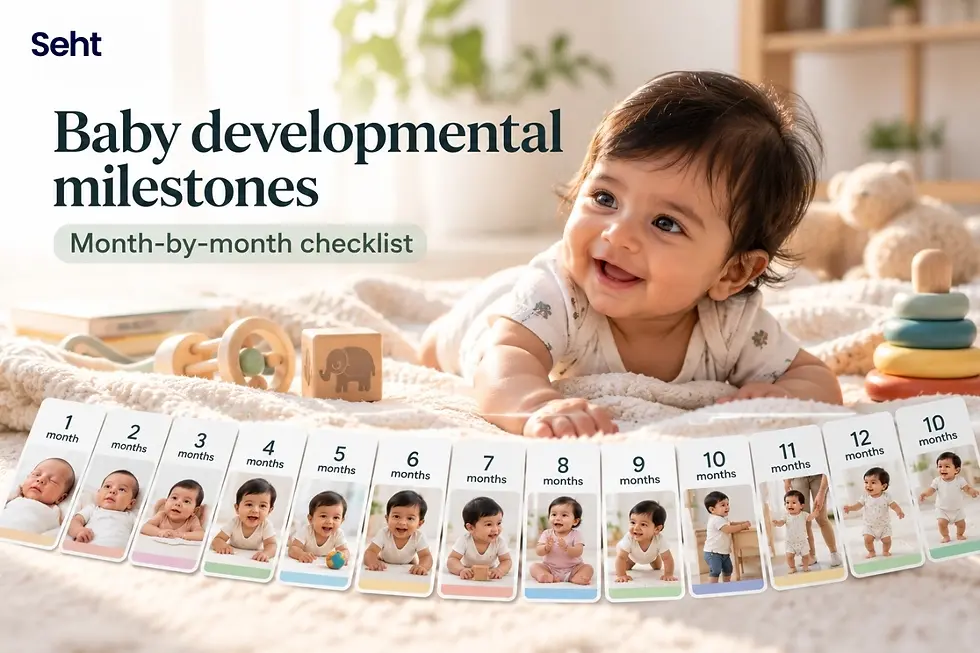
Baby developmental milestones follow a predictable order but a flexible timetable: social smile by 2 months, head control by 4, sitting without support by 9, first steps somewhere between 9 and 15 months, single words by 18 months and two-word phrases by 2 years. The order matters more than the exact date a baby sits before standing, babbles before speaking. What needs medical attention is not a late walker but a child who loses a skill they already had, or misses a whole category of development.
The month-by-month milestone chart
Quick answer: Track four streams at once gross motor (big movements), fine motor (hands), language, and social. Delay in one stream alone is often temporary. Delay across several streams is the pattern worth investigating.
Age | Gross motor | Fine motor | Language | Social |
2 months | Lifts head when on tummy | Hands open at times | Coos, makes vowel sounds | Social smile |
4 months | Steady head control, rolls front to back | Reaches for objects | Laughs, squeals | Smiles at familiar faces |
6 months | Sits with support, rolls both ways | Transfers toys hand to hand | Babbles “ba”, “da” | Knows familiar people |
9 months | Sits unsupported, crawls or shuffles | Picks up small objects, thumb and finger | Repeats sounds, responds to name | Stranger anxiety appears |
12 months | Pulls to stand, may take first steps | Neat pincer grip | 1–2 meaningful words | Waves bye-bye, plays peek-a-boo |
15 months | Walks well alone | Stacks two blocks | 3–5 words | Points at what they want |
18 months | Runs stiffly, climbs stairs with help | Scribbles, feeds self with spoon | 10–20 words, points to body parts | Copies household activities |
24 months | Kicks a ball, walks up stairs | Stacks 4–6 blocks, turns book pages | Two-word phrases, around 50 words | Plays alongside other children |
Why baby developmental milestones have such wide ranges
First steps anywhere between 9 and 15 months are normal. So are first words between 10 and 18 months. Babies also specialise for a while a child putting enormous effort into walking often pauses on new words for a few weeks, then catches up in a rush.
The four-stream check
A useful habit at every vaccine visit is to ask yourself one question per stream: is the baby moving, using hands, making sounds and connecting with people in a way that has changed since last time? Progress matters more than any single box.
Do this now: Note the date of each new skill in one place. “Sat without support 8 months” is exactly what a paediatrician wants to hear.
Red flags: when to stop waiting
Quick answer: Loss of a skill at any age, no social smile by 3 months, no sitting by 9 months, no babbling by 12 months, no words by 18 months, or no two-word phrases by 30 months all need a paediatric assessment rather than more time.
Indian families whose baby developmental milestones look late are often told to wait “boys speak late”, “he’ll catch up”. Sometimes that is right. But early intervention works best early, and an assessment costs one appointment.
The red flags by age
By 3 months: no social smile, no eye contact, does not startle to sound
By 6 months: poor head control, very stiff or very floppy limbs, does not turn to sound
By 9 months: not sitting with support, not babbling, no response to their own name
By 12 months: no gestures such as pointing or waving, no pincer grip, not bearing weight on legs
By 18 months: no single words, does not point to show interest, no pretend play
By 24 months: no two-word phrases, cannot follow a simple instruction, walks only on toes persistently
At any age: losing a skill previously mastered, a strong hand preference before 12 months, or persistent squint
Hearing and vision come first
A large share of apparent speech delay is undiagnosed hearing loss. Newborn hearing screening is available at most Indian hospitals, and if a child is not responding to sound or speech, a formal hearing test comes before any “wait and watch” plan. The same applies to squint and poor visual tracking.
Where to get screened in India
The government’s Rashtriya Bal Swasthya Karyakram (RBSK) screens children for defects at birth, deficiencies, diseases and developmental delays through anganwadi centres and government schools, and refers to District Early Intervention Centres for assessment and therapy at no cost. Private developmental paediatricians, and occupational and speech therapists, are available in most cities.
Do this now: If two or more red flags apply at your child’s age, book a paediatric appointment this month rather than waiting for the next vaccine visit.
Milestones for premature babies and other special cases

Quick answer: Use corrected age for a premature baby subtract the weeks of prematurity from the calendar age up to about two years. A baby born two months early who sits at 10 months is sitting at 8 months corrected, which is entirely normal.
How to calculate corrected age
If your baby was born at 32 weeks, that is 8 weeks early. At a chronological age of 9 months, the corrected age is 7 months, and milestones should be judged against 7 months. Most paediatricians stop correcting at around 24 months, by which point the gap has usually closed.
This is the reverse of how vaccines work for the same baby those are always timed by the actual birth date, as explained in our guide to vaccination for premature babies.
What helps baby developmental milestones along at home
Talk through your day out loud, in whatever language you speak at home
Read together daily, even at six months naming pictures builds vocabulary
Give supervised tummy time from the newborn weeks to build neck and shoulder strength
Limit screens; under-twos learn language from faces, not videos
Let them try things that are slightly hard spoons, stairs with support, stacking
Multilingual households do not cause speech delay. Children raised with two or three languages reach milestones within the same range, sometimes counting words across languages together.
Use the vaccine visit as the checkpoint
The ages at which vaccines are due 6 weeks, 9 months, 15 months, 18 months, 2 years are also the natural developmental checkpoints, which is why paediatricians assess both at the same visit. Keeping that calendar means your child is reviewed regularly by default. The dates are in our vaccination schedule for children in India guide.
If your baby is unusually sleepy or irritable in the days after a dose, that is expected and passes our guide to vaccine side effects in babies separates normal from worrying.
In simple terms: Babies learn to sit, stand, walk and talk in the same order, but not on the same day. A wide range of timing is normal. Get help if your child stops doing something they could already do, or if they are well behind in several areas at once.
When to see a doctor
Book a paediatric appointment if your child:
Has lost a skill they previously had words, walking, eye contact
Is not sitting without support by 9 months, or not walking by 18 months
Has no single words by 18 months or no two-word phrases by 30 months
Does not respond to their name or to loud sounds by 12 months
Has very stiff or very floppy limbs, or strongly favours one hand before 12 months
Has poor eye contact, or does not point to share interest by 18 months
Emergency: A seizure, sudden loss of consciousness, a limb that has stopped moving, or sudden loss of speech or responsiveness needs emergency care immediately.
FAQs
At what age should a baby walk and talk?
Most babies take their first independent steps between 9 and 15 months, and say their first meaningful words between 10 and 18 months. Both ranges are wide and both ends are normal. What matters more is steady progress and the usual order of baby developmental milestones sitting before standing, babbling before words. Not walking by 18 months or no words by 18 months warrants assessment.
My baby is behind on some milestones. Should I wait or see a doctor?
See a doctor if the delay covers more than one area, if a previously mastered skill has been lost, or if a specific red flag applies at that age. A single late milestone in an otherwise thriving, sociable baby is often just variation. An assessment is a single appointment, and early intervention works best when it starts early.
Do premature babies reach baby developmental milestones later?
Yes, and that is expected. Judge a preterm baby against their corrected age chronological age minus the weeks born early usually up to about two years. A baby born ten weeks early who sits at 9 months is sitting at roughly 7 months corrected, which is within range. Most preterm children catch up fully by their second birthday.
Does speaking two languages at home delay speech?
No. Children raised in multilingual homes reach speech milestones within the same normal ranges, and their total vocabulary should be counted across all languages. Mixing words from different languages in one sentence is a normal stage, not confusion. Persistent absence of words in any language is what needs assessment.
Where can I get free developmental screening for my child in India?
Through the Rashtriya Bal Swasthya Karyakram (RBSK), the government’s child health screening programme, which covers birth defects, deficiencies, diseases and developmental delays. Screening is done through anganwadi centres, government health facilities and schools, with referral to District Early Intervention Centres for further assessment and therapy at no cost.
Download Seht — free on iOS and Android
Seht lets you keep your child’s growth records, milestone notes, vaccination card and clinic reports in one family health record, so the next appointment starts with dates instead of guesses.
Download free:


Sources and references
World Health Organization — Child growth standards and windows of achievement for six gross motor milestones. https://www.who.int
Ministry of Health and Family Welfare, Government of India — Rashtriya Bal Swasthya Karyakram (RBSK) operational guidelines. https://www.mohfw.gov.in
Indian Academy of Pediatrics — Developmental surveillance and early intervention guidance. https://iapindia.org
Indian Council of Medical Research — Early childhood development and screening research. https://www.icmr.gov.in
Disclaimer: This blog is for informational purposes only and is not medical advice. Seht helps families stay informed, but is not a substitute for professional healthcare guidance.