Healthy eating for busy Indian professionals: simple nutrition tips

Updated: Apr 20

Healthy eating for busy Indian professionals does not require meal prep marathons, expensive superfoods, or abandoned social lives it requires a set of specific smart defaults that replace unhealthy convenient foods with equally convenient healthy alternatives. An ASSOCHAM 2024 survey found that 68% of urban Indian professionals eat their main meal at their desk or at a fast-food counter. The solution is not willpower it is changing the environment so the healthy choice becomes the default choice.
For the complete personalized nutrition framework, read: food as medicine personalized nutrition India (https://www.seht.in/post/food-as-medicine-personalized-nutrition-india)
What you'll learn: • 5-minute healthy breakfast ideas that beat skipping breakfast entirely • Smart desk lunch and office snacking alternatives for Indian professionals • The weekly meal prep approach that takes 90 minutes on Sunday • How to eat healthily at Indian restaurants and in the office canteen • The 3 most impactful nutrition habits for busy professionals |
Why nutrition fails for Indian professionals — and how to fix it
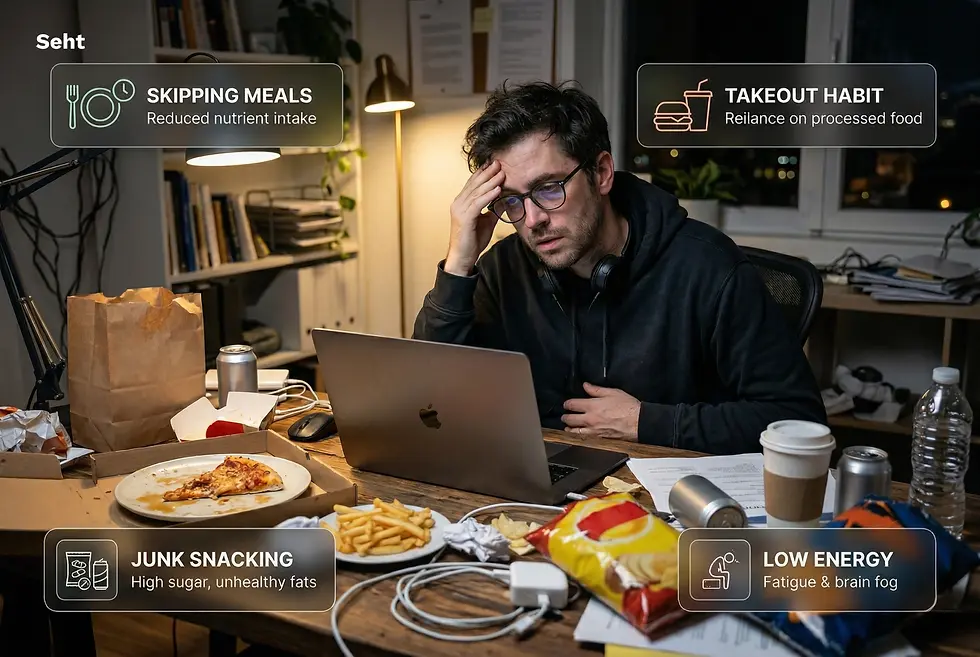
The nutrition problem for urban Indian professionals is structural, not motivational. Three specific structural barriers drive most dietary failures:
No time in the morning: Skipping breakfast or buying packaged biscuits and tea from a stall the default morning for millions of Indian professionals causes blood sugar instability, brain fog, and overeating at lunch
No healthy option at 4 PM: The afternoon energy crash drives the most nutritionally destructive decision of the working day: the vending machine samosa, the chai-biscuit combination, or the Maggi noodles from the office canteen
Exhaustion-driven evening eating: Arriving home at 8–10 PM after a 12-hour workday, most professionals choose the fastest available option which in most Indian homes is instant noodles, ordering in, or leftover canteen food
The solution to all three is not motivation it is preparation. Specifically: 20-minute Sunday meal prep that eliminates the need for in-moment healthy food decisions on weekdays.
5 healthy breakfast ideas that take under 10 minutes

Breakfast option | Prep time | Nutritional benefit | Make-ahead tip |
Overnight oats with nuts and fruit | 2 min (evening before) | High fibre, protein from nuts, slow-release energy no blood sugar crash | Soak oats in milk/curd overnight; add walnuts and fruit in the morning |
Boiled egg + whole fruit + black chai | 5 min | Complete protein + Vitamin C + antioxidants; no sugar spike from sweetened chai | Boil 6 eggs on Sunday; keep refrigerated for the week |
Moong dal chilla (2 small) | 7 min | High protein, low glycaemic prevents the 11 AM hunger crash | Keep soaked and blended moong dal batter refrigerated up to 3 days |
Sprout chaat | 5 min (if pre-soaked) | High protein, iron, B vitamins; extremely portable | Soak chana/moong overnight; refrigerate sprouted for 3–4 days |
Ragi / multigrain porridge | 7 min | High fibre, iron, calcium; sustaining energy for 4+ hours | Prepare ragi flour mix in bulk; just add water and heat each morning |
In simple terms: The most important meal rule for busy Indian professionals is this: never skip breakfast, and never replace breakfast with just chai and biscuits. Biscuits and sweetened chai spike your blood sugar for 90 minutes and then drop it below baseline causing brain fog, irritability, and a drive to overeat at lunch. Any of the five breakfasts above, eaten in under 10 minutes, sets up a stable energy and focus pattern that lasts until 1–2 PM. |
Smart desk lunch and snacking for Indian office professionals
The 3 rules for healthy office lunches
Most corporate canteens and restaurant meal deliveries offer at least one combination that approximates a healthy meal the problem is knowing which to choose:
Always order or bring dal: Dal at lunch provides protein that stabilises afternoon blood sugar and prevents the 4 PM energy crash. If the canteen offers dal, always add it regardless of what else you order.
Reduce the grain portion, double the vegetables: Ask for half the normal rice or fewer rotis, and extra sabzi or salad. Most canteens accommodate this without an additional charge.
Avoid fried sides: Papad, samosa, or fried snacks as lunch sides add 200–400 calories of refined flour and poor-quality fat with zero nutritional benefit. Replace with a small bowl of curd or a side salad.
Smart snacking alternatives for the Indian office
The 4 PM snack problem is the biggest single dietary failure point for Indian professionals. Standard office snacks (biscuits, namkeen, chakli, samosa) are high in refined flour, poor oils, and sodium with no protein or fibre. Evidence-based replacements that are equally convenient:
A small handful (30g) of mixed nuts almonds, walnuts, cashews: 15 minutes of easy satiety, 6–8g protein, omega-3 fats. Keep a small box on your desk. Cost: ₹20–₹30 per serving.
A banana or guava: Complete food, natural sugar with fibre, portable, no preparation. The best fast-food available in India at ₹5–₹20.
Boiled eggs (pre-boiled on Sunday): Highest satiety-per-calorie snack available. Keep 2–3 boiled eggs in your bag. ₹10–₹15 each.
Roasted makhana (fox nuts): Low calorie, moderate protein, high fibre, satisfying crunch. Better than any commercial namkeen. Available in most Indian supermarkets.
Dark chocolate (70%+ cocoa) with a handful of nuts: Satisfies chocolate cravings, provides antioxidants and magnesium, prevents binge eating later. One square is enough.
The 90-minute Sunday meal prep that transforms the working week
The single highest-leverage nutrition action a busy Indian professional can take is 90 minutes of batch cooking on Sunday. This eliminates weekday food decision fatigue and provides ready components for healthy meals all week.
Boil 6–8 eggs: Refrigerates for 5–6 days. Protein source for breakfast, lunch, and snacks all week.
Cook a large pot of dal (choose one masoor, moong, or rajma): Keeps refrigerated for 4–5 days. The protein and fibre base for weekday lunches and dinners.
Sauté 2–3 cups of chopped vegetables in mustard oil: Palak, gobi, capsicum, or mixed vegetables. Refrigerates for 3–4 days. Ready to eat with roti in 2 minutes.
Soak chana or moong for sprouting: Takes 8 hours soaking + 12–24 hours sprouting. Ready for Tuesday–Thursday sprout breakfasts or snacks.
Prepare a large container of mixed salad: Cucumber, tomato, onion, coriander, lemon keeps for 2–3 days in the fridge. Add to any meal as instant vegetables.
Portion out nuts into daily-use containers (7 containers, each 30g): Eliminates daily portion confusion. Leave one container in your desk drawer each day.
Total active prep time: 45–60 minutes. Total passive time (soaking, cooking): 90 minutes. The result: 5 days of healthy meal components requiring zero weekday decision-making.
For a complete healthy plate framework to use with your meal prep components, read: How to build a healthy plate: Indian nutrition made simple (https://www.seht.in/post/build-healthy-plate-nutrition-india)
When to see a doctor or dietitian
Persistent fatigue or brain fog despite improving breakfast and nutrition may indicate iron deficiency, Vitamin D deficiency, or thyroid issues that diet alone cannot fix
Blood glucose consistently above 126 mg/dL fasting despite 3 months of dietary improvement
Significant weight gain (above 5 kg in 6 months) without obvious explanation hormonal or metabolic evaluation may be needed
Eating disorders: restriction, bingeing, or purging patterns require specialist psychological and nutritional support
Any severe food reaction or allergy get allergy testing before making major dietary exclusions
FAQs
What is the best breakfast for busy Indian professionals?
The best breakfasts for healthy eating for busy Indian professionals are: overnight oats with nuts (2 minutes prep, made the evening before), 2 boiled eggs with a banana (5 minutes, eggs pre-boiled on Sunday), moong dal chilla (7 minutes from pre-made batter), or ragi porridge (7 minutes). All provide protein and fibre that stabilise blood sugar through the morning the opposite of the biscuit-chai default that drives the 11 AM hunger crash.
How can a busy Indian professional eat healthy with limited time?
The 90-minute Sunday meal prep approach is the most effective strategy: cook dal, boil eggs, sauté vegetables, portion nuts, and soak sprouts on Sunday. These components require zero cooking on weekdays assembly only. Add to this: always eating dal at lunch, replacing biscuits with nuts or fruit at 4 PM, and avoiding the canteen fried sides. These changes require no extra time on weekdays only smart preparation once a week.
What should I eat at the office canteen as a healthy Indian professional?
Best office canteen choices: dal + vegetables + small portion of rice or 2 rotis + curd (when available). Worst choices: fried rice, biryani without raita, samosa and chai as a meal, noodles, or anything from the fried side section. Most canteens offer at least a dal-and-vegetable combination choose this as your default. Add a banana or a handful of nuts from your desk as a protein supplement if the canteen option is carbohydrate-heavy.
Are nutrition bars and health drinks good for Indian professionals on the go?
Most commercial nutrition bars and health drinks sold in India are highly processed, high in added sugar or sugar alcohols, and provide far less nutritional benefit than whole foods at the same cost or less. A boiled egg (₹10), a banana (₹8), or a handful of mixed nuts (₹25) outperforms almost every commercially available nutrition bar for satiety, blood sugar management, and actual nutritional value. The 'healthy snack' marketing in India is largely aspirational, not evidential.
How important is breakfast for healthy eating as a busy Indian professional?
Extremely important. Skipping breakfast or eating only sweetened chai and biscuits causes blood sugar instability throughout the day increasing cortisol, impairing cognitive function, and driving overeating at lunch. A 2023 meta-analysis confirmed that breakfast consumption is associated with significantly lower HbA1c in adults with prediabetes or diabetes. For busy Indian professionals who eat lunch at their desk, breakfast is often the only meal that can be properly controlled make it count.
Download Seht — free on iOS and Android
If you're a working professional managing your own nutrition or your family's, Seht helps you track the health markers that tell you whether your dietary changes are working HbA1c, lipid profiles, Vitamin D. Store all your annual health test results for every family member in Seht, and share them with your doctor in one tap during your next consultation.
Download free:


Sources and references
ASSOCHAM — Urban Indian professional wellness and nutrition survey 2024. https://www.assocham.org
ICMR — Dietary guidelines for Indians. https://icmr.gov.in
NIN — Nutritional requirements and dietary allowances. https://nin.res.in
Disclaimer: This blog is for informational purposes only and is not medical advice. Seht helps families stay informed but is not a substitute for professional healthcare guidance.


