Joint Family Health Management: One App, 8+ Members
- Seht Health Team

- Aug 3
- 9 min read

Joint family health management works best when every generation's records live in one shared system, instead of eight separate memories, WhatsApp folders, and prescription bags stuffed into a drawer. In a home with grandparents, parents, children, and sometimes an aunt, uncle or cousin under one roof, one person almost always ends up as the unofficial keeper of everyone's blood pressure numbers, insulin doses and vaccination dates. A single family health app, with a separate and permission-controlled profile for each member, replaces that mental filing cabinet with something the whole household can actually find when it matters most.
What this guide covers → How to set up one health profile per family member, done properly → Which records matter most at each life stage, from toddlers to grandparents → Who should hold admin access in a shared family account, and why → How joint families cut down duplicate tests and missed medicine doses → Where domestic staff, pets and festival travel fit into the same system |
Why a Joint Household Needs a Different System
A nuclear family of four can often get away with a shared notes app and a good memory. A joint family rarely can. Once a household crosses six, seven or eight members spanning three generations, the sheer volume of appointments, prescriptions, lab reports and vaccination schedules stops being something any one person can hold in their head however organised they are.
The Arithmetic of a Multigenerational Home
Picture a fairly ordinary joint household: two grandparents managing hypertension and diabetes, two working parents due for their annual checkups, three school-going children needing age-specific vaccinations, and perhaps a live-in relative recovering from surgery. That is eleven overlapping health timelines running at once. Each person visits a different set of doctors, uses a different pharmacy chain, and generates a fresh stack of paper every few weeks. Multiply that by a decade and you have a genuinely unmanageable pile unless it is organised from the start.
What Actually Goes Wrong With WhatsApp and Paper Files
Most Indian families default to two systems that feel free but quietly cost a lot: a WhatsApp thread where photos of reports get buried under festival wishes and forwards, and a physical folder or three that only one person knows how to navigate. Both fail at the exact moment they're needed most. A doctor asking for last year's ECG during an emergency consult doesn't care that the file is "somewhere in the cupboard in Nani's room." Search doesn't work on a decade of scanned images, and paper doesn't survive monsoon damp, house moves or simply being misplaced during a family function.
The One-App Alternative
The fix isn't more discipline from one exhausted family member it's a system built for exactly this scale. A dedicated family health app lets you create a separate profile for each person, tag records by member and category automatically, and pull up any single person's full history in seconds, from any phone in the family, even without the internet connection working perfectly. This is the entire premise behind Seht: it was built around the reality of Indian households with more than four people in them, not the nuclear-family assumption baked into most global health apps.
Setting Up Multigenerational Family Health Tracking

Getting multigenerational family health tracking right isn't about digitising everything on day one. It's about starting with the members whose records change fastest and matter most in an emergency, then filling in the rest gradually. In most joint households, that means starting at both ends of the age spectrum children and grandparents before moving to the working-age adults in between.
Children- Growth, Vaccination and School Paperwork
Every child in the household needs their own profile tracking birth weight and growth milestones, the full immunisation schedule as per the Indian Academy of Pediatrics and Universal Immunisation Programme, allergy history, and the school health certificates that seem to be demanded at the shortest possible notice. Parents managing two or three children often find the vaccination calendar is the single hardest thing to keep straight booster doses spaced months apart, across different children, are easy to lose track of without a system that reminds you automatically.
Working-Age Adults- The Group Everyone Forgets
Parents and adult children in their thirties, forties and fifties are usually the ones organising everyone else's health and quietly neglecting their own annual checkup, cholesterol panel or that referral a doctor mentioned two years ago. Give this group their own profiles too, not just an admin login. A record of your own blood work, family history flags and pending screenings is what stops a treatable issue from being caught only after it becomes urgent.
Grandparents- Chronic Conditions and Medication Lists
Elderly members of joint families are usually managing at least one chronic condition often two or three together, such as hypertension, type 2 diabetes and joint pain. Their profile should carry a current medication list with dosages, known drug allergies, recent lab trends (especially HbA1c and kidney function markers), and the contact details of every specialist they see. This is the profile most likely to be pulled up in a genuine emergency, so it deserves to be the most complete one in the household.
What each generation in a joint family typically needs tracked
Life stage | Records to prioritise | Review frequency |
Infants & children (0–12 yrs) | Vaccination schedule, growth charts, allergy history, school health forms | Every checkup + each new vaccine |
Teenagers | Vaccination boosters, vision/dental, sports physicals, mental health notes | Annually, or as needed |
Working adults (25–55 yrs) | Annual bloodwork, BP/sugar trends, family history flags, insurance documents | Annually |
Elderly parents (55+ yrs) | Chronic condition history, current medication list, specialist contacts, discharge summaries | Every 3–6 months |
Anyone with a chronic condition | Medication log, symptom trends, lab result history, next follow-up date | Ongoing / continuous |
Who Holds the Keys — Access, Roles and Privacy
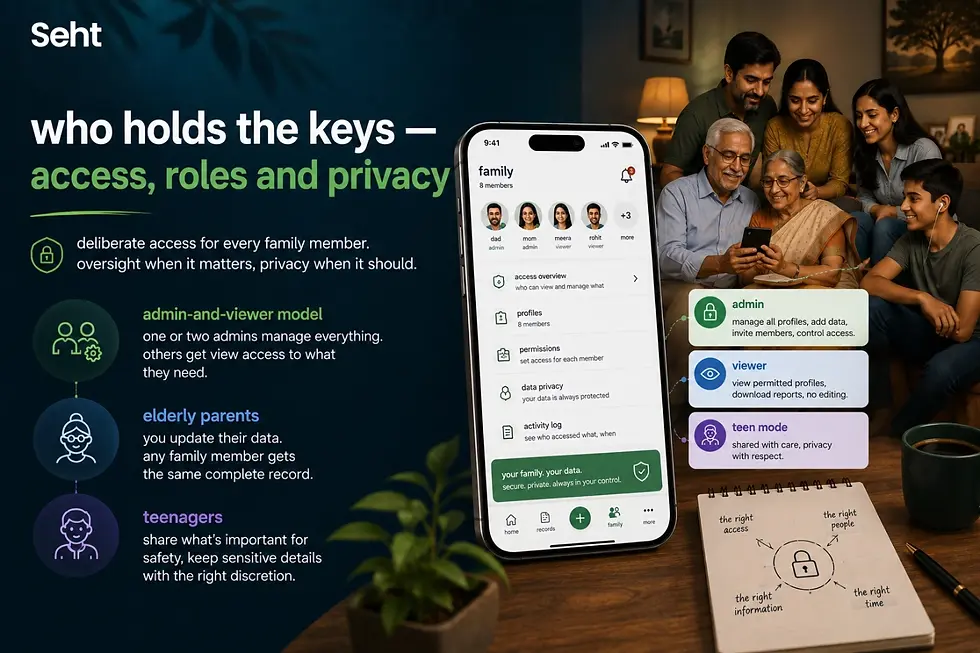
A shared family account only works if access is designed deliberately, not left to whoever happens to be holding the phone. Joint families have a particular version of this problem: several adults may reasonably want oversight, but not everyone should be able to edit or delete another member's records.
The Admin-and-Viewer Model
A workable structure gives one or two people often the eldest working-age couple, or whoever tends to accompany parents to appointments full admin rights across the family's profiles. Other adults get view access to the people they directly care for. This avoids both extremes: a single overloaded gatekeeper, and a free-for-all where records get edited or duplicated by well-meaning relatives.
Elderly Parents Who Don't Use Smartphones
A large share of grandparents in Indian households are not going to log their own blood pressure into an app, and that's fine. Set up their profile from your own device, add their readings after each visit or home check, and let the next family member who takes them to a doctor pull up the same profile instantly. The person managing the phone changes; the record doesn't.
Teenagers and Their Own Boundaries
Teenagers deserve a middle ground visible to parents for genuine safety reasons, but with some sensitive entries (mental health notes, certain consultations) handled with more discretion than a toddler's vaccination card. Most families find it easier to agree on this openly rather than assume; a five-minute conversation about what's shared and what isn't avoids resentment later.
Beyond Blood Relatives The Rest of the Household
A joint family's health footprint doesn't stop at the eight or ten people related by blood or marriage. Most Indian households of this size also share their home with domestic staff, often a pet, and spend a good part of the year travelling for festivals, weddings and family functions. Each of these brings its own health-tracking needs, and each deserves more than a passing thought.
Domestic Help and Household Staff
Cooks, house help and caregivers who spend most of their day in your home are part of your household's health picture too both for their own wellbeing and because food handlers and caregivers in close contact with elderly or very young family members carry some shared health responsibility.
Pets Sharing the Same Roof
Larger households are more likely to have a dog or cat, and pet vaccination records matter for more than the vet's convenience they matter for the humans in the house too, especially children and grandparents with lower immunity.
Festival Season and Travel
Joint families travel together, often, for weddings, festivals and family functions in another city. That means someone's insulin, someone else's inhaler and a grandparent's discharge summary all need to travel too correctly, and not just "whatever's in the bag."
Two more pieces complete the picture for most joint households: who in the family actually carries the mental weight of remembering all of this, and how to link every member's records to India's national digital health system through ABHA.
Getting Started This Week, Not Someday
The families who successfully switch to a real system rarely do it in one weekend, and they don't need to. A workable starting order looks like this: set up profiles for the two people whose records are most urgent right now usually the family member with a chronic condition and the youngest child due for vaccinations. Add everyone else over the following two or three weeks, a profile at a time, whenever you're already at a doctor's appointment or holding a report in hand.
Resist the urge to scan a decade of old paperwork before you start. Begin with whatever is most recent and most clinically relevant the last twelve to eighteen months for most people, and the full current picture for anyone managing an ongoing condition. Older records can be added gradually, whenever there's a spare ten minutes, without holding up the parts of the system that matter for day-to-day safety.
In simple terms: One app, one profile per family member, and one or two people with full access is all a joint family really needs. It replaces the WhatsApp-and-paper-folder system that quietly fails at the worst possible moment. Once it's set up, adding a new grandchild's vaccination or a grandparent's new prescription takes seconds, not a search through three rooms.
When to see a doctor not just log the symptom
A fever in a child or elderly member that lasts more than 48–72 hours
Any chest pain, breathlessness or fainting in an adult or elderly family member
A chronic condition (BP, sugar, thyroid) that's been "a bit off" for several weeks without review
A missed medication schedule for more than 2–3 consecutive days for a chronic condition
Any fall in an elderly family member, regardless of how minor it seems at the time
A child missing scheduled vaccinations by more than a month
In a genuine emergency chest pain, breathing difficulty, sudden confusion, uncontrolled bleeding, or loss of consciousness call emergency services or go to the nearest hospital immediately rather than waiting to check records first.
FAQs
What is the best app for joint family health management in India?
Look for an app built specifically for large, multigenerational Indian households one that supports unlimited family profiles, works with limited connectivity, and links to ABHA. Seht was designed around exactly this use case, with separate profiles for every family member and shared access controls for caregivers.
How many family members can I add to a health tracking app?
This depends on the app. Many global health apps cap family sharing at four or five members, which doesn't work for a typical joint household. Seht supports unlimited family profiles under one account, which matters for homes with eight or more people across three generations.
Can I manage my elderly parents' health records if they don't use smartphones?
Yes. You can create and update their profile from your own device logging vitals, uploading reports, and setting medication reminders on their behalf. Any other family member who later takes them to a doctor can access the same up-to-date profile instantly.
Is it safe to store an entire joint family's medical records in one app?
It is, as long as the app uses encryption and gives you control over who sees what. Look for role-based access (admin versus view-only), a strong password or biometric lock, and clear control over which family members can see which profiles.
How do I handle privacy when several adults share one family account?
Set one or two people as admins with full access, and give other adults view-only access to the specific family members they care for directly. This avoids both an overloaded single gatekeeper and unrestricted editing by everyone in the house.
What should a joint family's shared health record actually include?
At minimum: vaccination records for children, current medication lists for anyone on long-term treatment, allergy information for every member, recent lab reports, and each person's preferred doctor and hospital. This core set covers most emergency and routine-care scenarios.
Download Seht — free on iOS and Android
Seht was built around the reality of Indian households, not the nuclear-family assumption most health apps start from. Create a profile for every member grandparents, parents, children, and anyone else under your roof and keep every prescription, report and vaccination record in one place your whole family can actually find.
Download free:


Sources and references
Ministry of Health and Family Welfare, Government of India — Ayushman Bharat Digital Mission (ABDM), abdm.gov.in
Indian Council of Medical Research (ICMR) — National guidelines and public health advisories, icmr.gov.in
World Health Organization (WHO) — Family and multigenerational household health guidance, who.int
National Health Authority (NHA) — ABHA health account framework, abha.abdm.gov.in
Disclaimer: This blog is for informational purposes only and is not medical advice. Seht helps families stay informed, but is not a substitute for professional healthcare guidance.


Comments