Smartwatch Health Tracking in India: What Works in 2026
- Seht Health Team

- Jul 17
- 8 min read
Updated: 7 hours ago

A smartwatch can flag an unusually fast heartbeat, estimate your oxygen levels, and nudge you to move more but it cannot diagnose you, and it was never built to. That gap between what smartwatch health tracking in India actually measures and what people assume it measures is where most of the confusion sits.
By 2026, wearables have gone from a fitness fad to something close to a household habit in urban India sitting on wrists next to office badges and wedding bangles alike. Budget bands sell for under ₹1,500, premium watches cross ₹50,000, and every single one of them is making health claims. Some of those claims are solid. A good number are marketing gloss stretched over a sensor that was never designed for medical-grade accuracy. This guide draws the line clearly, tier by tier, feature by feature.
What you'll learn
– The sensor technology behind every wearable health reading
– Which vitals wearables measure well, and which they only guess at
– Why accuracy shifts with skin tone, motion, and price point
– Where a real medical device beats a wrist sensor every time
– How to fold wearable data into one family health record with Seht
How Wearables Actually Read Your Body
Every wearable is, underneath the marketing, a small package of sensors making indirect guesses about what's happening inside you. None of them draw blood, none of them take an X-ray, and almost none of them are regulated as medical devices in India. Understanding the three technologies doing the heavy lifting explains a lot about where the accuracy holds and where it slips.
Photoplethysmography (PPG): the LED trick behind heart rate and SpO2
Flip your watch over and you'll see a cluster of green or red LEDs. That's PPG light shone into the capillaries under your skin, with a sensor reading how much bounces back as blood pulses through. More blood absorbs more light. That rhythmic absorption pattern becomes your heart rate; the ratio between red and infrared absorption becomes your SpO2 estimate. It's clever, it's cheap to manufacture, and it's the reason a ₹1,500 band and a ₹70,000 watch can both claim to measure oxygen levels.
It's also indirect. PPG is measuring light, not oxygen molecules. Everything from wrist tattoos to a tight strap to sweat can distort the reading, which is why two watches on the same wrist at the same moment can disagree by two or three points.
Single-lead ECG: useful, but not the full picture
A handful of premium models Apple Watch, Samsung Galaxy Watch, a few Noise and boAt flagship devices now include a true single-lead ECG sensor, activated by pressing a finger to the crown or bezel. This is a genuinely different technology from PPG: it reads electrical activity, the same principle a hospital ECG uses, just from one lead instead of twelve. It can catch patterns consistent with atrial fibrillation reasonably well. It cannot rule out a heart attack, spot most arrhythmias, or replace a cardiologist's 12-lead reading.
Accelerometers and “sleep stages”: estimation, not clinical measurement
Sleep tracking runs on movement and heart-rate-variability patterns, not brain waves. A real sleep study (polysomnography) reads electrical brain activity to define REM and deep sleep precisely. Your watch is inferring the same labels from how still you are and how your heart rate shifts. It's a decent trend tool. It is not a diagnostic one, and it will misjudge you completely on a night you lie awake but motionless.
Where Smartwatch Health Tracking in India Genuinely Delivers
None of this means wearables are useless quite the opposite for the things they're actually built to do. The honest list of strengths is shorter than the marketing suggests, but each item on it is real.
Heart rate trends, not single readings
A single heart-rate number from your watch can be off by five to ten beats per minute. A month of that same watch's readings, plotted as a trend, is genuinely useful it will show you a resting heart rate that's creeping up over a stressful quarter, or dropping as your fitness improves. Trend over time is where wearables earn their keep.
Steps, activity minutes, and rough calorie burn
Accelerometer-based step counts are reasonably reliable, generally within 10 percent of an actual count during normal walking. Calorie estimates are rougher they lean on your entered weight and age more than any live measurement but as a consistency metric (am I moving more this week than last) they hold up fine.
Irregular rhythm alerts
Several apps now flag possible atrial fibrillation based on PPG irregularity, then prompt an ECG check on capable devices. This has genuinely pushed some Indian users toward a cardiologist earlier than they otherwise would have gone. Treat it exactly as it's designed: a nudge to get checked, not a diagnosis to act on alone.
Where Wearable Accuracy in India Breaks Down
This is the section most brand marketing skips, and it matters more in India than in the markets these devices are usually tested in.
Skin tone and PPG accuracy
PPG sensors rely on light passing through skin and being absorbed by blood. Melanin absorbs some of that same light, and studies on pulse oximetry the same underlying technology have repeatedly shown reduced accuracy on darker skin tones, particularly around lower oxygen readings. Given the range of skin tones across India, this isn't a footnote; it's a reason not to treat a borderline SpO2 alert from a wearable as final.
Blood pressure and blood glucose: the marketing gap
This is where the biggest overreach sits. As of 2026, no consumer wearable sold in India offers a blood pressure or blood glucose reading validated to the accuracy a clinical device provides. Cuffless “BP estimate” features exist on a few models, calibrated against an actual cuff every few weeks treat these as a rough trend at best. Continuous glucose monitoring is real and available in India, but it comes from a dedicated adhesive sensor worn on the arm, not from a wristwatch, and it's a genuine medical device, not a fitness feature.
Budget bands vs. premium watches: does price buy accuracy?
Broadly, yes, though not linearly. A ₹1,500–₹3,000 fitness band typically uses a single, simpler PPG sensor and a lighter processing algorithm fine for step counts, noticeably shakier for heart rate during exercise. Mid-range watches around ₹8,000–₹15,000 (Noise, boAt, Fire-Boltt flagship models) add better sensors and firmware but still skip ECG. Premium devices above ₹30,000 (Apple Watch, Samsung Galaxy Watch, Google Pixel Watch) generally combine more LEDs, better algorithms, and regulatory clearance for their ECG feature in several markets, though not always formally cleared in India specifically.
What it tracks | How reliable on a wearable | What to trust instead |
Heart rate trend | Good over weeks; rough second-to-second | Wearable for trend, doctor's pulse check for a single reading |
SpO2 spot-check | Rough estimate, wider error margin | A dedicated pulse oximeter for any reading you plan to act on |
Blood pressure | Not validated on any mainstream wearable | An upper-arm digital BP monitor, cuff-based |
Blood glucose | Not measurable non-invasively by any watch | A glucometer or a prescribed CGM patch |
Sleep stages | Estimated from motion and heart rate, not brain waves | A sleep study (polysomnography) if a disorder is suspected |
ECG rhythm (select models) | Reasonable for AFib-type pattern detection | A 12-lead ECG at a clinic for any confirmed concern |
Steps / activity | Fairly reliable, roughly ±10% | No substitute needed this is a wearable strength |
In simple terms: Wearables are good at showing you patterns over time and nudging you toward action. They are not good at giving you one precise number you can act on medically. When a reading looks unusual, check it with a proper device or a doctor before reacting.
Building a Home Health Tracking System That Actually Works
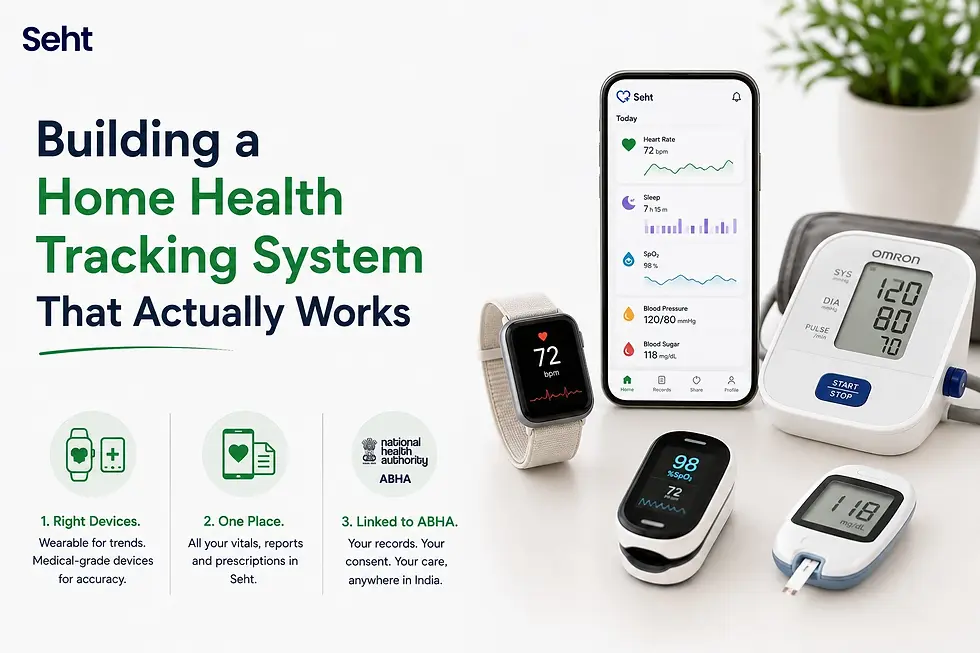
The most useful setup isn't “wearable versus medical device” it's both, feeding into one place a doctor can actually read.
Pair the wearable with the right medical-grade device
1. Keep the wearable for daily trends: heart rate, steps, sleep pattern, stress score.
2. Use a proper pulse oximeter for any SpO2 reading you plan to act on, especially during illness.
3. Use an upper-arm BP monitor for blood pressure never a wearable estimate and log it at the same time each day.
4. For anyone managing diabetes, stick with a glucometer or prescribed CGM, not a fitness tracker's glucose claims.
Where to actually store all this data
Wearable apps are built to keep you inside their own ecosystem great for the brand, useless the moment you switch phones, buy a different watch, or need to hand your numbers to a new doctor. This is precisely the gap Seht is built to close: one family app where vitals from any device, lab reports from Dr Lal PathLabs or SRL Diagnostics, and prescriptions from any clinic all sit in a single, shareable record.
Connecting to ABHA and India's digital health ecosystem
India's Ayushman Bharat Health Account (ABHA) is steadily becoming the backbone of digital health records nationally. Apps that support ABHA linking let any participating doctor pull up your history with your consent, instead of you carrying a folder of printouts to every appointment. Pairing a wearable's daily trend data with an ABHA-linked record gives a doctor both the long-term pattern and the official medical history in one sitting.
When to See a Doctor
Wearable alerts are a reason to check in, not a diagnosis. See a doctor promptly, not eventually if you notice any of the following, regardless of what your watch says:
– A persistent “irregular rhythm” or AFib-style notification appearing more than once
– SpO2 alerts below 92% that repeat across multiple readings, not a single blip
– Resting heart rate climbing steadily over several weeks with no clear cause
– Chest discomfort, breathlessness, or dizziness with or without a device alert
– Any wearable reading that contradicts how you actually feel and doesn't resolve with rest
Emergency: Chest pain, fainting, severe breathlessness, or an SpO2 reading below 90% on a proper pulse oximeter needs emergency care immediately don't wait for a second opinion from the device.
FAQs
Can a smartwatch measure blood pressure accurately in India?
No mainstream smartwatch sold in India has blood pressure accuracy validated to clinical standards. A few models offer a cuffless estimate that needs regular calibration against a real cuff monitor. For any reading you plan to act on, use a validated upper-arm digital BP monitor instead.
Are cheap fitness bands under ₹3,000 accurate for heart rate?
They're reasonably accurate for resting trends but noticeably less reliable during exercise or fast movement, since budget bands typically use a single, simpler light sensor. For daily trend-watching they're fine; for anything medically important, a dedicated pulse oximeter or clinic reading is safer.
Do smartwatches actually detect heart problems?
Select premium models can flag patterns consistent with atrial fibrillation using a built-in single-lead ECG, and this has genuinely prompted earlier doctor visits for some users. They cannot diagnose a heart attack, most arrhythmias, or any condition that needs a full 12-lead ECG.
Is smartwatch sleep tracking reliable?
It's a reasonable trend indicator but not a clinical measurement. Sleep stages are inferred from movement and heart rate, not brain activity, so a single night's “deep sleep” percentage should be read loosely rather than taken as fact.
Which is more accurate: a smartwatch or a dedicated pulse oximeter for SpO2?
A dedicated fingertip pulse oximeter is more accurate for a single reading. Smartwatch SpO2 uses the same underlying technology but a smaller, wrist-mounted sensor, which typically has a wider margin of error fine for a rough trend, not for a reading you'd act on medically.
Can I store my smartwatch health data with my family's medical records in India?
Yes, apps like Seht let you log wearable trends, lab reports, and prescriptions for every family member in one place, and connect with India's ABHA health ID so any doctor you visit can access the full picture with your consent.
Download Seht — free on iOS and Android
Your smartwatch is a good early-warning system, but it's only half the picture. Seht brings your wearable trends, lab reports, and every family member's prescriptions into one record your doctor can actually use with ABHA linking built in.
Download free:


Sources and references
World Health Organization – Digital health and wearable technology guidance, who.int
Indian Council of Medical Research (ICMR) – icmr.gov.in
National Health Authority – Ayushman Bharat Digital Mission / ABHA, abdm.gov.in
Sjoding MW, et al. “Racial Bias in Pulse Oximetry Measurement.” New England Journal of Medicine, ncbi.nlm.nih.gov/pmc
Ministry of Health and Family Welfare, Government of India – mohfw.gov.in
Disclaimer: This blog is for informational purposes only and is not medical advice. Seht helps families stay informed, but is not a substitute for professional healthcare guidance.


Comments