Stopping medication suddenly in India: the risks families don’t know
- Seht Health Team

- 7 days ago
- 6 min read
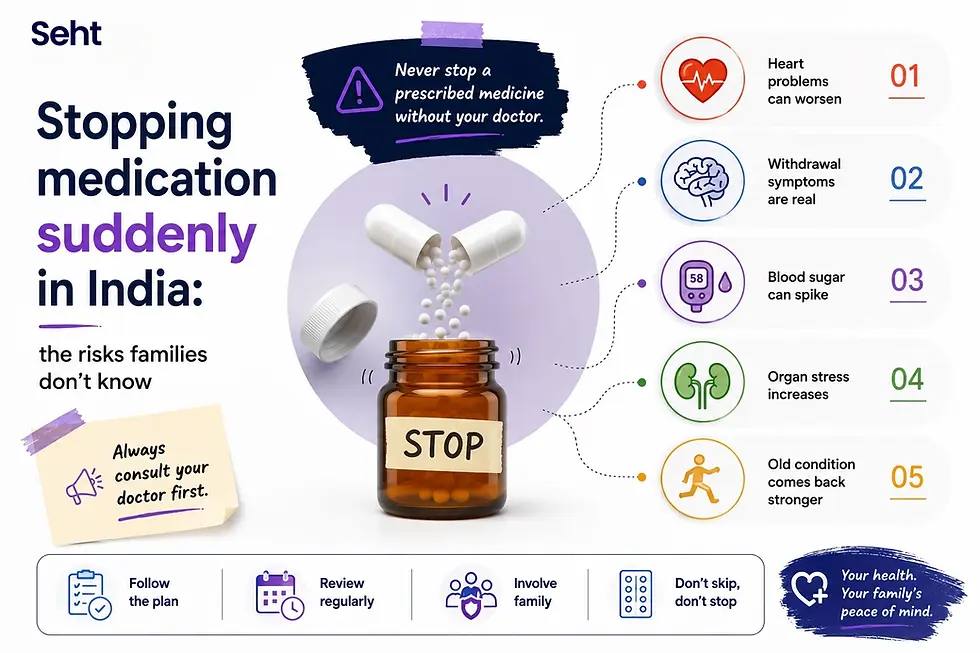
"I felt better, so I stopped." This one sentence explains a significant proportion of preventable hospitalisations in India. The drug that made someone feel better is usually the drug that’s most dangerous to stop without guidance.
Stopping medication suddenly in India carries specific risks that depend entirely on which medicine is involved. For some drugs, stopping abruptly causes nothing more than the return of the original symptom. For others blood pressure medicines, beta-blockers, steroids, antiepileptics, antidepressants, and anticoagulants stopping without a supervised taper can trigger dangerous rebound effects that are sometimes worse than the original condition. This guide explains which medicines require careful tapering, the mechanism behind withdrawal effects, and the warning signs families should recognise.
For managing medicines safely so they never run out unexpectedly, read: generic vs brand medicine India (https://www.seht.in/post/generic-vs-brand-medicine-india-savings)
What you’ll learn: • The difference between withdrawal symptoms and disease return • Which medicines are dangerous to stop without medical guidance • The rebound effects of specific drug classes in plain language • The most common reason Indians stop medicines prematurely • How Seht’s medication tracker prevents accidental discontinuation |
Why stopping medication suddenly causes problems: the mechanism
When the body adapts to a medicine over weeks or months, it makes compensatory physiological adjustments. The drug is suppressing something; the body quietly turns up the sensitivity or output of that pathway to compensate. When the drug is removed suddenly, the body’s upregulated pathway is now running at full intensity with no drug suppressing it. This is the rebound an overshoot in the opposite direction of the drug’s effect.
This is different from simply not getting the drug’s benefit. A rebound is an active adverse physiological response. It explains why someone who stops a beta-blocker for high blood pressure can have a cardiac event. The body had compensated for the beta-blockade by upregulating adrenergic receptors. Remove the drug: those receptors are now hypersensitive to the body’s own adrenaline.
Medicine class | Common Indian examples | What happens if stopped suddenly | Safe approach |
Beta-blockers (heart / BP) | Atenolol, Metoprolol, Carvedilol | Rebound hypertension, rapid heart rate, angina, cardiac event risk in those with coronary disease | Taper over 2–4 weeks under doctor supervision; never stop abruptly |
Corticosteroids (inflammation) | Prednisolone, Dexamethasone, Methylprednisolone | Adrenal insufficiency (adrenal crisis in severe cases): fatigue, low BP, vomiting, weakness, in severe cases: life-threatening | Taper dose over weeks; the longer and higher the dose, the longer the taper required |
Antiepileptics / anticonvulsants | Phenytoin, Valproate, Levetiracetam, Carbamazepine | Breakthrough seizures, sometimes severe and prolonged (status epilepticus) | Never stop without neurologist guidance; tapering is standard practice |
Antidepressants (SSRIs/SNRIs) | Fluoxetine, Sertraline, Venlafaxine | Discontinuation syndrome: dizziness, nausea, electric-shock sensations (‘brain zaps’), anxiety, irritability | Taper over 4–16 weeks depending on duration of use and drug half-life |
Blood pressure medicines (general) | Amlodipine, Ramipril, Losartan | Return of hypertension; for clonidine specifically: rapid, dangerous rebound hypertension | Continue unless doctor instructs; if missed, resume as soon as possible do not double dose |
Thyroid hormone (hypothyroidism) | Levothyroxine (Thyroxine) | Hypothyroid state returns: fatigue, cold intolerance, weight gain, in severe cases myxoedema | Continue daily; missing 1–2 days rarely matters clinically but a pattern of gaps degrades control |
Anticoagulants (blood thinners) | Warfarin, Apixaban, Rivaroxaban | Clot risk: deep vein thrombosis, stroke, pulmonary embolism in those at elevated clot risk | Never stop without haematologist or cardiologist guidance; brief gaps can be dangerous |
The straight answer: The simple rule: any medicine that changes how your heart, brain, adrenal glands, or blood clotting works needs medical supervision to stop. Feeling better while on the medicine is usually evidence that the medicine is working, not evidence that you can stop it. The body has adapted and unadapting needs to be managed as carefully as the original prescribing. |
The most common reasons Indian families stop medicines and which are addressable

‘I felt better’
The most common reason and almost always a misread of what ‘better’ means with chronic disease. Antihypertensives keep blood pressure controlled feeling well is proof the medicine is working, not proof that the condition is cured. The condition persists; the medicine manages it. This distinction needs to be explicitly made by prescribing doctors and reinforced by families.
‘It’s too expensive’
This is a genuinely solvable problem and the most avoidable cause of dangerous discontinuation. A family member stopping Atenolol because the branded strip runs out mid-month is a patient safety failure, not a financial inevitability. Generic equivalents at Jan Aushadhi Kendras bring most essential medicines to under ₹1–2 per tablet. Setting a 7-day refill reminder in Seht means the strip never runs out unexpectedly.
‘Side effects I couldn’t tolerate’
This is the one reason that may sometimes justify stopping but the stopping needs to be discussed with a doctor, not decided at home. Most drug classes have multiple molecules; an alternative in the same class may be better tolerated. Stopping a BP medicine because of a dry cough (a common ACE inhibitor side effect) and replacing it with nothing is not a safe solution. Replacing it with an ARB (same class, no cough) is.
What to do if a medicine is missed or accidentally stopped
One missed dose of most medicines: take it as soon as remembered, unless it’s close to the next dose time. Do not double dose.
Two or more consecutive missed doses: resume the medicine and contact the prescribing doctor the same day. Do not attempt to ‘catch up’ by taking missed doses together.
A controlled substance or anticoagulant missed: contact the prescribing doctor before resuming some drugs require a specific restart protocol.
Any withdrawal symptom appearing after stopping: see a doctor the same day. Do not attempt to self-manage drug withdrawal.
For the complete system to prevent gaps in elderly parents’ medicines, read: Managing medicines for elderly parents in India (https://www.seht.in/post/managing-elderly-parent-medicines-india)
When stopping suddenly becomes a medical emergency
Call 108 or go to hospital immediately if: ⚠ Chest pain or rapid irregular heartbeat appears within days of stopping a heart or blood pressure medicine ⚠ A seizure occurs in someone who was taking antiepileptic medication this is a medical emergency regardless of cause ⚠ Extreme weakness, inability to stand, very low blood pressure, or vomiting appears after stopping steroids ⚠ Stroke symptoms appear (sudden facial drooping, arm weakness, speech difficulty) in someone who recently stopped blood thinners ⚠ Severe confusion or disorientation in an elderly parent after any medicine change |
Emergency: Drug withdrawal emergencies can mimic cardiac events or neurological crises. Always tell the emergency doctor what medicines the patient takes and what was recently stopped.
FAQs
What happens if you stop taking blood pressure medicine suddenly in India?
Stopping blood pressure medicine suddenly, particularly beta-blockers (Atenolol, Metoprolol), can cause rebound hypertension a dangerous spike in blood pressure that exceeds pre-treatment levels. In people with coronary artery disease, this can trigger angina or a cardiac event. Other BP medicines have a gentler effect on stopping, but all should be continued as prescribed. Never stop antihypertensives without doctor guidance.
Is it dangerous to stop taking steroids suddenly in India?
Yes, particularly after prolonged or high-dose use. Corticosteroids suppress the adrenal gland’s natural production of cortisol. Stopping suddenly means the adrenal glands cannot produce enough cortisol for normal function this can cause adrenal insufficiency: severe fatigue, nausea, dizziness, and very low blood pressure. In severe cases, it becomes an adrenal crisis requiring emergency treatment. Taper under medical supervision always.
What is discontinuation syndrome from antidepressants in India?
Antidepressant discontinuation syndrome occurs when SSRIs or SNRIs (Fluoxetine, Sertraline, Venlafaxine) are stopped abruptly after weeks or months of use. Symptoms include dizziness, nausea, flu-like feelings, and distinctive ‘brain zap’ sensations. Symptoms are not dangerous but are distressing and last days to weeks. They are prevented by tapering the dose gradually over 4–16 weeks, which a psychiatrist or GP can plan.
Download Seht — free on iOS and Android
Seht’s medication tracker sends a daily reminder for every medicine in a family member’s profile so the beta-blocker or the antiepileptic is never accidentally missed for three days because the strip ran out and nobody noticed.
Download free:


Sources and references
WHO — Medication safety in transitions of care. https://www.who.int/publications/i/item/WHO-UHC-SDS-2019.9
JFMPC — Issues and challenges of polypharmacy in the elderly in India. https://doi.org/10.4103/jfmpc.jfmpc_2581_20
Medstown — How to read a prescription and order medicines online correctly in India. https://www.medstown.com/how-to-read-a-prescription-and-order-medicines-online-correctly/
Disclaimer: This blog is for informational purposes only and is not medical advice. Seht helps families stay informed, but is not a substitute for professional healthcare guidance.


Comments