Building a family medical emergency kit in India: the complete guide


A family medical emergency kit in India is not a box of bandages and paracetamol it is a structured collection of the specific documents, contact numbers, and health information that determine the quality of emergency medical care your family receives in the first critical minutes. Most Indian families have the bandages. Almost none have the blood group confirmations, complete medication lists, and emergency contacts organized and accessible at the moment they are actually needed. This guide tells you exactly what to build, how to build it, and how Seht makes it instantly shareable in any emergency.
For the complete guide to storing all your family's medical records digitally, read: store medical records digitally India (https://www.seht.in/post/store-medical-records-digitally-india-2026)
What you'll learn: • The exact documents and information every family emergency kit needs • The digital emergency kit using Seht that is always current • The physical emergency card for family members who don't use smartphones • The emergency contact hierarchy every Indian family needs • The 15-minute exercise that makes your family emergency-ready today |
What a family medical emergency kit in India must contain
An effective medical emergency kit for an Indian family is about information, not equipment. The information that changes emergency treatment outcomes is:
Information item | Why it is emergency-critical | For which family members | Where to keep it |
Confirmed blood group for every family member | Blood transfusion decisions in trauma and surgery; incompatible blood is life-threatening | Everyone especially children, elderly parents, and adults with chronic conditions | Digital: Seht emergency health card. Physical: laminated card in wallet |
Complete current medication list with doses | Prevents dangerous drug interactions with emergency treatment; guides anaesthesia protocol | Everyone on daily medications critical for elderly parents on 5+ medications | Digital: Seht medication record. Physical: printed card in wallet for elderly |
Drug and food allergies with reaction severity | Prevents anaphylactic reactions from standard emergency medications or IV fluids | Everyone with any known allergy especially to antibiotics (common in India), NSAIDs, or contrast dye | Digital: Seht allergy record. Physical: clearly marked on the wallet card |
Active chronic conditions | Tells ER team immediately which drugs are contraindicated, which protocols to adjust | Everyone with any ongoing medical condition diabetes, hypertension, heart disease, kidney disease, epilepsy | Digital: Seht conditions record. Physical: listed on wallet card |
Any cardiac devices or implants | Prevents contraindicated procedures MRI is dangerous with a pacemaker; defibrillation settings differ for ICDs | Family members with pacemakers, stents, cochlear implants, or any surgical implant | Digital: Seht notes field. Physical: device card (usually provided at implantation) in wallet |
Emergency contact with medical knowledge | ER team needs to reach someone who knows the patient's full history | Primary emergency contact who knows the medical history often the adult child managing the family's health | Digital: Seht emergency contact field. Physical: written on every physical card |
Treating doctor name and contact for each chronic condition | ER team may need to consult the treating cardiologist, nephrologist, or endocrinologist | For complex chronic conditions provide the specialist's contact, not just the GP | Digital: Seht provider records. Physical: on the back of the wallet card |
ABHA number | Links ER team to ABHA-integrated records from previous hospital visits with your consent | Everyone with an ABHA ID | Digital: Seht profile (ABHA linked). Physical: ABHA card in wallet |
Building the digital emergency kit using Seht: the 15-minute setup
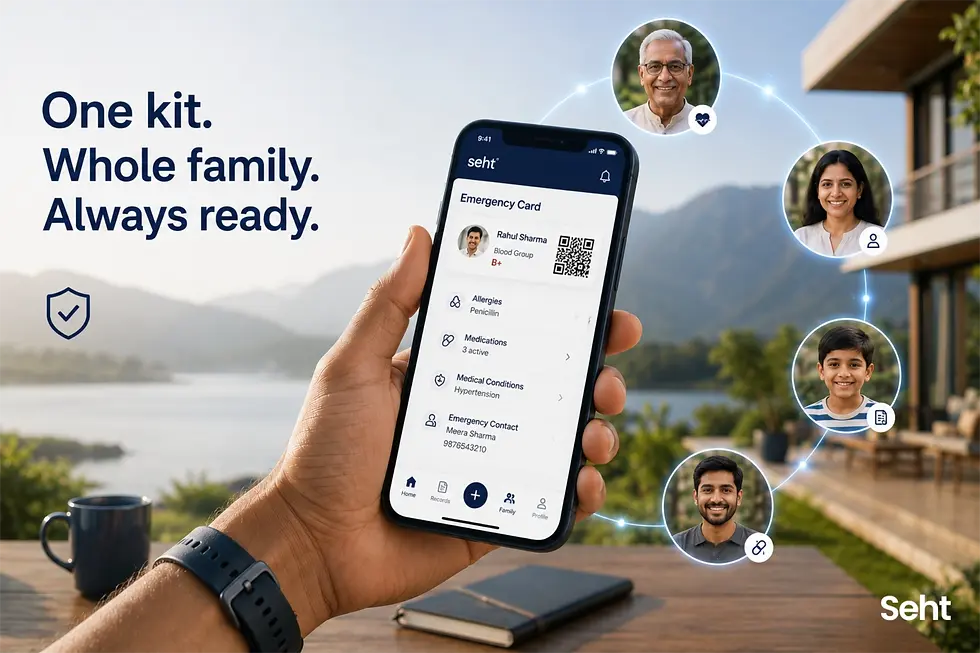
A complete digital emergency kit for a family of four can be set up in 15–30 minutes using the following process:
Create or update Seht profiles for every family member: name, date of birth, blood group
Blood group: Add from any lab report, hospital discharge summary, or blood bank card. If unknown for any family member, book a blood typing test at any NABL lab (Rs 80–150, no fasting required)
Medications: For every family member on daily medications enter drug name (generic), dose, frequency, prescribing doctor. For elderly parents: photograph every medication packet and enter the details
Allergies: For every family member add any known drug allergy (penicillin, sulpha, aspirin, NSAIDs, contrast dye), food allergy affecting medical care, and the severity (rash vs anaphylaxis)
Active conditions: For every family member add diagnosis name, date first diagnosed, and treating specialist name and contact number
Emergency contact: Add the primary emergency contact name and phone number in each profile this should be the person with the most complete knowledge of that family member's medical history
Generate and test emergency cards: In Seht, generate the emergency health card for each profile. Test by sharing the card link with another family member via WhatsApp confirm they can open it without logging in
Enable family sharing: Share each parent's profile with siblings or relevant family members so that multiple people can share the emergency card in a crisis
The physical emergency card for family members who don't use smartphones
For elderly parents, in-laws, or other family members who are not smartphone users, the digital Seht profile must be complemented by a physical emergency card. Print the Seht emergency health card. Laminate it. Distribute as follows:
One copy in the family member's wallet (with or behind their ID card)
One copy on the kitchen refrigerator, attached with a magnet the first place emergency responders check
One copy near the front door of their home
One copy with the primary local emergency contact (neighbour, local relative, caretaker)
The physical card should contain: full name, blood group, current medications with doses, known allergies with severity, active conditions, and 2 emergency contact numbers. Update the physical card every time the digital Seht profile is updated.
The emergency contact hierarchy for Indian families

Every Indian family emergency kit needs a contact hierarchy a chain of people who can be reached and who know the relevant medical history:
Primary emergency contact: The adult family member most likely to be reachable at any hour, who knows the complete medical history. Usually: the adult child who manages the family's health records.
Secondary emergency contact: A different family member or trusted friend who can be reached if the primary contact is unreachable. Should also have access to the Seht emergency health card.
Local emergency contact: For elderly parents or family members in another city one person who is physically near them and can respond in 30 minutes. This could be a neighbour, nearby relative, or hired caretaker.
Treating doctor(s) for chronic conditions: Each specialist managing an active chronic condition accessible during business hours for ER team consultation.
Primary care GP: The family GP who knows the complete history accessible for non-emergency but urgent consultations.
Store all of these numbers in the Seht profile notes and on the physical emergency card.
For the guide to sharing all these records with doctors and emergency teams, read: How to share medical records with a doctor instantly in India (https://www.seht.in/post/share-medical-records-doctor-india)
What to do when a medical emergency happens: the first 10 minutes
Call 108: For cardiac events, stroke, major trauma, severe breathlessness, or loss of consciousness call 108 immediately. Tell the dispatcher the patient's key conditions and medications while waiting.
Open Seht: While waiting for the ambulance, open the family member's profile and prepare the emergency health card for sharing.
Share the emergency card with the ambulance crew on arrival: Show on phone screen or share via WhatsApp to the crew's number if they provide it.
Share the emergency card with the ER team: On arrival at hospital, the ER team's first questions will be about blood group, medications, and conditions. Share the Seht emergency card immediately.
Notify the primary emergency contact: Call the adult family member who has the most complete medical knowledge. They should have access to the Seht profile via family sharing.
When to review and update your emergency kit
After any change in medications same day update to the Seht medication record and reprint physical card
After any new diagnosis add to the conditions list in Seht and update the physical card
After any hospitalization upload the discharge summary and update the active conditions if the diagnosis changed
Before any inter-city or international travel verify all emergency health cards are current for travelling family members
Annually do a 15-minute review of every family member's Seht profile to ensure nothing is outdated
Emergency: If any family member is in immediate danger call 108 first. The emergency kit is prepared before the emergency, not during it.
FAQs
What should be in a family medical emergency kit in India?
A family medical emergency kit India contains: confirmed blood group for every family member, complete current medication list with doses, all known drug and food allergies with severity, active chronic conditions list, cardiac device or implant information, emergency contact hierarchy (at least 3 contacts), treating doctor contacts for each chronic condition, and ABHA numbers. In Seht, the emergency health card auto-generates this information for every family profile and is shareable without login.
How do I create a medical emergency card for my family in India?
In Seht: create a profile for each family member, enter blood group, add all current medications, add all known allergies, list all active conditions. Seht automatically generates an emergency health card from this information shareable via WhatsApp without the recipient needing a Seht account. Print, laminate, and distribute physical copies for elderly family members: one in their wallet, one on the refrigerator, one near the front door.
How often should I update my family's medical emergency kit in India?
Update immediately when: any medication changes (same day), any new diagnosis, any new allergy identified, after any hospitalization. Review the entire kit annually. Before any inter-city or international travel by any family member verify emergency health cards are current. In Seht, the emergency health card shows the 'last updated' date the ER team can see how recent the information is.
Download Seht — free on iOS and Android
Your family's medical emergency kit is only as good as the last time it was updated. In Seht, updating takes 2 minutes enter the new medication, add the new diagnosis, regenerate the emergency card. Do the 15-minute setup once. Maintain it in 2 minutes when anything changes. That is the entire investment for being emergency-ready.
Download free:


Sources and references
National Health Authority — ABHA and ABDM emergency record access. https://abdm.gov.in
Samarth India — Health file for parents: preparing for health emergencies. https://care.samarth.community
ICMR — Emergency medical care guidelines India. https://icmr.gov.in
Disclaimer: This blog is for informational purposes only and is not medical advice. Seht helps families stay informed, but is not a substitute for professional healthcare guidance.


