Why storing medical records on WhatsApp is risky in India and what to use instead
- Seht Health Team

- 2 days ago
- 6 min read

Storing medical records on WhatsApp is the default behaviour of most Indian families in 2026 lab reports are sent by the lab to a WhatsApp number, prescriptions are photographed and forwarded to a family group, discharge summaries arrive as WhatsApp PDFs. The problem is not that WhatsApp is used to receive these documents. The problem is that WhatsApp is used as the archive. WhatsApp is a messaging app. It was built for conversations, not for health records management. Using it as a health records system creates five specific risks ranging from accidental data exposure to permanent data loss that every Indian family should understand.
For the complete guide to proper digital medical record storage, read: store medical records digitally India (https://www.seht.in/post/store-medical-records-digitally-india-2026)
What you'll learn: • The 5 specific risks of using WhatsApp as a medical records archive • The Pune clinic DPDP Act breach case involving WhatsApp • What India's DPDP Act 2023 says about WhatsApp and health data • Why WhatsApp records disappear when you change phones • The better alternative and how to migrate records today |
The 5 real risks of storing medical records on WhatsApp India
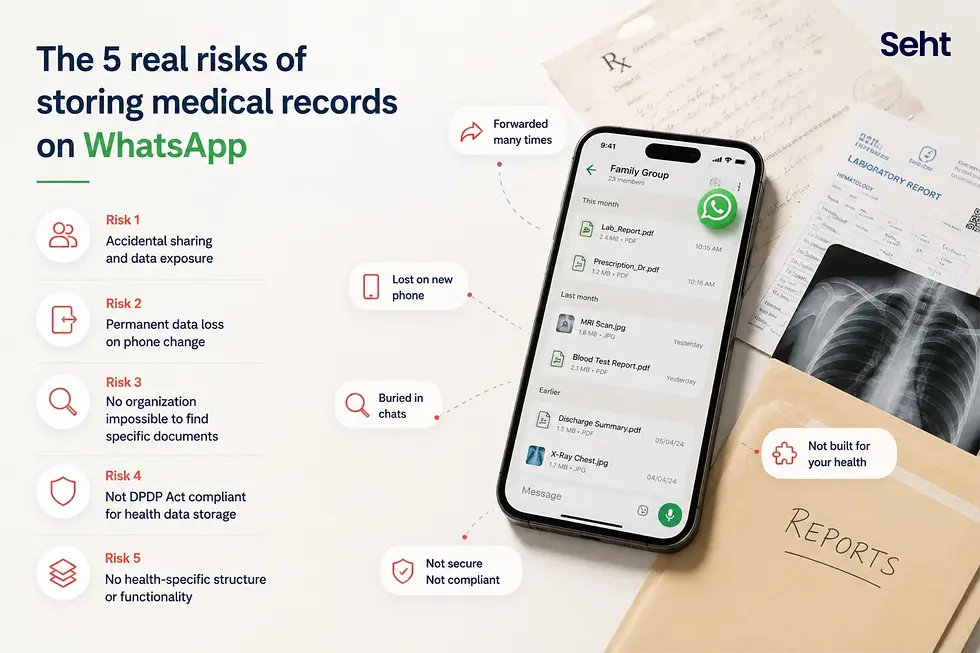
Risk 1: Accidental sharing and data exposure
WhatsApp's chat interface means your health records exist alongside family conversations, work chats, and social groups. Forwarding errors are common and in the context of health data, can have significant consequences. In 2026, a Pune clinic was reported to India's Data Protection Board after a staff member accidentally forwarded a patient's MRI report to a family WhatsApp group with 23 contacts. The incident was reported under India's DPDP Act framework. While this was a clinic error, the same accident happens in private WhatsApp use every day: a medical report forwarded to the wrong contact, shared to a group, or accidentally visible to others when someone borrows your phone.
Risk 2: Permanent data loss on phone change
WhatsApp media is stored on your device not in a health-specific cloud system. When you change phones, WhatsApp history transfers only if: you manually back up to Google Drive or iCloud, the backup completes fully before the phone change, the backup is restored correctly on the new phone, and media files are included in the backup (a setting many people never configure). In practice, Indian families routinely lose 1–3 years of WhatsApp health records on every phone change. Lab reports received via WhatsApp in 2022 that were never saved elsewhere are permanently gone when the 2022 phone breaks.
Risk 3: No organization impossible to find specific documents
WhatsApp health records are stored in message threads ordered by conversation partner and time. Finding a specific lab report from 18 months ago requires scrolling through months of messages in a chat, or searching for a keyword and hoping the PDF was named correctly. There is no categorization by record type, no family member profiles, no tagging by test type or date. In an emergency, finding the blood group confirmation or the medication list from a WhatsApp archive is not a 30-second task it is a 30-minute task under stress.
Risk 4: Not DPDP Act compliant for health data storage
India's Digital Personal Data Protection Act 2023 requires that personal health data be stored with explicit consent for a specific purpose, with access controls, without sharing to third parties, and with deletion capability when the purpose is complete. WhatsApp's Terms of Service and Meta's data practices do not meet health-data-specific DPDP standards. WhatsApp media files stored on Meta's servers are subject to Meta's data handling practices not India's health data protection framework. As DPDP enforcement progresses (Phase 3 from May 2027), using a non-compliant platform for health data storage creates measurable privacy risk.
Risk 5: No health-specific structure or functionality
WhatsApp has no medication list, no allergy record, no emergency health card generator, no family profiles, no ABHA linking, no trend tracking, and no offline-accessible health summary. It is a messaging platform. Storing health records in WhatsApp is like storing financial records in your SMS inbox technically possible, practically unreliable, and structurally wrong for the job.
Capability | Seht | |
Record organization by type and date | No messages in chat threads only | Yes, auto-categorised by record type, date, family member |
Find a specific record in 30 seconds | No, requires scrolling/searching | Yes, searchable by test name, date, provider |
Survives phone change without data loss | Only if backup configured correctly | Yes, cloud backup, accessible from any device |
DPDP Act compliant for health data | No, general messaging ToS | Yes, built for Indian health data compliance |
Emergency health card (shareable without login) | No | Yes, generated automatically from each profile |
Family profiles (multiple members) | No, all in one chat | Yes, unlimited, independent profiles |
ABHA/ABDM record linking | No | Yes, automatic record syncing on ABHA link |
Medication list and allergy records | No | Yes, structured, with drug interaction awareness |
Offline access to all records | No, requires connectivity | Yes, all stored records available offline |
End-to-end encryption at rest | Messages yes; server storage unclear | Yes, AES-256 at rest and in transit |
In simple terms: WhatsApp is a brilliant messaging app. It is a terrible medical records system. The difference is that a messaging app optimizes for conversations fast, informal, disappearing-into-history. A health records system optimizes for permanence, findability, and clinical structure. Lab reports and prescriptions arrive via WhatsApp but they should leave WhatsApp within 24 hours and be stored in Seht. The arrival route and the storage system are two different things. |
How to migrate your WhatsApp health records to Seht today
Identify the main WhatsApp sources: The lab/clinic numbers that sent you reports, the family groups where health documents were shared, and saved messages containing health PDFs
For PDF lab reports: Long-press the PDF in the chat, tap 'Download', then open Seht, go to the relevant family member's profile, tap 'Upload', select the downloaded file
For photographed prescriptions: Save the image from WhatsApp to your phone gallery. In Seht, use 'Upload Photo' and select from gallery, or photograph the original physical prescription directly using the in-app scanner
For discharge summary PDFs: Download and upload as above, tagging as 'Hospitalization' with hospital name and dates
Going forward the 24-hour rule: When any health document arrives via WhatsApp, download and upload to Seht within 24 hours. This breaks the habit of WhatsApp as the archive.
When to seek help about data privacy in India

If you believe health records you sent or received via WhatsApp have been shared without your consent this may be reportable under DPDP Act
If a clinic or hospital has been sending your health data via WhatsApp without your explicit consent to use WhatsApp for this purpose this is a potential DPDP Act violation by the data fiduciary
If you have received another patient's medical records via WhatsApp in error do not forward or share; inform the sender and delete
For data privacy complaints in India: contact the Data Protection Board of India at https://dpboard.gov.in (operational from November 2025 under DPDP Phase 1).
FAQs
Why is storing medical records on WhatsApp risky in India?
Storing medical records on WhatsApp India creates five risks: accidental sharing to wrong contacts or groups; permanent data loss when changing phones if backup is not configured; no organization by record type, family member, or date; non-compliance with India's DPDP Act 2023 health data standards; and no health-specific functionality (medication lists, emergency cards, ABHA linking, family profiles). WhatsApp is a messaging app not a health records system.
Do medical records stored in WhatsApp disappear when I change phones?
Yes, if the backup was not configured and completed correctly. WhatsApp media (PDFs and photos) stores on your device and in your Google Drive or iCloud backup only if you specifically enabled media backup in WhatsApp settings. Many users lose 1–3 years of WhatsApp health records on every phone change. Records stored in Seht survive any phone change because they are backed up to Seht's secure servers and restored immediately on a new device.
Is sending medical reports via WhatsApp legal in India?
Sending medical reports via WhatsApp for convenience is common in Indian healthcare. Under India's DPDP Act 2023, the key question is whether the patient has given explicit, purpose-specific consent for their health data to be shared via WhatsApp. As DPDP enforcement progresses (Phase 3 from May 2027), healthcare providers who transmit patient data via WhatsApp without explicit consent may face regulatory scrutiny. For patients, the best practice is to receive reports via WhatsApp but immediately transfer them to a DPDP-compliant health records app like Seht.
Download Seht — free on iOS and Android
The solution is not to stop receiving lab reports via WhatsApp labs will continue to use it. The solution is to use the 24-hour rule: every health document that arrives on WhatsApp leaves WhatsApp within 24 hours and is stored permanently in Seht. Download, upload, tag. 3 minutes per document. Permanent storage. Done.
Download free:


Sources and references
EasyClinic — Patient data privacy mistakes India 2026: WhatsApp Pune clinic DPDP breach. https://www.easyclinic.io/patient-data-privacy-mistakes
DPDP Act 2023 — Digital Personal Data Protection Act India. https://www.meity.gov.in
Recording Law — India data privacy laws DPDP Act compliance guide 2026. https://www.recordinglaw.com/world-laws/world-data-privacy-laws/india-data-privacy-laws/
Disclaimer: This blog is for informational purposes only and is not medical advice. Seht helps families stay informed, but is not a substitute for professional healthcare guidance.


Comments