Managing blood pressure naturally after 45: complete India guide

Updated: Apr 30
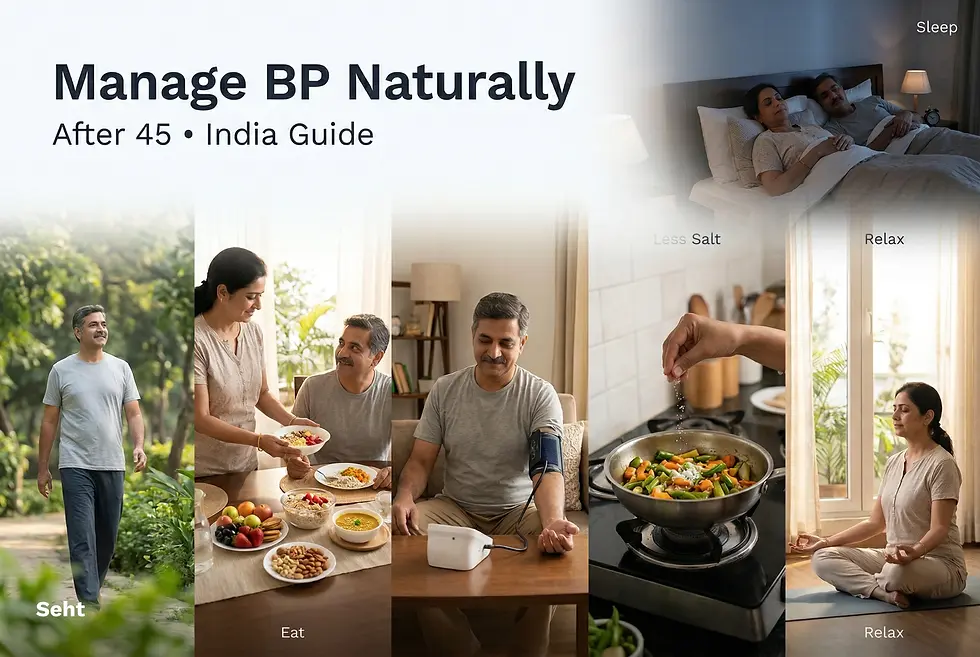
Managing blood pressure naturally after 45 in India is both possible and critically important because blood pressure rises progressively with age as arteries stiffen, and the lifestyle factors that drive this rise are largely within your control. Sustained lifestyle changes reduce systolic blood pressure by 8–14 mmHg equivalent to a moderate-dose antihypertensive medication without any pharmaceutical side effects. After 45, however, lifestyle and medication are often partners, not alternatives.
For the full foundation of heart health, read: Ultimate guide to heart health
What you'll learn: • Why blood pressure rises after 45 and what drives it in Indians • The 5 most effective natural approaches to lowering BP • The DASH diet adapted for Indian meals • How much BP reduction each lifestyle change produces • When natural management is not enough and medication is necessary |
Why blood pressure management after 45 is different in India
After 45, three biological changes make blood pressure harder to control naturally in Indian adults:
Arterial stiffness: Arteries progressively lose elasticity with age. Less elasticity means higher systolic pressure for the same cardiac output a process that begins in the 40s and accelerates through the 50s and 60s
Renin-angiotensin system changes: The kidney hormone system that regulates blood pressure becomes less responsive to lifestyle changes after 50, making dietary sodium reduction and exercise relatively less effective than in younger adults
Hormonal shifts: In women, the loss of oestrogen after menopause removes a significant cardiovascular protective effect, causing blood pressure to rise more rapidly in the late 40s and 50s
This does not mean lifestyle interventions are ineffective after 45 they remain the foundation of blood pressure management. It means that the interventions need to be more deliberate, more consistent, and monitored more carefully.

The 5 most effective natural approaches to managing blood pressure after 45
1. Sodium reduction: the single highest-impact dietary change
Reducing dietary sodium from the average Indian intake of 8–10 grams per day to below 5 grams per day (the WHO recommended maximum) reduces systolic blood pressure by 4–9 mmHg in most hypertensive adults. For Indians with salt-sensitive hypertension a genetically higher-than-average BP response to sodium intake, common in Indian populations the reduction can exceed 10 mmHg.
Practical reduction steps for Indian households:
Stop adding extra salt at the table this alone eliminates 1–2 grams of daily sodium
Reduce pickle and papad frequency from daily to twice weekly
Cook with a measured amount of salt (half a teaspoon per meal for two people) rather than 'to taste'
Replace namkeen snacks with unsalted roasted chana or walnuts
Check sodium content on packaged food labels 'low sodium' means below 120 mg per 100g
2. The DASH diet adapted for Indian meals
The Dietary Approaches to Stop Hypertension (DASH) diet, clinically proven to reduce systolic BP by 8–14 mmHg, is easily adapted to Indian cooking. The core principles align remarkably well with traditional Indian dietary patterns:
DASH Principle | Daily target | Indian food sources | Easy swap |
Vegetables | 4–5 servings | Spinach, bhindi, gobi, lauki, beans, tomato | Add one extra sabzi to lunch and dinner |
Fruits | 4–5 servings | Guava, amla, banana, papaya, orange | Replace afternoon biscuits with fruit |
Whole grains | 6–8 servings | Brown rice, jowar roti, bajra, ragi | Replace 30% of white rice with millet |
Legumes | 4–5 per week | Dal, rajma, chana, moong, lentils | Dal at every meal |
Low-fat dairy | 2–3 servings | Low-fat curd, buttermilk, skimmed milk | Replace full-fat paneer with low-fat versions |
Nuts and seeds | 1 serving | Walnuts, almonds, flaxseeds | 30g walnut + 2 tsp flaxseed daily |
Limit sodium | Below 2,300 mg/day | Reduce pickles, papads, salted snacks | Use herbs and lemon instead of salt |

3. Exercise: the most consistent BP reducer
Regular aerobic exercise reduces systolic BP by 5–8 mmHg comparable to a single antihypertensive medication at standard dose. After 45, the most effective and safe exercises for blood pressure management are:
Brisk walking: 30 minutes daily, 5 days per week. The most accessible and evidence-backed option for Indian adults over 45.
Swimming: Excellent for those with joint problems. 30 minutes, 3–4 times per week.
Yoga: Specific yoga protocols including pranayama, shavasana, and slow-flow sequences have been shown in Indian studies to reduce systolic BP by 5–7 mmHg over 12 weeks.
Resistance training: 2 sessions per week. Builds muscle that improves metabolic function and independently reduces resting BP.
Avoid: isometric exercises (prolonged gripping, intense weight training with breath-holding) these spike BP acutely and are not recommended for people with Stage 2 hypertension.
4. Stress management and sleep the underrated BP tools
Every episode of acute psychological stress raises systolic BP by 20–50 mmHg temporarily. In people with chronic stress common in India's high-pressure professional culture these spikes are frequent and cause progressive vascular damage. Evidence-backed stress management approaches for Indians over 45:
Pranayama (slow, diaphragmatic breathing): 10 minutes of 4-7-8 breathing or alternate nostril breathing daily has been shown to reduce resting BP by 4–6 mmHg in Indian studies
Progressive muscle relaxation: 20 minutes before bed reduces cortisol and both systolic and diastolic pressure
Digital detox periods: Scheduled screen-off time reduces sympathetic nervous system activation that chronically elevates BP
5. Weight loss and waist circumference reduction
For every 1 kg of weight lost, systolic BP falls by approximately 1 mmHg. More importantly for Indians: reducing waist circumference by 2–3 cm through visceral fat loss produces disproportionate BP improvements because visceral fat directly promotes aldosterone secretion, which causes sodium retention and elevated BP. A 5% body weight reduction in overweight Indians with hypertension typically produces 3–5 mmHg systolic BP improvement within 3 months.
In simple terms: Managing blood pressure naturally after 45 comes down to four actions: reduce the salt in your cooking, add a daily 30-minute walk, lose even a small amount of belly fat, and take 10 minutes to breathe slowly before bed. Together, these four changes can reduce your blood pressure by 10–15 mmHg which is enough to take some people from Stage 2 hypertension back to Stage 1. |
How much BP reduction each intervention produces
Sodium reduction to below 5g/day: 4–9 mmHg systolic reduction
DASH diet (full implementation): 8–14 mmHg systolic reduction
Aerobic exercise (150 mins/week): 5–8 mmHg systolic reduction
Weight loss (5% body weight): 3–5 mmHg systolic reduction
Stress management / yoga + pranayama: 4–7 mmHg systolic reduction
Stopping smoking: 3–5 mmHg systolic reduction
All interventions combined: potentially 20–30 mmHg reduction significant enough to eliminate need for medication in Stage 1 hypertension
For guidance on warning signs that indicate BP has reached emergency levels, read: 7 warning signs of high blood pressure you must not miss
When natural management is not enough: medication becomes necessary
Natural management of blood pressure after 45 is powerful but it has clinical limits. Medication alongside lifestyle changes is recommended when:
BP remains above 140/90 mmHg after 3 months of consistent lifestyle change
BP is above 160/100 mmHg at initial diagnosis medication typically begins immediately alongside lifestyle change
The person has diabetes, chronic kidney disease, heart disease, or prior stroke in these cases, the BP target is below 130/80 mmHg and medication is usually required to achieve it
Age above 65 with systolic above 150 mmHg evidence supports medication to reduce stroke risk in this group
When to see a doctor
BP consistently above 130/80 mmHg on 3 or more consecutive morning readings despite lifestyle changes
Any of the 7 warning signs of high blood pressure appearing headaches, vision changes, palpitations, shortness of breath
BP above 160/100 mmHg on any reading this requires medical evaluation within 24–48 hours
Starting a new intensive exercise programme after 45 without a cardiac assessment first
Emergency: BP above 180/120 mmHg with any symptom this is a hypertensive crisis. Call 108 immediately.
FAQs
Can blood pressure be controlled naturally after 45 without medication?
In Stage 1 hypertension (130–139 / 80–89 mmHg), aggressive lifestyle change DASH diet, daily exercise, sodium reduction, stress management, and weight loss can bring blood pressure to normal range without medication in many people. In Stage 2 (140/90 mmHg or above), lifestyle alone is usually insufficient to achieve optimal control, and most cardiologists recommend lifestyle plus medication. The lifestyle changes remain essential regardless of whether medication is taken.
What is the best natural remedy for blood pressure in India?
The single most evidence-backed natural approach to managing blood pressure naturally after 45 India is sodium reduction combined with daily aerobic exercise. The DASH diet has been shown to reduce systolic blood pressure by 8–14 mmHg — equal to a moderate-dose antihypertensive drug. Specific Indian additions with clinical evidence include arjuna bark tea (Terminalia arjuna), which has shown BP-lowering properties in Indian studies, and hibiscus tea.
How much sodium is too much for Indians with high blood pressure?
The WHO recommends below 5 grams of sodium per day for adults with hypertension. Average Indian dietary sodium intake is 8–10 grams per day nearly double the safe limit. The largest single sources of excess sodium in the Indian diet are salt added during cooking, pickles and papads consumed daily, salted namkeen, and packaged processed foods. Reducing to 5 grams requires conscious measurement, not just estimation.
Is yoga effective for managing blood pressure after 45 in India?
Yes. Multiple Indian clinical trials have shown that a consistent yoga practice including pranayama (breathing exercises), specific postures, and yoga nidra (guided relaxation) reduces resting systolic BP by 5–10 mmHg over 8–12 weeks. The mechanism involves both direct cardiovascular effects (improved arterial elasticity) and stress hormone reduction (lower cortisol and adrenaline). Yoga complements but does not replace aerobic exercise for blood pressure management.
Should I stop blood pressure medication if my BP normalises through lifestyle changes?
Never stop or reduce blood pressure medication without your doctor's guidance. If your BP normalises through lifestyle changes, your doctor may choose to reduce your medication dose but this decision requires careful monitoring over weeks or months to ensure the improvement is sustained before medication is adjusted. Stopping medication abruptly can cause a dangerous rebound spike in blood pressure.
Download Seht — free on iOS and Android
Managing blood pressure after 45 is a daily practice and Seht makes it easier. Log your daily BP readings, track trends over months, store your cardiologist prescriptions, and set reminders for annual screenings. Whether you are managing your own BP or an elderly parent's, Seht keeps every reading organized and accessible.
Download free:


Sources and references
1. ICMR — Dietary guidelines for Indians. https://icmr.gov.in
2. Indian Guidelines on Hypertension-IV (IGH-IV, 2019).
3. WHO — DASH diet and blood pressure management. https://www.who.int
4. Lancet — DASH diet clinical trial meta-analysis.
Disclaimer: This blog is for informational purposes only and is not medical advice. Seht helps families stay informed, but is not a substitute for professional healthcare guidance.


