7 warning signs of high blood pressure you must not miss

Updated: Apr 30

The 7 warning signs of high blood pressure that should never be dismissed are your body's last attempt to communicate a crisis that has been building silently for months or years. Hypertension which affects nearly 30% of Indian adults rarely produces symptoms. But when it does, those symptoms mean blood pressure has reached a level that is actively damaging your organs. Acting on these warning signs within hours, not days, can prevent a stroke, heart attack, or kidney failure.
For our complete heart health guide, read: Ultimate guide to heart health
What you'll learn: • All 7 warning signs of high BP and exactly what each one signals • Which signs require emergency care vs same-day doctor visit • The BP numbers that make each warning sign dangerous • How to respond to each warning sign at home • How to set up a warning sign monitoring system with Seht |
Why warning signs of high blood pressure demand immediate action
When warning signs of high blood pressure appear in India, they typically indicate one of two situations: blood pressure has been silently elevated for years and has now crossed a threshold high enough to produce symptoms (usually above 160/100 mmHg), or blood pressure has spiked acutely to crisis levels. In either case, the presence of symptoms means that organ damage is already occurring not approaching, but happening right now.
India's hypertension crisis deepens this urgency. Of the estimated 220 million Indians with hypertension, more than half are unaware of their condition. For many, the first awareness comes through symptoms by which time years of silent vascular damage have already accumulated.
The 7 warning signs and what each one means

Warning Sign 1: Severe morning headache at the back of the head
A pounding, throbbing headache specifically at the back of the head (occipital region) upon waking, that improves as the day progresses, is one of the most recognised early symptoms of significantly elevated blood pressure. Blood pressure peaks naturally in the early morning hours if your baseline is already elevated, the morning peak pushes it into a range where it compresses blood vessels in the brain. This type of headache, specifically worse in the morning and specifically at the back of the head, is different from tension headaches or migraine and should prompt an immediate BP check.
Warning Sign 2: Sudden blurred vision or visual disturbances
Visual disturbances including blurred vision, seeing floating spots, or temporary loss of vision in one part of the visual field are among the most urgent warning signs of high blood pressure. Hypertension damages the delicate blood vessels in the retina (hypertensive retinopathy) and can cause retinal haemorrhage. Any new visual disturbance in a person over 35 requires a blood pressure check and a same-day or next-day ophthalmology or emergency evaluation.
Warning Sign 3: Unexplained nosebleeds
Recurrent nosebleeds without an obvious cause not caused by dry air, nose-picking, or direct trauma can indicate that small blood vessels in the nasal passages are rupturing under the pressure of elevated BP. While most nosebleeds are benign, a pattern of unexplained nosebleeds (two or more in a month) in an adult over 40 deserves a blood pressure check. During a nosebleed, do not tilt your head back; lean forward, pinch the soft part of the nose, and check BP when the bleeding stops.
Warning Sign 4: Irregular or racing heartbeat (palpitations)
Feeling your heart beating unusually fast, pounding, skipping beats, or beating irregularly particularly at rest or while doing light activity can indicate that hypertension has begun to affect the heart's electrical system. Chronic high blood pressure causes the left ventricle to thicken (left ventricular hypertrophy), which creates an environment where arrhythmias can develop. Palpitations combined with lightheadedness or near-fainting require urgent cardiac evaluation.
Warning Sign 5: Difficulty breathing with mild activity
Shortness of breath during activities that previously felt effortless climbing one flight of stairs, walking to the market, or carrying groceries when accompanied by high blood pressure suggests that hypertension has begun to impair cardiac output. This is a sign of hypertensive heart disease and requires evaluation the same day.
Warning Sign 6: Buzzing, ringing in the ears (tinnitus)
Pulsatile tinnitus a whooshing or ringing sound in the ears that matches your heartbeat can be a symptom of significantly elevated blood pressure. The elevated pressure creates turbulent blood flow in the blood vessels near the ear. While tinnitus has many causes, pulsatile tinnitus in a person above 40 with other risk factors deserves a blood pressure assessment.
Warning Sign 7: Sudden severe headache with confusion or neck stiffness
This is the emergency warning sign. A sudden, very severe headache described as 'the worst headache of my life', combined with any of: neck stiffness, confusion, altered consciousness, vision loss, severe chest pain, or inability to speak is a hypertensive emergency. Blood pressure above 180/120 mmHg with these symptoms requires immediate emergency care. Call 108 in India and do not drive. This combination can indicate a haemorrhagic stroke.
Warning Sign | Act within | BP level where this typically appears |
Morning occipital headache | Same day check BP | Often above 150/95 mmHg |
Blurred or spotty vision | Same day see a doctor | Often above 160/100 mmHg |
Recurrent unexplained nosebleeds | Within 48 hours | Often above 145/90 mmHg |
Palpitations with dizziness | Same day urgent evaluation | Variable can occur at lower levels |
Shortness of breath with mild activity | Same day | Often above 155/95 mmHg |
Pulsatile tinnitus (ringing matching heartbeat) | Within 48 hours | Often above 150/90 mmHg |
Sudden severe headache + confusion + neck stiffness | IMMEDIATELY call 108 | Above 180/120 mmHg EMERGENCY |
In simple terms: Your blood pressure has no pain receptors. It does not hurt when it rises. The seven warning signs in this article are not the blood pressure itself hurting you they are organ systems (your brain, eyes, heart, kidneys) responding to damage that has been accumulating silently. Every single one of these signs is telling you the same message: get your blood pressure checked now. |
How to respond when you notice a warning sign
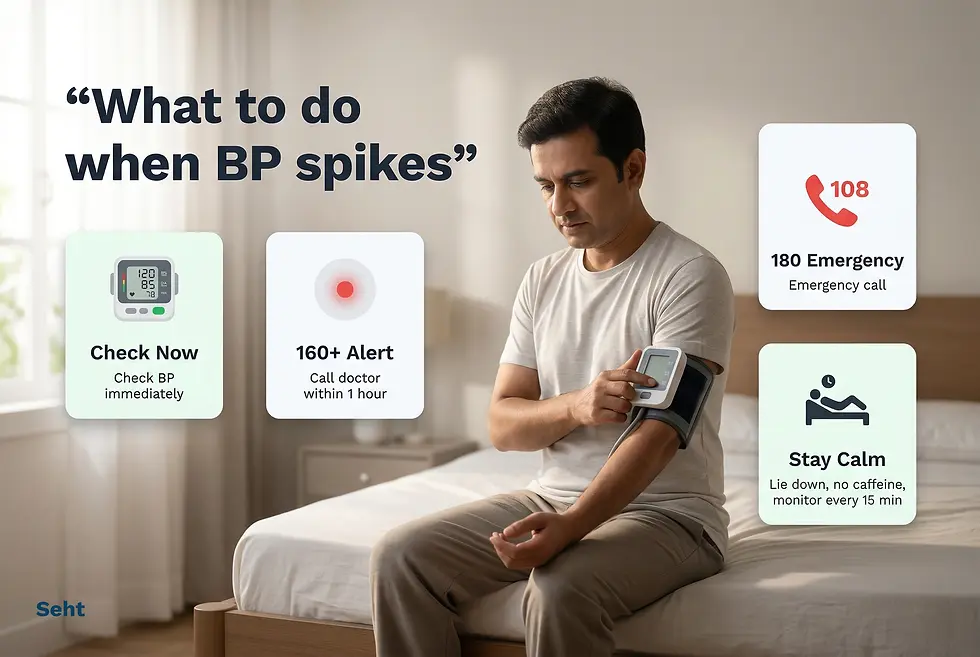
Check your blood pressure immediately if you have a home monitor. Record the reading in Seht with the exact time.
If BP is above 160/100 with any of the above symptoms call your doctor within the hour, not tomorrow.
If BP is above 180/120 mmHg with severe headache, confusion, or chest pain call 108. This is an emergency.
Do not take extra doses of blood pressure medication without medical guidance. Lowering BP too rapidly can cause its own complications.
Lie down quietly, avoid caffeine and exertion, and take readings every 15 minutes while waiting for medical advice.
For guidance on managing blood pressure day-to-day and naturally, read: Managing blood pressure naturally: tips for 45+
When to see a doctor
Any two or more warning signs appearing in the same day or week
Any first-time visual disturbance in a person above 35
Home BP reading above 140/90 mmHg on two consecutive days
Palpitations that last more than 5 minutes or are accompanied by dizziness
Morning headaches that have persisted for more than 3 days in a row
Emergency: Any sudden severe headache with confusion, vision loss, or chest pain call 108 immediately. This is India's emergency number.
FAQs
What are the 7 warning signs of high blood pressure?
The 7 warning signs of high blood pressure that you should never ignore are: morning headaches at the back of the head, blurred or spotty vision, recurrent unexplained nosebleeds, heart palpitations with dizziness, shortness of breath with mild activity, pulsatile tinnitus (ringing in the ears matching the heartbeat), and sudden severe headache with confusion or neck stiffness. The last sign is a medical emergency requiring 108 immediately.
Can you feel high blood pressure?
Most people cannot feel high blood pressure including at dangerously elevated levels. The warning signs listed above appear in a minority of patients, typically when BP is significantly elevated or during an acute spike. This is the central danger of hypertension in India: the absence of feeling is not the absence of damage. The only way to know your blood pressure is to measure it.
What does a blood pressure headache feel like?
A blood pressure-related headache is most commonly described as a throbbing, pulsating pain specifically at the back of the head (occipital area), worse in the morning upon waking, and gradually improving as the day goes on. It is different from tension headaches (band-like pressure around the head) and migraine (typically one-sided with nausea and light sensitivity). If your headache is at the back of your head and is worse on waking, check your blood pressure.
How quickly can high blood pressure cause damage?
Sustained blood pressure above 140/90 mmHg causes measurable arterial damage within months, not years. Hypertensive retinopathy (retinal damage) can develop within 12–18 months of uncontrolled Stage 2 hypertension. Left ventricular hypertrophy (heart wall thickening) develops within 2–5 years of uncontrolled hypertension. Kidney damage (nephrosclerosis) can be detected on laboratory tests within 2–3 years of uncontrolled hypertension.
What should I do if I notice warning signs of high blood pressure at night?
Check your blood pressure immediately with a home monitor. If above 160/100 mmHg with any of the warning signs above call your doctor's emergency contact or go to the nearest emergency room. If BP is 140–159 / 90–99 mmHg without severe symptoms rest quietly, avoid caffeine and exertion, take readings every 30 minutes, and contact your doctor first thing in the morning. Log all readings in Seht with exact times.
Download Seht — free on iOS and Android
When you notice a warning sign of high blood pressure, the last thing you want is to be searching for last month's BP reading. Seht keeps your complete blood pressure log every reading, every date, every time for you and every family member. Share it with your doctor in one tap when it matters most.
Download free:


Sources and references
WHO — Hypertension fact sheet. https://www.who.int
American Heart Association — Understanding blood pressure readings. https://www.heart.org
Indian Ministry of Health & Family Welfare — Standard Treatment Guidelines: Hypertension. https://mohfw.gov.in
Disclaimer: This blog is for informational purposes only and is not medical advice. Seht helps families stay informed, but is not a substitute for professional healthcare guidance.


