Optional vaccines for children in India: worth the cost?


The optional vaccines for children in India are typhoid conjugate, hepatitis A, chickenpox, influenza and meningococcal none are free under the government programme, and together they add roughly ₹12,000 to ₹22,000 to the first five years. Ranked by how much disease they actually prevent in Indian conditions, typhoid conjugate and hepatitis A come first, chickenpox and annual flu next, and meningococcal only for specific risk groups. “Optional” here means optional to the government’s budget, not optional to your child’s protection.
The five optional vaccines for children in India, ranked
Quick answer: If your budget covers only two, buy typhoid conjugate and hepatitis A. Both target diseases spread by water and street food, which is exactly how Indian children get sick, and both give long protection from few doses.
The Indian Academy of Pediatrics recommends all five optional vaccines for children in India for every child. The Universal Immunization Programme funds none of them, which is a budget decision rather than a judgement on their value.
Vaccine | Age due | Doses | Typical private cost per dose | Priority in India |
Typhoid conjugate (TCV) | 9–12 months | 1 + booster at 2 yrs | ₹1,200–₹2,200 | Highest |
Hepatitis A | 12 months, then 18 months | 2 | ₹1,200–₹2,000 | Highest |
Varicella (chickenpox) | 15 months, 4–6 yrs | 2 | ₹1,800–₹2,800 | High |
Influenza | 6 months, then annual | 2 first year, 1/yr | ₹1,000–₹2,000 | High |
Meningococcal (MCV4) | Risk groups, travel, Hajj | 1–2 | ₹3,000–₹4,500 | Situational |
Typhoid conjugate: the one Indian paediatricians argue for hardest
India carries one of the world’s heaviest typhoid burdens, and drug-resistant strains have made treatment slower and more expensive. The newer conjugate vaccine works from 6–9 months of age, protects for several years and replaced the older, weaker polysaccharide version that needed repeating every three years.
One dose at 9–12 months plus a booster around age 2 covers a child through the highest-risk years. Against a single hospital admission for typhoid, the maths is not close.
Hepatitis A: cheap protection against a very Indian infection
Hepatitis A spreads through contaminated water and food. Rising urban hygiene has had an unexpected effect fewer children catch a mild infection as toddlers, so more reach adolescence unprotected, when the illness hits far harder. Two doses six months apart, from 12 months, settle it for good.
Do this now: At your child’s 9-month visit, ask specifically about TCV and hepatitis A. They are often not offered unless you raise them.
Flu, chickenpox and the vaccines worth buying every year
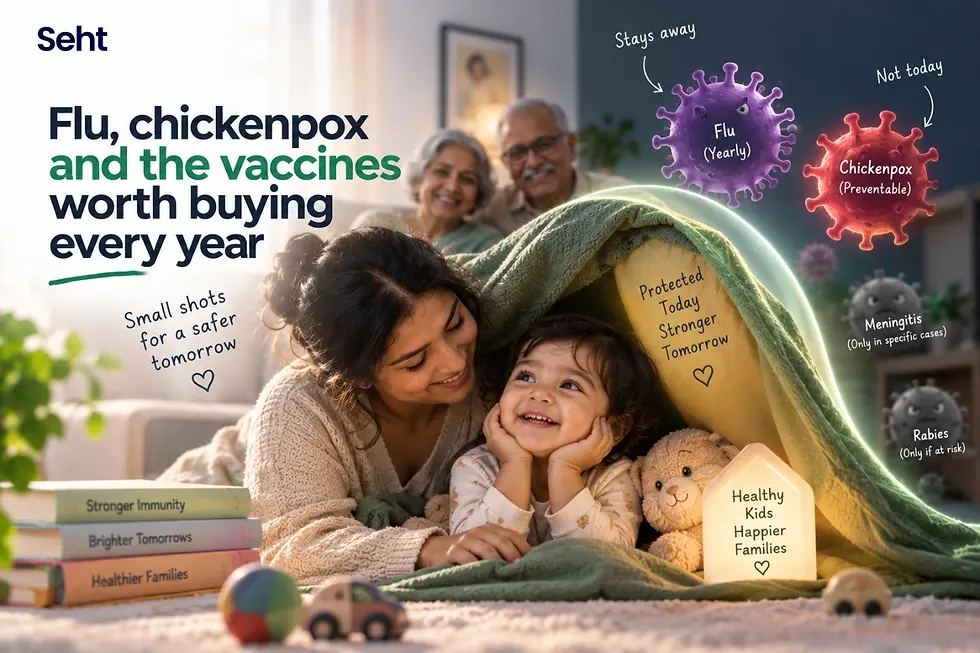
Quick answer: The influenza vaccine is the only childhood shot that must be repeated annually, and it is the most under-used of the optional vaccines for children in India despite being among the most useful for families with elderly members at home.
Why the flu shot earns its ₹1,500
Indian flu seasons run roughly June to September in most of the country, with a second winter peak in the north. Children under five are hospitalised at high rates, and they are the main carriers who bring influenza home to grandparents with diabetes or heart disease.
The first time a child under nine receives it, two doses four weeks apart are needed. After that it is one dose each year, ideally just before the monsoon. Book it as an annual family appointment rather than a one-off.
Chickenpox: not the harmless rite of passage it is assumed to be
Many Indian parents still deliberately expose children to chickenpox. It is a bad bet. Varicella can cause secondary skin infection, pneumonia and, rarely, encephalitis, and the virus stays dormant for life, re-emerging as shingles decades later. Two doses at 15 months and 4–6 years prevent nearly all severe disease.
The optional vaccines for children in India you can reasonably skip
Meningococcal vaccine is not needed for most Indian children. It becomes relevant for travel to the Hajj, for hostel or boarding-school entry in some institutions, during local outbreaks, or for children without a functioning spleen. Similarly, pre-exposure rabies vaccination is worth discussing only if you have dogs at home, live rurally, or have a toddler who plays outdoors unsupervised.
Do this now: Put a recurring reminder in your phone for “family flu shots” in May each year.
Fitting optional vaccines around the free schedule
Quick answer: Optional doses slot into the same visits as the free ones. Nothing needs a separate trip, and giving several vaccines in one sitting is safe — the limiting factor is how many injections you and your baby can tolerate in one morning.
A realistic combined plan
9–12 months: Take the free MR dose at the government centre, then get TCV at a private clinic in the same week.
12 months: Hepatitis A dose 1.
15 months: Varicella dose 1, plus MMR-2 and PCV booster if you are on the private schedule.
18 months: Hepatitis A dose 2, alongside the free DPT and MR boosters due at 16–24 months.
2 years: Typhoid booster; start annual flu doses if you have not already.
If some doses were given free and others privately, the record fragments immediately. Keep everything on one list the full free timeline is in our vaccination schedule for children in India guide, and the private add-ons should sit alongside it.
Combination shots reduce the injection count
Private clinics use hexavalent and other combinations that fold several antigens into one syringe, which is how a child on a full IAP schedule still receives only two or three pricks per visit. The mechanics are explained in our guide to the pentavalent vaccine and its bigger siblings.
The one optional vaccine that became free
HPV was the most expensive optional vaccine on this list until February 2026, when India began offering a free single dose to 14-year-old girls at government facilities. Anyone outside that window still pays privately the eligibility rules are set out in our explainer on the free HPV vaccine India programme.
In simple terms: Some vaccines are free from the government and some you pay for yourself. The paid ones are not extras they protect against typhoid, jaundice and chickenpox, which are common here. If money is tight, buy the typhoid and hepatitis A shots first and ask your doctor about the rest.
When to see a doctor
Speak to a paediatrician before buying any optional vaccine if your child:
Has a weakened immune system, or is on steroids or chemotherapy live vaccines like varicella may be unsafe
Has an egg allergy, which affects the choice of influenza vaccine brand
Had a severe reaction to a previous dose of the same vaccine
Has a chronic condition such as nephrotic syndrome, heart disease, thalassaemia or asthma, which usually raises the priority of flu and pneumococcal protection
Is due to travel abroad or to a high-risk area within the next month
Emergency: A high fever with a stiff neck, a non-fading purple rash, or drowsiness in a child of any age needs emergency care immediately meningococcal disease moves in hours, not days.
FAQs
Are optional vaccines for children in India actually necessary?
They are optional to the government budget, not to your child’s health. The Indian Academy of Pediatrics recommends typhoid conjugate, hepatitis A, varicella and influenza for every child, because these diseases are common here. Families who cannot afford all of them should prioritise typhoid conjugate and hepatitis A, which prevent the infections Indian children catch most often from food and water.
How much do optional vaccines cost in total?
Expect roughly ₹12,000 to ₹22,000 across the first five years in a private clinic, depending on city and brand. Typhoid conjugate runs ₹1,200 to ₹2,200 a dose, hepatitis A ₹1,200 to ₹2,000, varicella ₹1,800 to ₹2,800 and influenza ₹1,000 to ₹2,000 a year. Charitable and trust hospitals often charge substantially less than corporate chains.
Can optional vaccines be given at a government hospital?
Usually not. Government centres stock only the vaccines funded under the Universal Immunization Programme. A few state programmes and municipal hospitals offer additional vaccines at subsidised rates, so it is worth asking locally, but most families buy these at a private paediatric clinic or a trust hospital.
Is it safe to give several optional vaccines on the same day?
Yes. Giving multiple vaccines at one visit is standard practice worldwide and does not overload a child’s immune system. Different injections go into different sites or limbs. The only real constraint is comfort many parents split a heavy visit across two appointments a week apart to reduce the number of pricks at once.
Which optional vaccine should we buy first if money is tight?
Typhoid conjugate vaccine, given from 9 months. Typhoid is widespread in India, increasingly drug-resistant, and a hospital admission costs far more than the vaccine. Hepatitis A comes second, since two doses give long-term protection against a very common waterborne infection. Both are worth more per rupee than any other optional vaccine on the schedule.
Download Seht — free on iOS and Android
Seht lets you store every receipt, prescription and vaccination card for each child in one place, so you know exactly which optional vaccines are done and which are still due.
Download free:


Sources and references
Indian Academy of Pediatrics, Advisory Committee on Vaccines and Immunization Practices — IAP Immunization Timetable and recommendations. https://iapindia.org
World Health Organization — Typhoid conjugate vaccine and hepatitis A position papers. https://www.who.int
Ministry of Health and Family Welfare, Government of India — Universal Immunization Programme vaccine list. https://www.mohfw.gov.in
Indian Council of Medical Research — Antimicrobial resistance surveillance, typhoidal Salmonella. https://www.icmr.gov.in
Disclaimer: This blog is for informational purposes only and is not medical advice. Seht helps families stay informed, but is not a substitute for professional healthcare guidance.


Comments