Vaccination schedule for children in India: 2026 guide


The vaccination schedule for children in India runs from the day of birth to age 16, and the government’s Universal Immunization Programme (UIP) gives every child 27 doses free of cost, protecting against 12 diseases. The core dates are simple: BCG, Hepatitis B and OPV at birth; pentavalent, rotavirus, PCV and polio doses at 6, 10 and 14 weeks; measles-rubella at 9 months and again at 16–24 months; boosters at 16–24 months and 5–6 years; and Td at 10 and 16 years. Everything else chickenpox, hepatitis A, flu, typhoid conjugate is an optional private add-on your paediatrician may recommend.
The vaccination schedule for children in India, age by age
Quick answer: India follows two overlapping schedules the government’s UIP (free, 12 diseases) and the Indian Academy of Pediatrics (IAP) schedule used by private paediatricians, which adds a few vaccines and combines others into fewer injections. Both are safe. Most Indian families end up using a mix of the two.
Here is the full vaccination schedule for children in India as it stands in 2026, with the free doses and the private add-ons side by side.
Age | Free under UIP (government) | Protects against | Common private add-ons (IAP) |
At birth | BCG, Hepatitis B (birth dose), OPV-0 | TB, hepatitis B, polio | Same |
6 weeks | Pentavalent-1, fIPV-1, Rotavirus-1, PCV-1, OPV-1 | Diphtheria, tetanus, pertussis, hep B, Hib, polio, rotavirus, pneumococcus | Hexavalent (6-in-1) instead of pentavalent + IPV |
10 weeks | Pentavalent-2, Rotavirus-2, OPV-2 | As above | Hexavalent-2, PCV-2, IPV-2 |
14 weeks | Pentavalent-3, fIPV-2, Rotavirus-3, PCV-2, OPV-3 | As above | Hexavalent-3, PCV-3 |
6 months | — | — | Influenza dose 1 (then dose 2 after 4 weeks) |
9 months | MR-1, JE-1 (endemic districts), Vitamin A-1 | Measles, rubella, Japanese encephalitis | MMR-1 instead of MR |
9–12 months | — | — | Typhoid conjugate vaccine (TCV) |
12 months | — | — | Hepatitis A dose 1 |
15 months | — | — | MMR-2, Varicella-1, PCV booster |
16–24 months | MR-2, DPT booster-1, OPV booster, JE-2, Vitamin A-2 | Measles, rubella, diphtheria, tetanus, pertussis, polio | Hepatitis A dose 2, DTaP booster |
2 years | — | — | Typhoid booster |
5–6 years | DPT booster-2 | Diphtheria, tetanus, pertussis | Varicella-2, MMR-3 |
10 years | Td | Tetanus, diphtheria | Tdap instead of Td |
14 years (girls) | HPV — single dose, free since Feb 2026 | Cervical cancer | HPV for boys (IAP), 9–14 years |
16 years | Td | Tetanus, diphtheria | — |
Birth to 14 weeks: the doses that matter most
The first 14 weeks carry the heaviest load in the entire vaccination schedule for children in India, and for good reason. A newborn’s own immunity fades fast, and diseases like pertussis and rotavirus are most lethal in the first months.
Two doses here are time-critical.
The hepatitis B birth dose should go in within 24 hours of delivery that single injection dramatically reduces the risk of lifelong chronic infection if the mother is a carrier.
The first rotavirus dose must be given before 15 weeks of age. Miss that window and most paediatricians will not start the series at all, because the safety data for starting late is thin.
If your baby was born early, the rules shift slightly doses are timed by date of birth, not due date. That single point trips up a lot of NICU parents, so we have covered it separately in our guide to vaccination for premature babies.
Do this now: Photograph the hospital discharge summary and the vaccination card on the day you come home. Set three calendar reminders 6, 10 and 14 weeks from the date of birth.
9 months to 2 years: measles, boosters and the drop-off point
This is where Indian immunisation coverage quietly falls apart. Families are diligent for the first three visits, then the gap between 14 weeks and 9 months stretches out, the card goes into a drawer, and the measles-rubella dose slides.
Measles is not a mild childhood rash in India it remains a leading cause of vaccine-preventable death in under-fives. Two MR doses are needed, at 9 months and 16–24 months. A child with only one dose is partially protected at best.
The 16–24 month visit is a busy one: MR-2, the first DPT booster, an OPV booster, Vitamin A, plus JE-2 in endemic districts. Many private paediatricians will also give hepatitis A dose 2 here.
Do this now: If your child is past 9 months and the MR column on the card is blank, book it this week. No prescription is needed at a government centre.
5 to 16 years: the doses families forget
School-age doses have the worst completion rates of anything in the vaccination schedule for children in India, simply because nobody is weighing the child every month any more.
There are four: the DPT booster at 5–6 years, Td at 10 years, Td at 16 years, and new since February 2026 the free single-dose HPV vaccine for 14-year-old girls. The 10-year and 16-year Td doses matter more than parents realise, since tetanus immunity genuinely wanes, and a booster given now saves an emergency injection after every cut and fall later.
For the HPV programme specifics who qualifies, what it costs outside the free window, and how registration works see our full explainer on the free HPV vaccine India rollout.
The same booster logic applies to you: the parents giving these reminders are usually overdue themselves, which is why we built a separate guide to the adult vaccination schedule in India.
Do this now: Write “Td due” in your calendar on your child’s 10th and 16th birthdays. It is the single highest-value reminder you can set.
Missed a dose? Use the catch-up immunization schedule instead of panicking
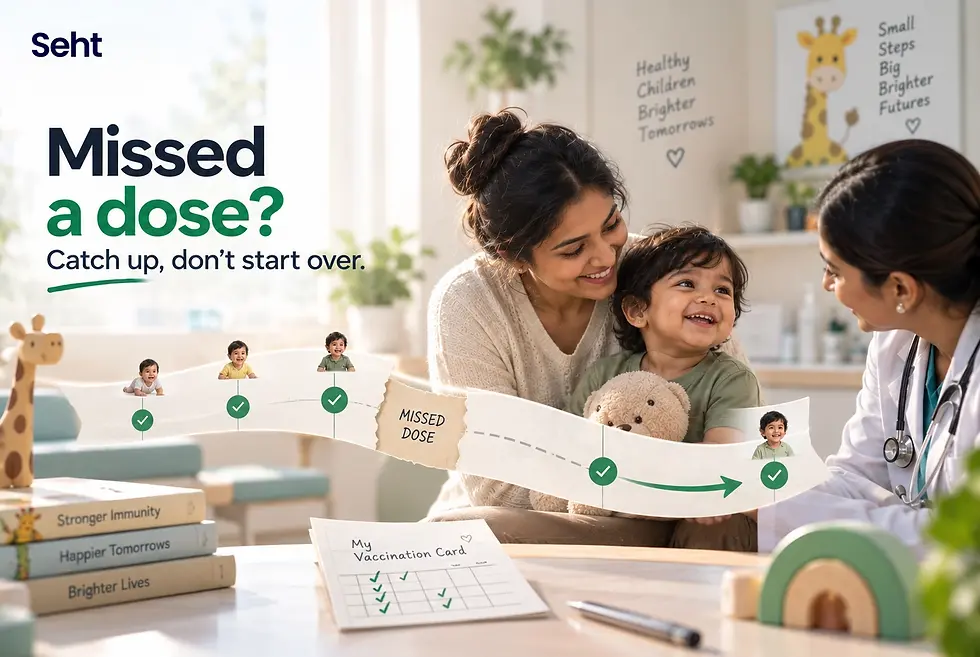
Quick answer: A missed dose is never a restart. Indian and WHO guidance is explicit you resume the catch-up immunization schedule from where you stopped, count the doses already given, and complete the remaining ones at minimum intervals. No child needs to begin the series again.
This is the single most misunderstood rule in the vaccination schedule for children in India. Parents who return after a two-year gap often expect to be told the money and the pricks were wasted. They were not.
The one rule that saves you money: doses already given always count
Immune memory does not expire because a calendar page turned. A pentavalent dose given at 10 weeks still counts three years later. What changes is only the interval the minimum gap before the next dose, usually four weeks for primary series doses and six months for boosters.
There are only a handful of genuine cut-offs in the catch-up immunization schedule:
Rotavirus the first dose must be before 15 weeks; the series must finish by 8 months. Miss it, and it is dropped.
BCG usually given up to 1 year; after that most centres will not give it without a specific indication.
PCV children over 2 years generally need fewer doses, or none if healthy.
Hepatitis B birth dose cannot be recreated, but the remaining series still protects.
Everything else pentavalent, MR, polio, DPT, hepatitis A, typhoid can be caught up well into childhood.
Where to get catch-up doses free
Catch-up is free at any government facility. Ask specifically for the Mission Indradhanush drive, the national programme designed for exactly this children who are partially immunised or have zero doses. Sessions run at anganwadi centres, sub-centres, PHCs and urban health posts, typically on fixed immunisation days each week.
Take whatever record you have, even a torn card or a photo on your phone. If you have nothing at all, a health worker can look the child up on U-WIN by mobile number, and if there is genuinely no record, the standard approach is to treat the child as unimmunised and start a catch-up course which is safe. Extra doses of most routine vaccines do not harm a child.
Do this now: Count the blank rows on the card, take it to the nearest government immunisation session, and ask for a written catch-up plan with dates.
What the vaccination schedule for children in India actually costs
Quick answer: Zero at a government centre. In a private clinic, expect roughly ₹25,000–₹45,000 across the first two years if you take the full IAP schedule with combination vaccines, and ₹1,000–₹3,500 a year after that for flu and boosters.
The gap is not a quality gap. UIP vaccines are the same WHO-prequalified products India exports to the world. What private clinics sell is convenience, fewer injections, painless (acellular) formulations, and a handful of vaccines the government does not yet fund.
Vaccine | Government (UIP) | Typical private cost per dose | Doses needed |
BCG, OPV, Hep B birth dose | Free | ₹200–₹600 | 1 each |
Pentavalent (5-in-1) | Free | ₹1,200–₹2,000 | 3 |
Hexavalent (6-in-1) | Not offered | ₹2,500–₹4,000 | 3 |
Rotavirus | Free | ₹700–₹1,500 | 2–3 |
PCV | Free | ₹1,500–₹3,800 | 3–4 |
MR / MMR | Free (MR) | ₹400–₹900 (MMR) | 2–3 |
Typhoid conjugate | Not offered | ₹1,200–₹2,200 | 1 + booster |
Hepatitis A | Not offered | ₹1,200–₹2,000 | 2 |
Varicella (chickenpox) | Not offered | ₹1,800–₹2,800 | 2 |
Influenza | Not offered | ₹1,000–₹2,000 | Annual |
HPV (girls, age 14) | Free since Feb 2026 | ₹2,000–₹10,500 | 1–3 |
Mixing government and private safely
Most Indian families run the vaccination schedule for children in India as a mix of both, and that is perfectly acceptable. Take the free core doses at the government centre, buy only the add-ons privately. The one rule: keep it all on one record. Splitting doses across a sarkari card and three clinic receipts is how children end up double-dosed or under-dosed.
Before you spend on optional shots, it is worth knowing which ones earn their price in the Indian disease environment our breakdown of optional vaccines for children in India ranks them by real-world value.
Fewer pricks, same protection
Combination vaccines are the reason a modern schedule involves fewer injections than your own childhood did. The pentavalent shot replaced five separate ones; hexavalent replaces six. Parents often worry this “overloads” the immune system. It does not a baby handles more antigens in an afternoon of crawling than in an entire vaccination course. The full explanation sits in our guide to the pentavalent vaccine and what each combination covers.
Proof matters as much as the dose: U-WIN, ABHA and the paper card problem

Quick answer: Since the nationwide rollout of U-WIN, every dose given at a government facility generates a QR-coded, downloadable e-vaccination certificate and that digital record, not the paper card, is what will survive the next decade of school admissions, visa applications and specialist visits.
Every dose in the vaccination schedule for children in India is only as useful as the proof that it happened. The paper card is a beautiful, fragile thing. It fades, tears, gets left at a grandparent’s house, and gets lost in exactly the year your child needs it for Class 1 admission.
What U-WIN gives you
U-WIN (uwin.mohfw.gov.in) is the immunisation successor to Co-WIN, now running nationally, with more than 11 crore children registered. It records every UIP dose against the child’s name and the parent’s mobile number, sends SMS reminders for upcoming doses, and generates a universal e-vaccination certificate with a verifiable QR code. Ask the ANM at every session to confirm the entry was made on U-WIN before you leave.
Child ABHA and the long game
At registration you can also create a child ABHA ID under Ayushman Bharat, linked to a parent’s Aadhaar for children under six. That gives your child a single health identifier that immunisation, hospital and lab records can all attach to over time.
The gap neither one closes
Neither U-WIN nor ABHA captures the private paediatric clinic doses most urban families buy the hexavalent, the flu shot, the chickenpox dose on a printed receipt. That is the record that goes missing. Scanning and storing every card, receipt and prescription in one family folder is the only reliable fix, and it takes about four minutes per visit. It also saves a scramble later, since a vaccination certificate for school admission is usually needed at exactly the point the card has gone missing.
If the card has already gone missing, do not panic it is reconstructable. Our step-by-step guide covers what to do when you have a lost vaccination card, and what proof schools will accept in the meantime.
In simple terms: Your child needs a set of injections at fixed ages, and the government gives most of them free. If you miss one, you never start over you just carry on from where you stopped. Keep one copy of the record where you can always find it, because you will need it for years.
When to see a doctor
Mild fever, a sore thigh and a fussy evening after a vaccine are expected and settle within 48 hours. Take your child to a doctor the same day if you see:
Fever above 40°C, or any fever in a baby under 3 months
Crying that will not stop for more than three hours
A seizure, floppiness, or unusual drowsiness where the child is hard to wake
Swelling at the injection site that spreads beyond the joint, or keeps growing after 48 hours
A hard, hot, red lump with pus a possible injection abscess
Repeated vomiting, blood in the stool or a drawn-up-legs pain pattern in the week after a rotavirus dose
Emergency: Breathing difficulty, swelling of the face or lips, or collapse within minutes of a vaccine needs an ambulance or the nearest emergency room immediately this is anaphylaxis, it is rare, and it is treatable when treated fast.
For the full normal-versus-worrying breakdown, see our guide to vaccine side effects in babies.
Vaccine visits are also the natural checkpoint for growth and development. Most paediatricians use them to check whether your child is sitting, babbling or walking on time our baby developmental milestones checklist tells you what to watch between shots.
FAQs
Is the vaccination schedule for children in India the same at government and private hospitals?
The core is identical. Government centres follow the UIP schedule and give 12 vaccines free. Private paediatricians follow the IAP schedule, which includes everything in UIP plus optional vaccines like typhoid conjugate, hepatitis A, chickenpox and flu, often using combination shots to reduce the number of injections. A child fully vaccinated under UIP is properly protected against the diseases that cause the most deaths in India.
What happens if my child misses a vaccine dose by several months?
Nothing is lost. The catch-up immunization schedule lets you resume from the last dose given doses already received always count, and the series is never restarted. Only rotavirus has a hard cut-off, since the first dose must be given before 15 weeks. Take the card to any government immunisation session and ask for a written catch-up plan.
How many vaccines does a child get under the vaccination schedule for children in India?
Under the Universal Immunization Programme a child receives 27 doses between birth and 16 years, protecting against tuberculosis, polio, diphtheria, pertussis, tetanus, hepatitis B, Hib, rotavirus, pneumococcal disease, measles, rubella and Japanese encephalitis in endemic districts. Girls aged 14 now also receive a free single HPV dose. Private schedules add roughly 8–12 more doses.
Are government vaccines as good as private ones?
Yes. UIP vaccines are WHO-prequalified and made by the same Indian manufacturers that supply much of the world’s vaccine demand. The differences are practical, not protective: private clinics offer combination shots, painless acellular pertussis formulations, fixed appointment times, and vaccines the government does not yet fund.
Can I get a vaccination certificate online in India?
Yes, for doses given at government facilities. U-WIN generates a QR-coded e-vaccination certificate that can be downloaded using the registered mobile number. Private clinic doses are not on U-WIN, so keep those receipts and stamped cards yourself. Schools generally accept either a stamped card or a doctor’s immunisation certificate.
Which vaccines are not covered by the government programme?
Typhoid conjugate, hepatitis A, chickenpox, influenza, meningococcal, rabies (pre-exposure) and hexavalent combination vaccines are not part of UIP. They are recommended by the IAP in specific situations and bought privately. PCV and rotavirus, once private-only, are now free nationwide under UIP.
Download Seht — free on iOS and Android
Seht lets you store every vaccination card, hospital discharge summary and clinic receipt for each family member in one place, so the record is on your phone when a school, a new paediatrician or an emergency room asks for it.
Download free:


Sources and references
Ministry of Health and Family Welfare, Government of India — Universal Immunization Programme and National Immunization Schedule. https://www.mohfw.gov.in
Ministry of Health and Family Welfare — U-WIN digital immunisation platform. https://uwin.mohfw.gov.in
Press Information Bureau, Government of India — Nationwide HPV Vaccination Programme launch, 28 February 2026. https://www.pib.gov.in
World Health Organization — Immunization: India country profile and WHO position papers on routine immunisation. https://www.who.int/india
Indian Academy of Pediatrics, Advisory Committee on Vaccines and Immunization Practices — IAP Immunization Timetable. https://iapindia.org
National Health Authority — Ayushman Bharat Health Account (ABHA). https://abha.abdm.gov.in
Disclaimer: This blog is for informational purposes only and is not medical advice. Seht helps families stay informed, but is not a substitute for professional healthcare guidance.


Comments