Understanding cholesterol in India: when should you be worried?

Updated: Apr 30

Understanding cholesterol in India means recognizing that the standard 'normal range' on your lab report may not tell the whole story for an Indian adult. Indians have a uniquely dangerous cholesterol pattern characterized by borderline LDL, critically low HDL, and high triglycerides that increases cardiovascular risk even when total cholesterol appears normal. This guide explains exactly what your cholesterol numbers mean, which specific values demand immediate action, and what the 2026 ACC/AHA guideline updates mean for Indians.
For the complete guide to heart health, read: Ultimate guide to heart health: Learn how to keep your heart healthy
What you'll learn: • What LDL, HDL, triglycerides, and ApoB actually mean • The cholesterol ranges that matter specifically for Indian adults • Why Indian cholesterol is different from Western patterns • The 2026 AHA guideline changes that affect Indians • When and where to get your cholesterol tested affordably |
What cholesterol actually is and why not all of it is bad
Cholesterol is a waxy, fat-like substance produced by the liver and obtained through food. It is essential for producing hormones, vitamin D, and bile acids for digestion. The problem is not cholesterol itself but cholesterol carried by specific transport particles in the blood particularly LDL particles, which deposit cholesterol into arterial walls and form plaque.
The four key cholesterol measurements

LDL (Low-Density Lipoprotein): The 'bad' cholesterol that deposits plaque in arteries. Lower is better. The primary target for treatment.
HDL (High-Density Lipoprotein): The 'good' cholesterol that carries excess cholesterol back to the liver for removal. Higher is better. India has a serious HDL deficiency problem.
Triglycerides: Fats in the blood that rise with sugar intake, refined carbohydrates, and alcohol. Elevated triglycerides in Indians are strongly linked to the atherogenic dyslipidaemia pattern.
ApoB (Apolipoprotein B): A 2026 ACC/AHA update positions ApoB as a more accurate risk marker than LDL alone. ApoB counts the number of harmful cholesterol particles rather than just the cholesterol amount even if LDL appears normal, high ApoB indicates dangerous particle density.
Cholesterol numbers explained for Indian adults the complete reference
Test | Optimal for Indians | Borderline Concern | High Risk — Action Required |
Total Cholesterol | Below 200 mg/dL | 200–239 mg/dL | 240 mg/dL or above |
LDL Cholesterol | Below 100 mg/dL | 100–129 mg/dL | 130 mg/dL or above; above 160 requires urgent treatment |
HDL Cholesterol | Above 60 mg/dL | 40–59 mg/dL (men), 50–59 mg/dL (women) | Below 40 mg/dL (men), below 50 mg/dL (women) |
Triglycerides | Below 150 mg/dL | 150–199 mg/dL | 200 mg/dL or above |
ApoB | Below 90 mg/dL | 90–110 mg/dL | Above 110 mg/dL |
Non-HDL cholesterol | Below 130 mg/dL | 130–159 mg/dL | 160 mg/dL or above |
LDL/HDL ratio | Below 2.5 | 2.5–3.5 | Above 3.5 |
Why the Indian cholesterol pattern is uniquely dangerous
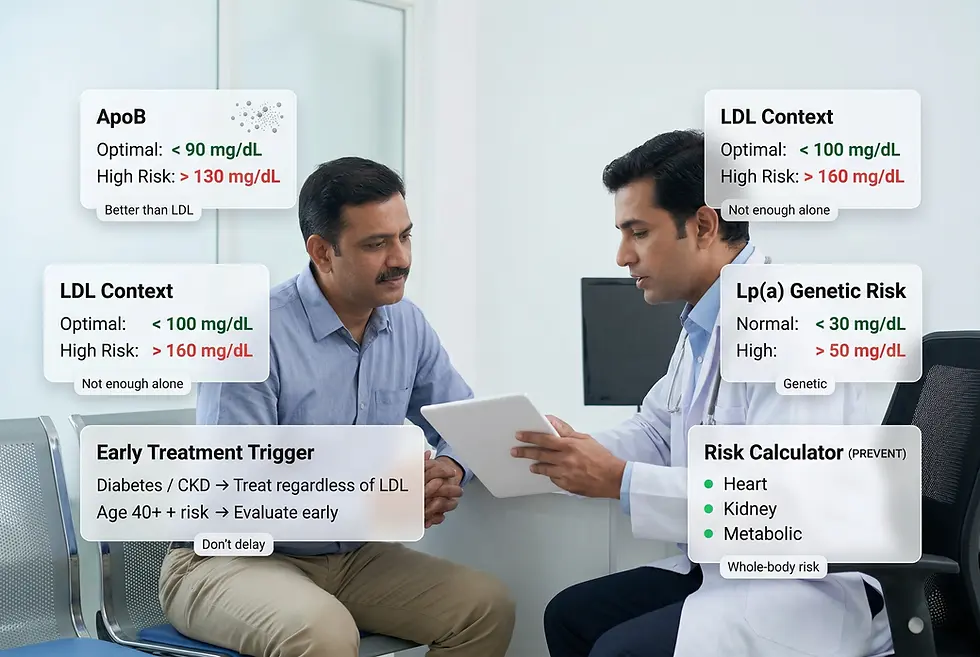
The most alarming finding from the Lancet Southeast Asia review on Indian cardiovascular disease is that Indians develop serious heart disease at cholesterol levels that would not concern a Western cardiologist. The Indian atherogenic dyslipidaemia pattern borderline high LDL (120–140 mg/dL), very low HDL (below 40 mg/dL), and elevated triglycerides (above 175 mg/dL) is more dangerous than high LDL alone. This pattern is driven by genetics and is worsened by the dietary transition from traditional Indian foods to refined carbohydrates and processed oils.
The implication: if your lipid profile shows LDL of 125 mg/dL with HDL of 35 mg/dL and triglycerides of 190 mg/dL a result that might be described as 'borderline' on the lab report an Indian cardiologist should treat this as high risk, not borderline.
In simple terms: Think of LDL as trucks that deliver cholesterol to your artery walls, and HDL as trucks that collect it and take it back to the liver. Indians tend to have too many delivery trucks and not enough collection trucks even when the total 'cholesterol' number looks acceptable. That is why the LDL/HDL ratio matters more than total cholesterol for Indians. |
The 2026 ACC/AHA cholesterol guideline updates what they mean for Indians
The 2026 ACC/AHA cholesterol guidelines introduced several updates that are specifically relevant to Indian adults:
ApoB as a better risk marker: ApoB is now recommended as a more accurate risk indicator than LDL alone. Many Indian adults with 'normal' LDL have elevated ApoB, indicating a higher particle density of harmful cholesterol. If you are Indian, above 40, and have any risk factors, ask your doctor for an ApoB test alongside your standard lipid profile.
PREVENT risk calculator: A new tool that incorporates cardiovascular, kidney, and metabolic health factors together more appropriate than the old ASCVD calculator for Indians who often have metabolic syndrome elements at lower BMI.
Start treatment earlier: The guidelines reinforce beginning cholesterol-lowering treatment earlier in people with diabetes, kidney disease, or HIV all conditions with elevated prevalence in India.
Lp(a) testing: The guidelines now recommend measuring Lp(a) a genetic form of cholesterol that does not respond to lifestyle changes for anyone with a family history of early heart disease.
When to get your cholesterol tested and what to ask for
The Indian guidelines recommend a fasting lipid profile starting at age 30 for anyone with risk factors (family history, diabetes, abdominal obesity, hypertension, or smoking). Without risk factors, begin screening at 35. Frequency: annually if any value is in the borderline or high-risk range; every 3 years if all values are optimal.
Where to test in India: Dr. Lal Path Labs, SRL Diagnostics, Thyrocare, Metropolis Healthcare fasting lipid profile costs ₹300–₹600. Request ApoB and Lp(a) if you have family history of early heart disease (additional ₹200–₹500).
What to ask for: A complete fasting lipid profile (LDL, HDL, total cholesterol, triglycerides), ApoB if applicable, and non-HDL cholesterol calculated from the results.
Preparation: Fast for 10–12 hours before the test. Drink water freely. Avoid alcohol for 24 hours before the test.
For guidance on reducing cholesterol through lifestyle, read: Lifestyle habits that reduce cholesterol naturally in India
When to see a doctor
LDL above 130 mg/dL on any fasting lipid profile
HDL below 40 mg/dL for men or below 50 mg/dL for women
Triglycerides above 200 mg/dL
ApoB above 110 mg/dL
Family history of heart attack or stroke before age 55 in a parent or sibling regardless of your own numbers
Any cholesterol result alongside existing diabetes, hypertension, or kidney disease combined risk requires immediate medical review
FAQs
What cholesterol level is dangerous for Indians?
For Indians, understanding cholesterol means recognizing that the danger lies not just in high LDL but in the combination: LDL above 130 mg/dL, HDL below 40 mg/dL, and triglycerides above 200 mg/dL together constitute the atherogenic dyslipidaemia pattern that is especially dangerous in Indians. LDL above 190 mg/dL on any result is considered very high risk and typically requires medication regardless of other factors.
Does high cholesterol have symptoms?
High cholesterol has almost no symptoms in the vast majority of cases. The only visible sign xanthomas (yellowish fat deposits under the skin around the eyes or on tendons) appears only in severe familial hypercholesterolaemia. For most Indians with dangerously high cholesterol, the first symptom is the heart attack or stroke that results. This is why testing is the only way to know your cholesterol status.
Which cholesterol test should I get in India?
A standard fasting lipid profile provides LDL, HDL, total cholesterol, and triglycerides this is the baseline for all adults. Additionally request ApoB if you have a family history of early heart disease, are above 45, or have borderline LDL with low HDL. Request Lp(a) testing if a parent or sibling had a heart attack before 55. The complete advanced lipid panel costs ₹800–₹1,500 at major Indian diagnostic labs.
Can high cholesterol be reversed with diet in India?
LDL cholesterol can be reduced 20–30% through dietary changes alone specifically reducing saturated fats (vanaspati, full-fat dairy), increasing soluble fibre (dal, oats, methi), and eliminating refined carbohydrates that drive triglycerides. HDL can be raised 10–15% through regular exercise. However, genetic familial hypercholesterolaemia (FH) where LDL is very high due to genetics requires medication regardless of diet.
What is the difference between LDL and non-HDL cholesterol?
LDL cholesterol measures one type of harmful cholesterol particle. Non-HDL cholesterol (total cholesterol minus HDL) captures all the harmful cholesterol particles together including LDL, VLDL, and IDL. Non-HDL is considered a better risk predictor than LDL alone for Indians, particularly those with the high-triglyceride, low-HDL pattern. A non-HDL cholesterol above 160 mg/dL requires treatment regardless of the LDL value.
Download Seht — free on iOS and Android
Your cholesterol numbers tell a story over years, not just at a single point in time. Seht stores all your lipid profiles, HbA1c results, and cardiac lab reports in one place so you and your doctor can see the full trend, not just today's snapshot. Upload your next lipid profile and start building your cholesterol history today.
Download free:


Sources and references
ACC/AHA — 2026 Cholesterol Guidelines. https://www.saaoldelhi.com/blogs/new-cholesterol-guidelines-2026
Lancet Southeast Asia — Cardiovascular disease epidemic in Indians. https://www.thelancet.com/journals/lansea
ICMR — Guidelines for lipid management in Indian adults. https://icmr.gov.in
Disclaimer: This blog is for informational purposes only and is not medical advice. Seht helps families stay informed, but is not a substitute for professional healthcare guidance.


