Why healthy-looking people collapse suddenly — The silent risks Indians miss


He was 38. Gym every morning. Never smoked. Two kids. Last Tuesday, his colleagues watched him collapse in a Bangalore office meeting. He survived barely.
This is not an isolated story. Cardiac arrests in Indians under 45 have risen by nearly 50% over the last decade. Most victims had no prior diagnosis. No warnings in their last health check. No flag on any report.
If you or someone you know exercises regularly, eats reasonably well, and has had a 'normal' checkup this article is essential reading.
Why young, healthy-looking Indians face hidden cardiac risk
Indians carry a genetic cardiovascular burden that most Western risk models simply do not account for. Research consistently shows that South Asians have 3× the risk of heart disease compared to European populations at equivalent cholesterol or blood pressure levels.
What makes this harder to detect:
Visceral fat — the dangerous fat around organs accumulates in Indians even at normal body weight. A lean person with a 'normal' BMI can have dangerously high visceral fat.
Indians tend to have high triglycerides and low HDL cholesterol the most harmful combination even when total cholesterol reads as 'normal'.
South Asian stress hormone patterns (cortisol and adrenaline responses) are more damaging to the cardiovascular system than in other ethnic groups.
Standard Western cardiac risk calculators underestimate Indian risk by a significant margin. A 35-year-old Indian with borderline numbers may have the cardiac risk of a 50-year-old Western patient.
The 6 numbers that actually predict collapse that most Indians never check

Your basic lipid panel is not enough. Here are the markers that actually matter for Indians:
Non-HDL Cholesterol
Not total cholesterol the harmful fraction. Non-HDL cholesterol includes LDL plus all other atherogenic particles. This is what actually builds plaques in arteries. Normal: below 130 mg/dL.
Lipoprotein(a) — Lp(a)
Genetic. Unchangeable by diet or exercise. Elevated Lp(a) is found in a disproportionate number of Indians and dramatically raises cardiac risk. Most standard lipid panels do not include it. Cost: Rs. 800–1,200 at Thyrocare or Dr. Lal PathLabs. Ask your doctor specifically for this test.
Homocysteine
Elevated in Indians especially vegetarians lacking sufficient B12. High homocysteine damages arterial walls and accelerates plaque formation. Normal: below 15 micromol/L.
HbA1c
Silent prediabetes is one of the biggest cardiac risk multipliers. At prediabetes levels, blood sugar is already damaging blood vessels. Normal: below 5.7%. Prediabetes: 5.7–6.4%.
Resting Heart Rate Trend
Not a single reading a trend over weeks. A resting heart rate above 80 bpm consistently, or a gradual rise over months, is a significant marker. Track daily, first thing in the morning.
Blood Pressure Variability
Not a single clinic reading, but the pattern over 2+ weeks of home monitoring. High variability between readings is more dangerous than a consistently elevated reading. Measure morning and evening using a validated device.
Warning signs that appear weeks before — most people miss them
Survivors' families, when interviewed retrospectively, almost always describe signs that were present but dismissed. These are not dramatic symptoms. They are subtle enough to explain away:
Unusual fatigue on exertion more tired than expected climbing stairs or walking briskly
Breathlessness going up 2 flights of stairs when this wasn't previously an issue
Jaw or left shoulder discomfort that comes and goes often dismissed as posture or gym soreness
Persistent headache with any visual changes (blurring, dots)
Awareness of your own heartbeat while sitting still especially in the evening
Important: none of these are diagnostic. They are signals to investigate, not ignore. The presence of two or more together in an otherwise healthy person warrants a cardiac evaluation.
What to do starting this week — The 45-minute health check
The following tests cost between Rs. 2,500–4,000 and can be done with home collection from Thyrocare or Dr. Lal PathLabs:
1. HbA1c — Rs. 180–400
2. Lipid panel with non-HDL cholesterol specified — Rs. 600–1,200
3. Lipoprotein(a) — Rs. 800–1,200 — ask specifically, it is not in standard panels
4. Homocysteine — Rs. 600–1,000
5. ECG — Rs. 200–500 at any clinic if you are above 35
Daily tracking to start immediately:
Morning blood pressure: same time, after 5 minutes seated rest, before chai or coffee
Resting heart rate: from a smartwatch or the BP monitor's pulse reading
If you already use Seht to track daily vitals, add these results to your health profile so trends are visible over time a single reading tells you very little.
When to see a doctor — The threshold for action
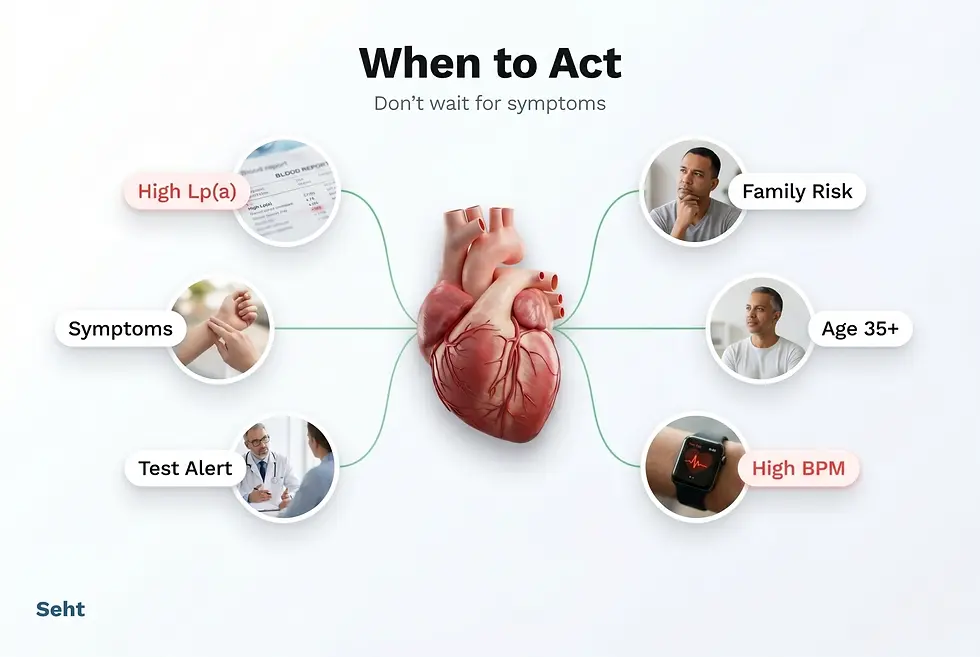
Do not wait for symptoms. See a cardiologist if:
Any of the above tests return elevated results even borderline
Your Lp(a) comes back above 50 mg/dL
You have experienced any of the warning symptoms above
You are above 35 with a family history of heart disease regardless of how healthy you feel
Your resting heart rate is consistently above 90 bpm
An elevated Lp(a) alone warrants discussion of preventive statins and more aggressive monitoring not panic, but a plan.
In simple terms
Young, fit-looking Indians are collapsing from cardiac events at alarming rates not because of bad luck, but because the real risk markers are almost never tested. This article explains what those markers are and how to check them.
Disclaimer: This blog is for informational purposes only and is not medical advice. Seht helps families stay informed, but is not a substitute for professional healthcare guidance.
Download the mobile app:


FAQs
Can young Indians with no family history have cardiac risk?
Yes. South Asian genetics independently elevate cardiovascular risk regardless of family history. Research shows Indians develop coronary artery disease a decade earlier than Western populations and at lower traditional risk factor levels. The absence of family history does not mean low risk it may simply mean the family was not tested.
What is the single most important test for hidden cardiac risk in Indians?
Lipoprotein(a) or Lp(a). It is genetic, cannot be reduced by lifestyle or standard medications, and is found elevated in a disproportionate number of Indians. Most basic lipid panels do not include it. You have to specifically request it from your doctor. Cost is Rs. 800–1,200.
Is daily home tracking actually useful for preventing cardiac events?
Yes, significantly. Consistent daily BP and resting heart rate tracking over 8–12 weeks reveals upward trends that no single clinic reading will catch. Cardiac risk intervention at the trend stage before thresholds are crossed is far more effective and far less expensive than intervention after a cardiac event.
Does being thin or physically fit eliminate cardiac risk for Indians?
No. Indians can carry dangerous levels of visceral fat around abdominal organs at normal body weight. This fat is metabolically active and generates insulin resistance and inflammatory markers that damage the cardiovascular system. BMI is a poor proxy for Indian cardiac risk.
How much does a comprehensive cardiac risk screening cost in India?
A meaningful cardiac risk panel HbA1c, full lipid panel with non-HDL, Lp(a), homocysteine, and an ECG costs between Rs. 2,500–4,000 with home collection from Thyrocare or Dr. Lal PathLabs. This is a one-time annual investment that can literally be life-saving.
What is the best time of day to measure blood pressure accurately?
Morning, before breakfast and before taking any medications, after sitting quietly for at least 5 minutes. This is called 'morning home blood pressure' and is the most accurate predictor of cardiovascular risk. Take two readings, 2 minutes apart, and record the average.


Comments