Vaccination certificate for school admission in India

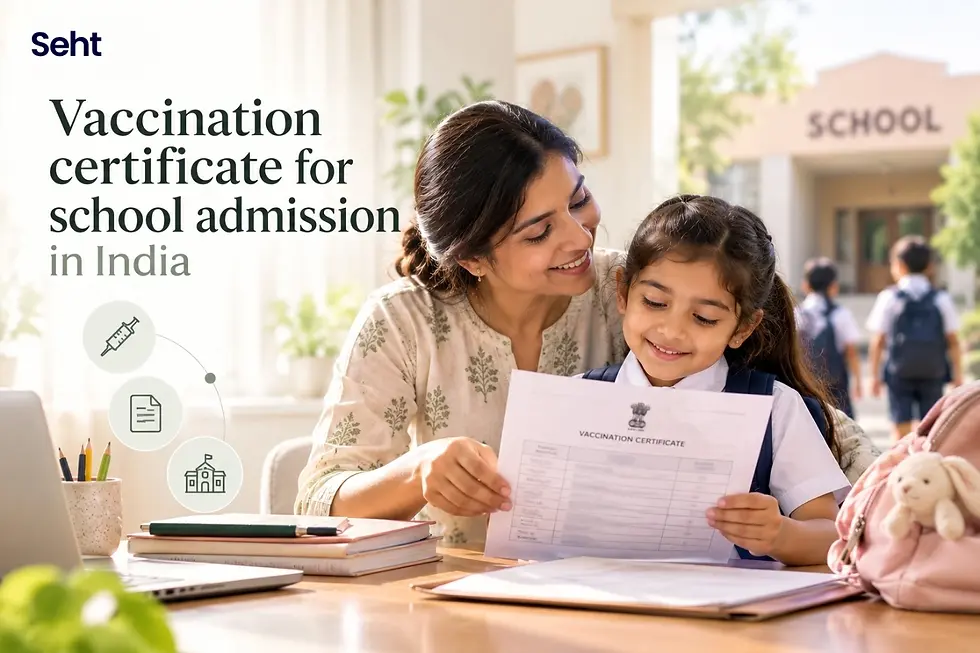
For most Indian schools, a vaccination certificate for school admission means one of three documents: a photocopy of the child’s stamped immunisation card, a certificate on the letterhead of a registered medical practitioner listing vaccines and dates, or a printed U-WIN e-vaccination certificate with its QR code. There is no single national format. Schools set their own requirement, some states insist on proof of full immunisation for Class 1 entry, and a child cannot be denied elementary school admission purely for missing paperwork.
What counts as a vaccination certificate for school admission
Quick answer: Any document from a registered doctor or a government health facility that names the child, lists the vaccines with dates, and carries a signature and stamp. A photocopy of the immunisation card is the most commonly accepted form.
A vaccination certificate for school admission is checking two things: that the child is protected against the diseases that spread fastest in a classroom, and that there is a health record on file in case of an emergency.
Document | Who issues it | Best for | Usually accepted? |
Stamped immunisation card (photocopy) | ANM, PHC or paediatric clinic | Most nursery and Class 1 admissions | Yes |
Certificate on doctor’s letterhead | Any registered medical practitioner | Private-clinic vaccinations, lost cards | Yes |
U-WIN e-vaccination certificate | Government (uwin.mohfw.gov.in) | Government-facility doses, QR verification | Yes |
Medical fitness certificate | Registered practitioner | Schools asking for a general health check | Often required alongside |
Self-written list by parents | — | Nothing | No |
What the certificate must contain
A certificate that gets rejected usually fails on the same details. Make sure yours carries:
1. The child’s full name and date of birth, spelled exactly as on the birth certificate
2. Each vaccine by name, with the date it was given
3. The name and address of the clinic, hospital or health centre
4. The doctor’s signature, registration number and stamp
5. The date of issue
The mismatch that causes the most trouble
Names. If the birth certificate says “Aarav Kumar Sharma” and the vaccination card says “Aarav Sharma”, admission desks flag it. Fix the spelling on the health record before you submit rather than explaining it at the counter with a queue behind you.
Do this now: Lay the birth certificate and the vaccination card side by side and check the name and date of birth match exactly.
What schools and states actually require

Quick answer: There is no uniform national rule. CBSE has directed affiliated schools to collect immunisation records at admission, some states such as Himachal Pradesh require a full-immunisation certificate for Class 1 entry, and most private schools list the immunisation card in their standard document checklist.
The typical nursery and Class 1 checklist
Most schools ask for broadly the same pile of paper. Getting it together in one sitting is far easier than being sent back twice:
Birth certificate from the municipal corporation
Immunisation card photocopy or vaccination certificate
Medical fitness certificate from a registered doctor
Address proof and parents’ identity documents
Passport-sized photographs of the child, and often of the parents
Aadhaar of the child where available
Transfer certificate, for admission beyond entry level
Where full immunisation is a formal condition
Some state governments have tied Class 1 admission to a certificate of complete immunisation under the Universal Immunization Programme, applying the rule to government, private and board-affiliated schools alike. The intent is coverage, not exclusion the practical effect is that parents are asked to complete missing doses rather than turned away.
Before an admission season, it is worth checking your child’s record against the full vaccination schedule for children in India so that any gaps are closed with months to spare.
What the law says about missing documents
Under India’s Right to Education framework, no child may be denied admission to elementary school for want of documents, and the burden is on the school to help enrol the child rather than refuse. That protection is real and worth knowing. It does not mean schools will stop asking it means a missing certificate is a problem to be solved, not a closed door.
Do this now: Ask the school office for its exact document list in writing before the admission window opens.
If the record is incomplete, lost or fragmented
Quick answer: Get a duplicate certificate from the clinic or download the U-WIN certificate, complete any missing doses through a catch-up plan, and submit a doctor’s letter confirming the catch-up is under way. Schools accept work-in-progress far more readily than a blank.
Missing doses before a vaccination certificate for school admission is issued
A child who has missed doses should be started on a catch-up course no vaccine series is ever restarted, and most can be completed in a few visits. A paediatrician’s letter stating which doses have been given and when the remainder are due is normally enough for an admission file.
Lost card
If the card itself is gone, the record usually survives elsewhere: on U-WIN, in the ANM’s register, at the delivery hospital and in your paediatrician’s files. The full retrieval process is set out in our guide for parents dealing with a lost vaccination card.
Records split between government and private care
This is the most common Indian situation free doses at a government centre, optional ones at a private clinic, and no single document listing both. Ask your paediatrician to consolidate everything onto one letterhead certificate. Bring the government card and all clinic receipts to that appointment. Which optional doses you bought, and when, is covered in our guide to optional vaccines for children in India.
In simple terms: Schools want proof that your child has had their injections. A stamped copy of the vaccination card, or a letter from your doctor listing the vaccines and dates, is usually enough. If some doses are missing, get them done and ask the doctor to write a note no school can turn a young child away just for missing papers.
When to see a doctor
Book a paediatric appointment ahead of the admission season if your child:
Has visible gaps in the vaccination card, especially the measles-rubella doses
Has never had a documented DPT booster at 5–6 years, which falls exactly at school-entry age
Has a chronic condition the school should be told about, such as asthma, epilepsy or a severe allergy
Needs a medical fitness certificate, which requires an actual examination rather than a signature
Has a food or insect-sting allergy that will need an action plan filed with the school
Emergency: Any child with a known severe allergy should have an emergency plan and, where prescribed, an adrenaline auto-injector arrangement agreed with the school before the first day, not after an incident.
FAQs
Is a vaccination certificate for school admission mandatory in India?
There is no single national law, but in practice most schools require it. CBSE has instructed affiliated schools to collect immunisation records, several states require a full-immunisation certificate for Class 1 entry, and nearly every private school lists the immunisation card in its admission checklist. Under the Right to Education framework, a child cannot be denied elementary admission solely for missing documents.
Who can issue a vaccination certificate for school admission?
Any registered medical practitioner — your paediatrician, a hospital, or the medical officer at a government health centre. The ANM at your PHC can also stamp and certify the immunisation card. For doses given at government facilities, the U-WIN e-vaccination certificate with its QR code is issued by the government itself and is accepted by most schools.
What if my child has missed some vaccines before admission?
Start a catch-up course immediately and ask the paediatrician for a letter confirming which doses have been given and when the rest are due. Doses already received always count and the series is never restarted, so most gaps can be closed within a few weeks. Schools generally accept a documented catch-up plan in the interim.
Can I use the U-WIN certificate as a vaccination certificate for school admission?
Yes, in most cases. The U-WIN e-vaccination certificate is a government-issued, QR-verifiable document covering doses given at government facilities. Print it and submit it with the admission form. If some vaccines were given privately, add a certificate from that clinic, since private doses are not recorded on U-WIN.
What is the difference between a vaccination certificate and a medical fitness certificate?
A vaccination certificate lists which vaccines a child has received and when. A medical fitness certificate is a doctor’s statement after examining the child, covering general health, vision, any chronic conditions and allergies the school should know about. Many schools ask for both, and a single visit to your paediatrician can produce them together.
Download Seht — free on iOS and Android
Seht keeps every child’s immunisation card, doctor’s certificates and hospital records in one place on your phone, ready to show or share at a school counter.
Download free:


Sources and references
Ministry of Education, Government of India — Right of Children to Free and Compulsory Education Act, 2009, admission provisions. https://www.education.gov.in
Central Board of Secondary Education — Circulars on student health and immunisation records. https://www.cbse.gov.in
Ministry of Health and Family Welfare — U-WIN e-vaccination certificate. https://uwin.mohfw.gov.in
Ministry of Health and Family Welfare — Universal Immunization Programme, National Immunization Schedule. https://www.mohfw.gov.in
Disclaimer: This blog is for informational purposes only and is not medical advice. Seht helps families stay informed, but is not a substitute for professional healthcare guidance.