Vaccination schedule for children in India 2026: complete guide for parents
- Seht Health Team

- Apr 15
- 6 min read

The complete vaccination schedule for children India 2026 covers every immunization from birth through 12 years including both the government's Universal Immunization Program (UIP) vaccines given free at government hospitals and the additional vaccines recommended by the Indian Academy of Pediatrics (IAP). This guide gives you the full age-wise schedule, explains what each vaccine prevents, and tells you exactly what to do if your child has missed a dose.
Track your child's vaccines and never miss a due date: Best app to store family medical records in India 2026
What you'll learn: • Complete age-wise IAP vaccination schedule for 2026 • Which vaccines are free at government hospitals vs paid • What each vaccine protects your child against • What to do if your child has missed a vaccine • How to track and store vaccination records digitally |

Complete vaccination schedule for children in India 2026
This table reflects the IAP immunization schedule India 2026 as recommended by the Indian Academy of Pediatrics. Government (UIP) vaccines are provided free at government hospitals and health centres:
Age | Vaccine | Disease prevented | Free (Govt) or Paid | Notes for parents |
At birth | BCG | Tuberculosis | Free (Govt) | Given within 24 hours of birth |
At birth | OPV-0 | Polio | Free (Govt) | First dose within 24 hours of birth |
At birth | Hepatitis B (Birth dose) | Hepatitis B | Free (Govt) | Within 24 hours — critical for birth dose timing |
6 weeks | DTwP/DTaP-1 | Diphtheria, Tetanus, Whooping cough | DTwP free; DTaP paid (₹300–500) | DTaP has fewer side effects; discuss with paediatrician |
6 weeks | IPV-1 | Polio | Free (Govt) | Injectable form alongside OPV |
6 weeks | Hib-1 | Haemophilus influenzae type b | Paid (₹400–600) | Often in combination DTPwP-Hib-HepB vaccine |
6 weeks | Hepatitis B-1 | Hepatitis B | Free (Govt) | Part of Pentavalent vaccine in Govt schedule |
6 weeks | Rotavirus-1 | Rotavirus diarrhoea | Free at select Govt centres; ₹700–1,200 private | Major cause of severe diarrhoea in infants |
6 weeks | PCV-1 | Pneumococcal disease | Free at select centres; ₹3,000–3,500 private | Protects against pneumonia and meningitis |
10 weeks | DTwP/DTaP-2 + IPV-2 + Hib-2 + HepB-2 | As above (2nd dose) | As above | Maintain 4-week interval from dose 1 |
10 weeks | Rotavirus-2 | Rotavirus diarrhoea | As above | Must complete within age window |
14 weeks | DTwP/DTaP-3 + IPV-3 + Hib-3 + HepB-3 | As above (3rd dose) | As above | Complete primary series by 14 weeks |
14 weeks | PCV-3 | Pneumococcal disease | As above | Third dose completes primary PCV series |
6 months | OPV-1 | Polio | Free (Govt) | Oral polio drops |
6 months | Influenza (optional) | Seasonal flu | Paid (₹700–1,000/year) | Annual dose recommended; especially for at-risk children |
9 months | MMR-1 | Measles, Mumps, Rubella | Free (Govt) | Do not give before 9 months |
9 months | OPV-2 | Polio | Free (Govt) |
|
12 months | Hepatitis A-1 | Hepatitis A | Paid (₹1,200–1,500) | Two doses 6 months apart |
12 months | Varicella-1 | Chickenpox | Paid (₹1,800–2,500) | Two doses recommended by IAP |
15 months | MMR-2 / MMRV | Measles, Mumps, Rubella, Varicella | MMR free; MMRV paid | Booster dose |
15–18 months | DTwP/DTaP booster + IPV booster + Hib booster | Booster doses | As primary series | Critical booster — do not skip |
15–18 months | PCV booster | Pneumococcal disease | As above | Final PCV dose |
18 months | Hepatitis A-2 | Hepatitis A | Paid | Complete 6 months after first dose |
2 years | Typhoid conjugate vaccine (TCV) | Typhoid fever | Paid (₹800–1,200) | Single dose; boosted at age 5 |
4–6 years | DTwP/DTaP booster-2 | Diphtheria, Tetanus, Pertussis | Free (Govt) | Pre-school booster |
4–6 years | OPV booster | Polio | Free (Govt) |
|
4–6 years | Varicella-2 (if not given at 15 months) | Chickenpox | Paid | Second dose |
10–12 years | Tdap / Td | Tetanus, Diphtheria, Pertussis | Paid (₹400–600) | Adolescent booster |
10–12 years | HPV (girls and boys) | Cervical cancer, HPV-related cancers | Paid (₹2,500–3,500/dose) | 2 doses 6 months apart; IAP now recommends for all genders |
Government (free) vs paid vaccines: what you need to know
The government vaccination schedule India (UIP) covers the most critical vaccines free of cost at government hospitals, CGHS centres, and urban health centres. However, the IAP immunization schedule India 2026 recommends additional vaccines particularly PCV, Rotavirus, Varicella, Hepatitis A, and HPV that are not yet universally free but are strongly recommended by paediatricians.
The additional paid vaccines cost between ₹700 and ₹3,500 per dose. For most families, the total cost of completing the full IAP schedule is approximately ₹15,000–₹25,000 over 12 years a significant but worthwhile investment given the diseases prevented.
What to do if your child has missed a vaccine
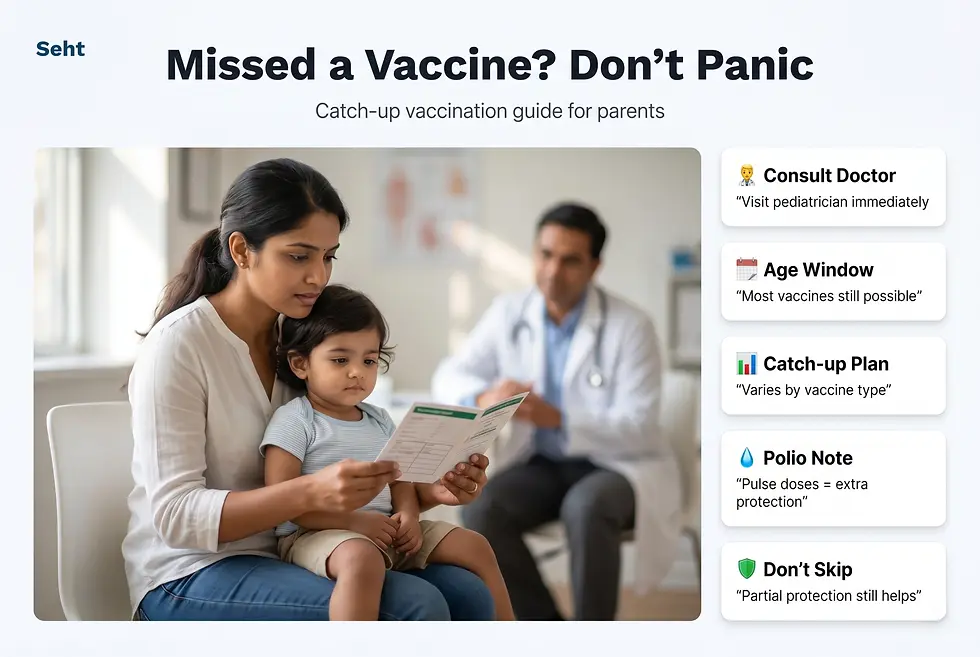
Missing a dose in the vaccination schedule for children India 2026 does not mean starting over. Pediatricians follow a 'catch-up' schedule:
Consult your pediatrician immediately do not wait for the next scheduled visit
Most vaccines can be given up to a certain age window your doctor will confirm what is still applicable
The catch-up schedule varies by vaccine: some can be given at any age, others have upper age limits
For polio specifically: pulse polio drops given at national immunization days count as additional doses
Never skip a vaccine permanently just because a dose was missed the benefit of partial immunization is still significant
In simple terms: India's vaccination schedule for children has two layers: the government's free UIP vaccines (covering the most critical diseases) and the IAP's additional recommended vaccines (paid but strongly advised). Missing a dose is not a crisis — but it must be caught up promptly. Your pediatrician's advice takes priority over any online schedule. |

Common vaccine side effects and what is normal
Normal reactions (no cause for concern)
Mild fever (up to 38.5°C) for 1–2 days after DTP, MMR, or PCV
Redness, swelling, or tenderness at the injection site for 24–48 hours
Irritability and reduced feeding for 1–2 days
A small lump at the BCG injection site this is expected and normal
When to call a doctor immediately
Fever above 39°C or fever lasting more than 3 days
Persistent crying for more than 3 hours after vaccination
Seizures or convulsions
Difficulty breathing, facial swelling, or hives these indicate a possible allergic reaction and require emergency care
How to track your child's vaccination records
The most common reason children miss vaccines is that parents lose track of what was given and what is due. A child vaccine tracker India app like Seht solves this completely:
Create a profile for your child in the Seht app and enter their date of birth
Upload the vaccination certificate from your hospital or government health centre Seht auto-reads the vaccine names and dates
Seht generates the complete due vaccine schedule based on your child's age and vaccines already received
Set reminders 1 week before each due date so you never scramble at the last minute
Share the vaccination record digitally with school admissions, camp registrations, or travel health requirements
When to see a doctor
See your pediatrician immediately if:
Your child has an allergic reaction to a vaccine hives, facial swelling, or breathing difficulty within 30 minutes of injection
Your child has a fever above 39°C that does not respond to paracetamol within 24 hours post-vaccination
Your child has a seizure following any vaccination
You are unsure whether a previous vaccine was genuine some private clinics have been known to administer expired or improperly stored vaccines
FAQs
What vaccines are free for children in India?
The government vaccination schedule India (UIP) provides BCG, OPV, Hepatitis B, DTP, IPV, MMR, and Vitamin A free at all government hospitals and health centres. Rotavirus, PCV, and Hepatitis A vaccines are free at select government facilities in states that have introduced them in the state schedule.
What is the IAP vaccination schedule for 2026?
The IAP immunization schedule India 2026 is the comprehensive schedule published by the Indian Academy of Pediatrics, including both government UIP vaccines and additional recommended vaccines like PCV, Rotavirus, Varicella, Hepatitis A, Typhoid conjugate, and HPV. The full schedule runs from birth through 15 years.
What happens if my child misses a vaccine?
Missing a dose in the vaccination schedule for children India 2026 requires a catch-up consultation with your pediatrician. Most vaccines can be given on a delayed schedule. Do not skip a vaccine permanently even late vaccination provides significant protection against serious diseases.
Are paid vaccines necessary if government vaccines are free?
The government UIP covers essential vaccines but not all childhood vaccines India age-wise recommended by pediatricians. PCV (pneumonia protection), Rotavirus (prevents severe diarrhea), Varicella (chickenpox), and HPV (cervical cancer prevention) are strongly recommended by the IAP and worth the additional cost for families who can afford them.
How do I keep track of my child's vaccination records?
Use the Seht app as your child vaccine tracker India. Upload your child's vaccination certificate, and Seht generates a complete due-date schedule with reminders. The digital record is accessible instantly for school admissions, travel, or doctor visits far more reliable than a paper booklet.
Download Seht — free on iOS and Android
Never miss a vaccination date again. Seht is the most complete child vaccine tracker India free for all family members on iOS and Android.
Download:


Sources and references
Indian Academy of Pediatrics (IAP) — Immunization Schedule 2026 — iapindia.org
Universal Immunization Program — Ministry of Health and Family Welfare, India — mohfw.gov.in
World Health Organization — Immunization schedules — who.int
Disclaimer: This blog is for informational purposes only and is not medical advice. Seht helps families stay informed, but is not a substitute for professional healthcare guidance.


Comments