Health checkup for women over 35 in India: what tests are essential
- Seht Health Team

- May 6
- 7 min read
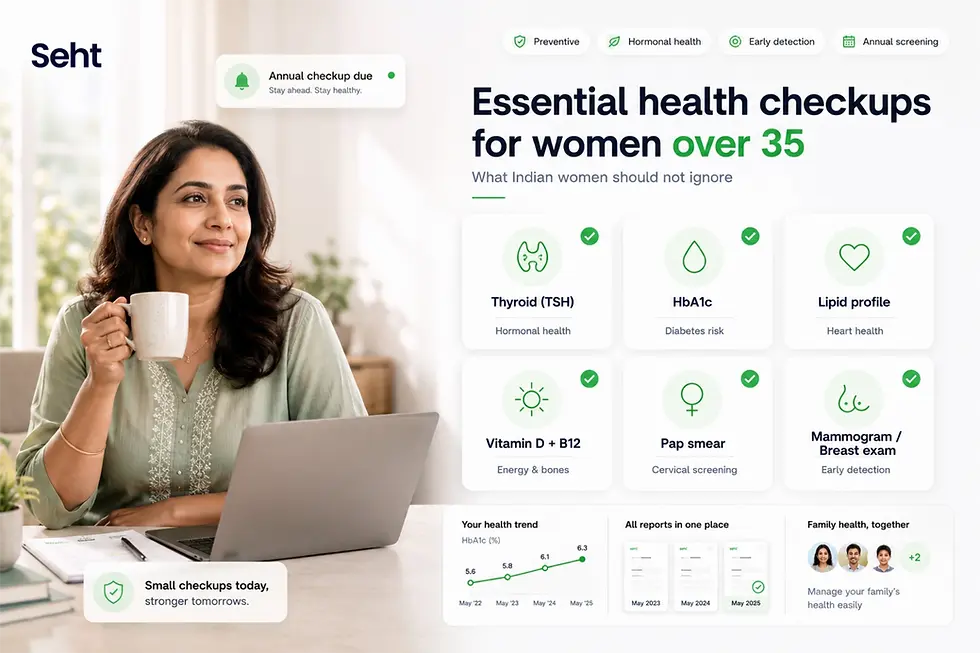
The health checkup for women over 35 in India requires a specific set of tests that goes significantly beyond the standard full body panel because Indian women face a unique combination of high-prevalence conditions: thyroid disorders, anaemia, PCOD, early cardiovascular disease, cervical cancer, and osteoporosis. According to Dr. Bhumika Maikhuri, Gynaecologist at Apollo Hospitals Ahmedabad, 'Many conditions like anaemia, thyroid imbalance, or vitamin deficiencies develop silently and may go unnoticed until they begin affecting overall well-being.' This guide ensures no silent condition goes undetected.
For the complete guide to family health packages and costs, read: health checkup packages for family India 2026 (https://www.seht.in/post/health-checkup-packages-family-india-2026)
What you'll learn: • The 14 essential health tests for Indian women over 35 • Why each test matters specifically for women in India • When to start Pap smear, mammogram, and bone density screening • The PCOD and thyroid tests most Indian women are missing • Approximate costs at major Indian labs with home collection options |
Why women over 35 in India need a different health checkup
Women in India face a health paradox: they manage health for their entire family while consistently delaying or skipping their own checkups. Only 37% of women in India have access to quality healthcare compared to 67% of men. And when women do get checked, they often receive the same generic panel as men missing the tests most critical for female-specific conditions.
The conditions that most frequently go undetected in Indian women over 35:
Thyroid disorders: About 42 million Indians are estimated to have thyroid disease, with women affected disproportionately especially in the 30–55 age group
Anaemia: Caused by iron deficiency, nutritional deficiency, or chronic disease affects a large proportion of Indian women and is often dismissed as 'normal tiredness'
PCOD: Affects 8–13% of women of reproductive age globally; up to 70% of cases are undiagnosed in India. Directly linked to insulin resistance and diabetes risk.
Cervical cancer: India has one of the highest cervical cancer rates in the world yet only a fraction of Indian women have ever had a Pap smear
Vitamin D and B12 deficiency: Affects the majority of urban Indian women due to indoor lifestyles and predominantly vegetarian diets
The 14 essential health tests for Indian women over 35
Test | What it detects | When to start | Frequency | Cost at NABL lab |
Haemoglobin (CBC) | Iron deficiency anaemia most common deficiency in Indian women | From any age | Annually; every 6 months if anaemic | ₹150–₹350 (CBC) |
Ferritin + iron studies | Iron stores more sensitive than haemoglobin alone for early deficiency | From age 20 | Annually | ₹400–₹700 |
TSH (Thyroid) | Thyroid dysfunction: hypothyroidism, hyperthyroidism, autoimmune thyroiditis | From age 35 | Annually; 6-monthly if on thyroid medication | ₹200–₹400 |
Free T3, Free T4, Anti-TPO antibodies | Full thyroid picture; Hashimoto's autoimmune thyroid disease | If TSH abnormal or symptoms present | As directed by endocrinologist | ₹600–₹1,200 |
HbA1c + Fasting glucose | Type 2 diabetes and prediabetes PCOD increases diabetes risk 3–7x | From age 30 (earlier if PCOD) | Annually | ₹300–₹600 |
Full lipid profile | Cardiovascular risk; women's risk rises sharply approaching menopause | From age 35 | Annually | ₹300–₹600 |
Vitamin D (25-OH D) | Bone health, immunity; deficiency near-universal in urban Indian women | From age 25 | Annually | ₹500–₹900 |
Vitamin B12 | Neurological function; deficiency common in vegetarian Indian women | From age 30 | Annually | ₹300–₹600 |
Pap smear (cervical cytology) | Cervical cancer early detection; pre-cancerous cell changes | From age 30 | Every 3 years (or every 5 with HPV co-test) | ₹300–₹800 |
HPV DNA test | High-risk HPV strains cause 99% of cervical cancers | From age 30 (combined with Pap) or age 35 independently | Every 5 years if normal | ₹800–₹2,000 |
Mammogram (bilateral) | Breast cancer screening India's rising incidence in younger women | From age 40 (earlier if family history) | Annually or every 2 years | ₹800–₹2,500 |
Breast ultrasound | Denser breast tissue more sensitive than mammogram in young Indian women | From age 35 if any symptom or family history | As directed by doctor | ₹600–₹1,500 |
DEXA scan (bone density) | Osteoporosis screening accelerates with oestrogen loss from perimenopause | From age 45 (earlier if risk factors) | Every 2–3 years from perimenopause | ₹1,500–₹3,000 |
FSH, LH, AMH (Antimullerian hormone) | Ovarian reserve; perimenopause assessment; PCOD hormonal profile | When irregular cycles appear or from age 40 | As directed by gynaecologist | ₹600–₹1,500 |
In simple terms: Most Indian women who get a health checkup receive the same blood panel as their husband. That panel misses the tests women specifically need: thyroid antibodies, Pap smear, iron stores, PCOD hormone profile, and breast and cervical cancer screening. A woman's health checkup after 35 is a clinically different set of tests not a generic blood panel with a pink brochure. |
Cervical and breast cancer screening: the most neglected tests in India
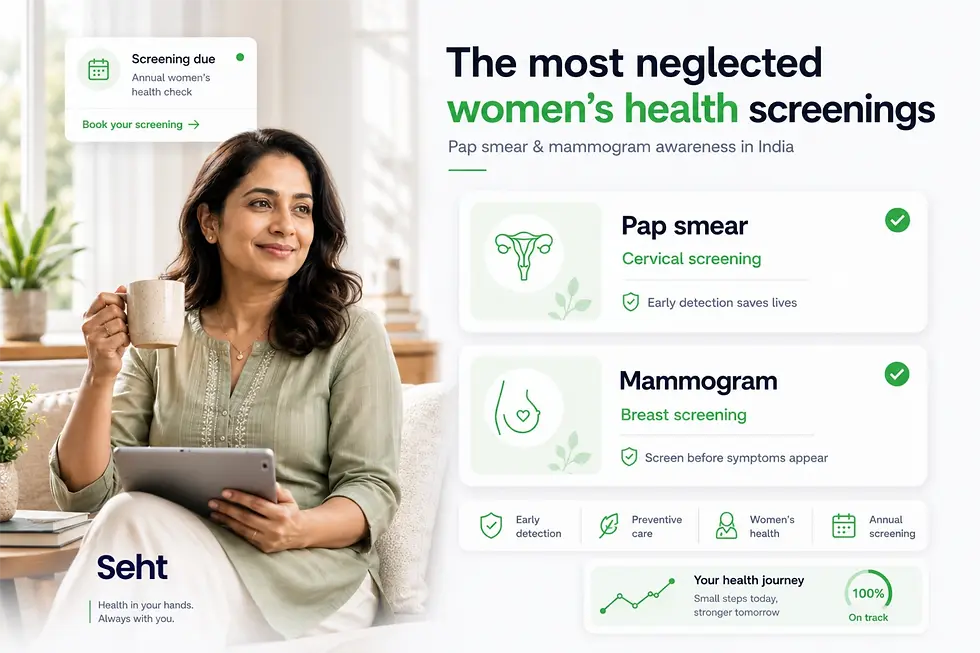
Pap smear India's most critical underutilised test
India has one of the highest rates of cervical cancer in the world, yet the Pap smear the gold standard for early detection is among the least utilised preventive tests in the country. The WHO recommends Pap smear screening starting at age 30, every 3 years. An HPV DNA test every 5 years from age 30–35 offers even greater sensitivity. Cost: ₹300–₹800 at Apollo, Fortis, or any government hospital's gynaecology clinic. CGHS beneficiaries can access these free at empanelled hospitals.
Mammogram when and why
Women aged 40 and older should get a mammogram every 1–2 years. Women with a family history of breast cancer should discuss earlier screening often from age 35 with their doctor. In India, where breast tissue tends to be denser, breast ultrasound is often used alongside mammogram, particularly in women under 45. Cost: ₹800–₹2,500 at hospital radiology departments in major Indian cities.
PCOD and thyroid: the two conditions most missed in Indian women

PCOD screening beyond just a scan
Many women are told 'your ultrasound is normal, so you don't have PCOD.' This is incorrect. PCOD diagnosis under the Rotterdam Criteria requires two of three findings: irregular or absent periods, excess androgen evidence, and polycystic ovaries on ultrasound. Blood tests essential for PCOD evaluation:
Fasting insulin and HbA1c: Insulin resistance present in 50–70% of Indian women with PCOD
Total testosterone and DHEA-S: Androgens elevated in PCOD
LH/FSH ratio: Typically elevated in PCOD (greater than 2:1)
AMH (Antimullerian hormone): Elevated in PCOD; also assesses ovarian reserve
Fasting lipid profile: Dyslipidaemia (low HDL, high triglycerides) characteristic of PCOD-related metabolic syndrome
Cost of PCOD panel at Dr. Lal Path Labs, SRL, or Metropolis: approximately ₹1,500–₹2,500.
Thyroid beyond TSH what Indian women over 35 need
TSH alone misses autoimmune thyroid disease (Hashimoto's thyroiditis) the most common cause of hypothyroidism in Indian women. Women with TSH slightly outside normal range or with symptoms benefit from Anti-TPO antibody testing. Anti-TPO positive + borderline TSH indicates autoimmune thyroid disease that will likely progress to overt hypothyroidism and can be managed proactively with early intervention.
For understanding your blood test results once reports arrive, read: Normal blood test results explained for Indian patients
When to see a doctor
Abnormal Pap smear result: Schedule colposcopy within 4–6 weeks as recommended by your gynaecologist
TSH above 4.5 mIU/L, especially with fatigue, weight gain, or hair loss endocrinologist referral
Haemoglobin below 10 g/dL do not self-supplement with iron without testing for cause
Any breast lump, nipple discharge, or skin change same-week gynaecologist or surgical appointment
Irregular periods with weight gain, facial hair, acne, or difficulty conceiving PCOD evaluation with gynaecologist
Emergency: Heavy menstrual bleeding causing dizziness or fainting, or sudden severe pelvic pain requires immediate emergency care call 108 or go directly to casualty.
FAQs
What health tests are essential for Indian women over 35?
Essential health tests for Indian women over 35 are: CBC with haemoglobin and ferritin (anaemia), full TSH with anti-TPO antibodies (thyroid), HbA1c and fasting glucose (diabetes), full lipid profile (cardiovascular), Vitamin D and B12, Pap smear from age 30, mammogram from age 40, and PCOD hormone panel (FSH, LH, testosterone, AMH, fasting insulin) for any menstrual irregularity. A comprehensive women's health package at Dr. Lal PathLabs or Metropolis covering most of these costs ₹3,500–₹6,000.
At what age should Indian women start getting Pap smears?
The WHO and Indian gynaecology guidelines recommend starting Pap smear screening at age 30 for all sexually active Indian women, repeated every 3 years. An HPV DNA test every 5 years from age 30–35 provides even more sensitive cervical cancer screening. Pap smear is available free at government hospitals in most Indian states for women under 65.
What is the best health checkup package for women over 40 in India?
Women over 40 need a package that includes: full blood panel (CBC, lipids, HbA1c, thyroid, vitamins), Pap smear or HPV test, mammogram, breast ultrasound, and bone density assessment. Hospital-based women's wellness packages at Apollo, Fortis, or Manipal cost ₹5,000–₹9,000. Lab-only packages at Dr. Lal PathLabs, SRL, or Metropolis cover blood tests for ₹2,500–₹4,500; imaging must be booked separately.
Can Indian women book a health checkup without a prescription?
Yes. All blood tests CBC, thyroid, glucose, lipids, vitamins, and hormone panels can be booked at NABL labs without a prescription. Pap smear requires a gynaecologist consultation. Mammogram and DEXA scan are booked at radiology centres; some require a referral. Home collection services from Thyrocare, Redcliffe, Dr. Lal, and SRL collect blood samples for the full panel without a prescription.
Why do Indian women over 35 need thyroid testing every year?
Thyroid disorders particularly hypothyroidism and Hashimoto's autoimmune thyroiditis are significantly more prevalent in Indian women than in men and peak in the 35–55 age group. Hypothyroidism can cause unexplained weight gain, fatigue, hair loss, irregular periods, and depression symptoms frequently attributed to 'stress' or 'perimenopause' rather than tested. Annual TSH with anti-TPO antibodies ensures early detection and treatment.
Download Seht — free on iOS and Android
As an Indian woman managing your family's health, you deserve a tool that stores your own health history as carefully as you track everyone else's. Seht gives you a secure profile for your Pap smear results, thyroid reports, mammogram findings, PCOD hormone panels, and everything else so your health story is never lost.
Download free:


Sources and references
Medical Dialogues — Women's Day 2026: essential health tests every Indian woman should undergo. https://health.medicaldialogues.in/health-topics/women-health
MASSH — 8 essential preventive health checkups for Indian women. https://massh.in
Apollo 24/7 — Women's health statistics India. https://www.apollo247.com
Rainbow Hospitals — Health screening: essential tests every woman should know. https://www.rainbowhospitals.in
Disclaimer: This blog is for informational purposes only and is not medical advice. Seht helps families stay informed, but is not a substitute for professional healthcare guidance.


Comments