How long should you keep medical records in India? The definitive guide
- Seht Health Team

- 4 days ago
- 6 min read

How long you should keep medical records in India depends on the record type and the answer is almost always longer than most Indian families assume. For records involving chronic conditions, the answer is permanently. For lab reports, 3–5 years minimum. For prescriptions, 1–2 years for standard medications and indefinitely for chronic conditions. For discharge summaries and surgical records, permanently. This guide gives you the exact retention period by record type, the legal requirements under India's consumer protection and DPDP Act framework, and what you can safely delete.
For the complete guide to storing and organizing records once you know what to keep, read: store medical records digitally India (https://www.seht.in/post/store-medical-records-digitally-india-2026)
What you'll learn: • Exact retention periods for 10 types of Indian medical records • What the DPDP Act 2023 says about personal health data retention • The insurance claim rules that determine how long you need specific records • What records to keep permanently regardless of age • The safe disposal procedure for paper records you no longer need |
Medical record retention in India: the complete guide by type
Record type | Minimum to keep | Recommended to keep | Keep permanently | Reason for retention period |
Lab reports, routine annual (CBC, lipids, thyroid, glucose) | 3 years | 5 years | If managing chronic conditions | Trend analysis for chronic disease management requires multi-year data; insurance claims may require up to 3 years of history |
HbA1c, creatinine, TSH (chronic condition markers) | 5 years | 10 years | Yes, if actively managing diabetes, kidney disease, or thyroid | Year-over-year trend is the primary clinical tool for managing these conditions; losing history erases the trend |
Blood group confirmation | Permanently | Permanently | Yes, always | Blood group does not change; confirmed blood group is emergency-critical information |
Prescriptions, acute illness (antibiotic, short-term) | 1 year | 2 years | No | Reference for prescribing history; low clinical value after the condition resolves |
Prescriptions, chronic condition (diabetes, hypertension, thyroid) | 5 years | 10 years | Yes, indefinitely | Medication history is critical for any future specialist; prescribing patterns reveal treatment response over time |
Hospital discharge summaries | 5 years minimum | 10 years | Yes, all major hospitalisations | Required for insurance claims; critical context for any subsequent specialist or hospitalisation |
Surgical and procedure records | Permanently | Permanently | Yes, always | Anaesthesia protocol for any future surgery requires surgical history; implant records are permanently critical |
Imaging reports (X-ray, CT, MRI, ultrasound) | 5 years | 10 years | Yes, for cardiac, oncology, orthopaedic imaging | Comparison imaging requires previous films; a cardiac CT from 5 years ago is relevant context for a new scan |
Vaccination records, children | Permanently | Permanently | Yes, always | School entry, travel, boosters, and lifetime immunity record; cannot be reconstructed if lost |
Vaccination records, adults and elderly | 5 years | Permanently | Yes | Booster schedules and travel vaccination history; influenza and pneumococcal records for elderly care |
Insurance EOBs and receipts | 3 years | 5 years (until tax period closes) | No | Section 80D tax deduction claims; insurance dispute resolution |
In simple terms: The practical rule for Indian families: never delete anything related to a chronic condition, a surgery, or a vaccination. Delete freely only short-term illness prescriptions that are more than 3 years old and have no ongoing relevance. When in doubt, keep it digital storage is essentially free, and the cost of deleting a record you later need is always higher than the cost of keeping it. For elderly parents, the default is permanent retention of everything. |
What India's DPDP Act 2023 says about health record retention
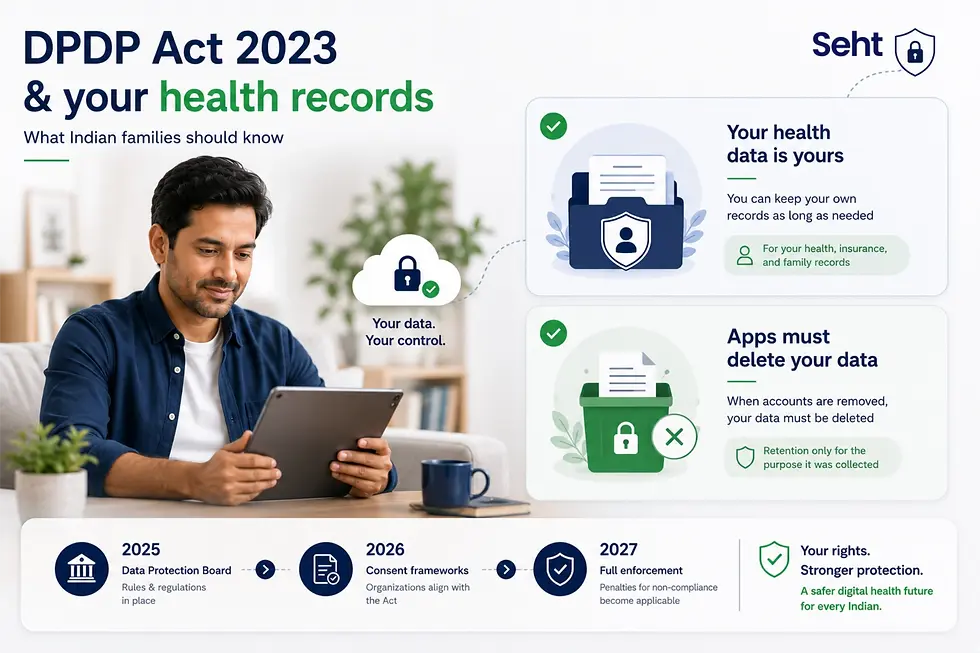
India's Digital Personal Data Protection Act 2023 includes a purpose-limitation principle: personal data (including health data) should only be stored as long as necessary for the stated purpose. For individuals storing their own health records, this principle works in your favour you have the right to retain your own health data as long as you have a legitimate personal purpose (managing your health, supporting insurance claims, maintaining a family health record). No external entity can require you to delete your own records.
For healthcare providers and apps handling your data: the DPDP Act requires that companies establish clear retention policies and delete data when the purpose for which it was collected is complete. This means if you delete your account from a health records app, the company must delete your data. Under Phase 3 enforcement (May 2027), retention and erasure obligations become enforceable with penalties.
Insurance rules that determine retention periods in India
Health insurance claim rules in India are the most practically important driver of medical record retention:
Pre-existing condition disputes: Health insurance companies in India may dispute claims by arguing a condition was pre-existing and not disclosed. A complete medical record going back to the condition's first appearance is the definitive evidence in your favour. Losing records from before the policy start date leaves you without defence in a dispute.
Section 80D deduction: The Rs 5,000 preventive health checkup deduction under Section 80D requires receipts. Keep all health-related receipts and diagnostic lab invoices for at least 3 years (the standard income tax assessment period).
Group insurance and employer health benefits: Claims under employer group policies may be audited up to 2–3 years after the claim. Retain all supporting documentation for this period.
CGHS and government health scheme records: For CGHS beneficiaries and government employees, retain all health records for the duration of service and for 5 years after retirement claims disputes can arise years after treatment.
What records to keep permanently no exceptions

Blood group confirmations for every family member
Known drug and food allergy records with severity documentation
All surgical and procedure records implant cards, operation notes, anaesthesia records
All vaccination records especially childhood vaccination books and COVID-19 vaccination certificates
All discharge summaries from major hospitalizations heart attack, stroke, major surgery, serious infections
All diagnostic reports confirming a chronic condition the first HbA1c confirming diabetes, the first TSH confirming hypothyroidism, the first creatinine confirming kidney disease
Any genetic or hereditary condition documentation affects children, grandchildren, and future generations' risk assessment
For the guide to digitizing and safely storing paper records before disposing of them, read: How to digitize old paper prescriptions and lab reports in India (https://www.seht.in/post/digitise-paper-prescriptions-lab-reports-india)
How to safely dispose of paper medical records you no longer need
Paper medical records contain sensitive personal health information. Simply discarding them in a dustbin creates a privacy risk. Safe disposal options in India:
Shredding: A cross-cut paper shredder (Rs 2,000–5,000) is the most reliable home disposal method for paper health records. Available at most stationery and electronics retailers.
Burning: Safe and complete suitable for areas where this is practical and legal. Ensure all paper is fully combusted.
Paper recycling with caution: Standard recycling is inadequate for sensitive health records because paper waste pickers may sort through materials before recycling. Shred before recycling.
Before disposing of any paper record: photograph and upload it to Seht. The digital copy is permanent; the paper can then be safely discarded.
When the absence of old records causes a problem
A surgical procedure from 8 years ago requires anaesthesia documentation that no longer exists the anaesthetist must proceed with incomplete information
A health insurance claim is disputed because the diagnosis from 6 years ago that pre-dates the policy cannot be documented
A 70-year-old parent's childhood vaccination history is unknown required for travel visa applications and cannot be reconstructed
A chronic condition's management history is lost a new specialist must start treatment planning from zero rather than building on years of documented response
Emergency: If you discover during a record review that a family member's surgical history is undocumented before an upcoming procedure contact the original operating hospital immediately to request records.
FAQs
How long should I keep medical records in India?
The minimum retention periods for medical records India: routine lab reports 3 years (5 recommended); chronic condition markers (HbA1c, TSH, creatinine) 5–10 years; discharge summaries 5 years minimum, permanently for major hospitalizations; surgical records permanently; vaccination records permanently; blood group and allergy records permanently. When using digital storage in Seht, the effective cost of permanent retention is zero keep everything indefinitely.
Do I need to keep old prescriptions in India?
Old prescriptions India: keep acute illness prescriptions for 1–2 years (for prescribing history reference). Keep chronic condition prescriptions for 5–10 years or permanently medication history is critical context for any future specialist. Blood thinner, anticoagulant, and epilepsy medication prescription history is particularly important to retain permanently due to drug interaction and safety implications.
How long should I keep hospital discharge summaries in India?
Keep hospital discharge summaries India for a minimum of 5 years. For major hospitalizations (cardiac events, strokes, surgeries, serious infections), keep permanently. Discharge summaries are required for insurance claims, provide critical context for any future specialist treating the same condition, and document the complete treatment plan from the hospitalization.
What records should I keep permanently in India?
Keep permanently India: blood group confirmations, all drug and food allergy records, all surgical and implant records, all vaccination records (especially childhood), discharge summaries from major hospitalizations, first diagnostic reports confirming any chronic condition, and any genetic/hereditary condition documentation. For digital storage in Seht, permanent retention is the default there is no practical reason to delete these records.
Download Seht — free on iOS and Android
Digital storage in Seht means you never have to decide whether to throw away a medical record. Permanent storage is the default no physical space is used, no risk of accidental loss. Photograph old records before disposing of the paper, upload to the relevant family member's profile, and the record is preserved forever.
Download free:


Sources and references
DPDP Act 2023 — Purpose limitation and retention principles. https://www.meity.gov.in
ICMR — Medical records management guidelines for India. https://icmr.gov.in
Income Tax India — Section 80D preventive health deduction. https://incometaxindia.gov.in
Disclaimer: This blog is for informational purposes only and is not medical advice. Seht helps families stay informed, but is not a substitute for professional healthcare guidance.


Comments