How to store medical records digitally in India: 2026 guide

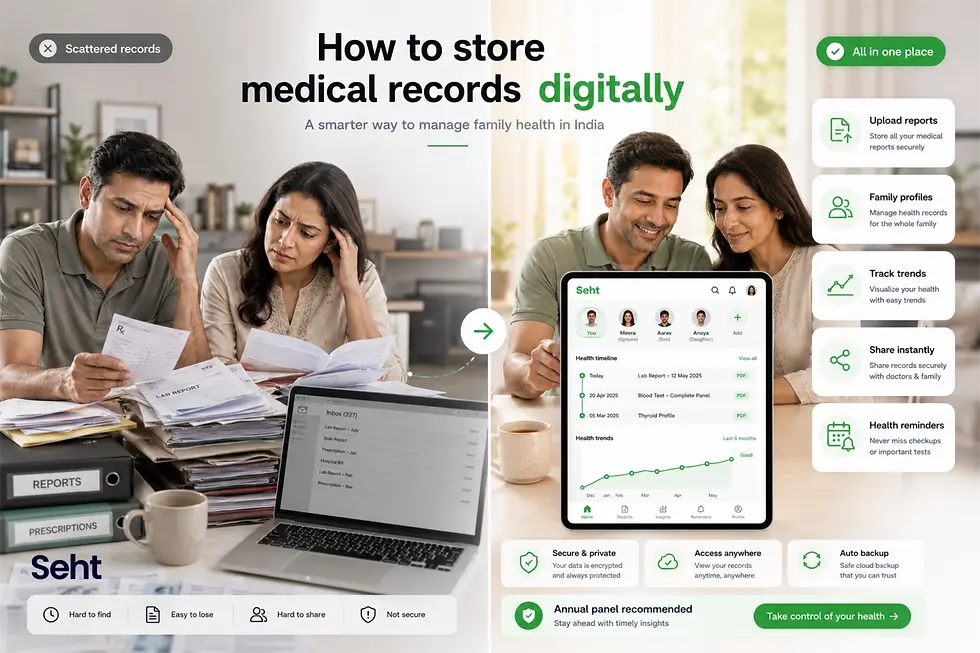
Storing medical records digitally in India in 2026 means choosing a system that handles India's specific healthcare reality: handwritten prescriptions, PDF lab reports on WhatsApp, multi-generational family records, ABHA-linked government hospital encounters, and the need to access everything from any city at any time. This guide gives you the complete system what to store, what tool to use, how to migrate from paper, how to stay current, and how to protect your records under India's Digital Personal Data Protection Act 2023 (DPDP Act).
What you'll learn: • The 8 record types every Indian family must store digitally • How to choose between cloud apps, offline storage, and ABHA • The priority order for digitizing existing paper records • How India's DPDP Act 2023 protects your digital health data • How Seht handles every record type in one organized system |
Why most Indian families are still losing medical records and the cost
India's healthcare system generates millions of medical records every day. Lab reports from Dr. Lal Path Labs, SRL, Thyrocare, and Metropolis arrive as PDFs on WhatsApp and disappear into chat history when the phone is changed. Discharge summaries from Apollo, Fortis, and government hospitals are folded into paper files that survive until the next house move. Handwritten prescriptions from neighbourhood GPs are photographed and saved in gallery folders that no one can find 6 months later.
The cost of this disorganization is concrete: Indian families spend Rs 800–2,000 per year on repeated diagnostic tests simply because previous results cannot be produced at a new provider. Insurance claims are rejected for missing documentation. Emergency rooms treat patients as complete strangers because no one can recall the medication list. Specialist consultations start from zero because three years of relevant history exists only in scattered files.
The scale of the problem in India
Over 70% of Indian patients cannot produce their complete health history during a medical consultation ABDM survey data
India generates over 2 billion prescriptions annually the vast majority handwritten and paper-based
Most Indian families lose 2–3 years of medical history in every house relocation
A single repeated blood panel costs Rs 1,500–4,500 at NABL labs families repeat 2–4 tests annually due to lost records
Health insurance claim rejections due to missing documentation are among the top 3 claim failure reasons in India
The 8 record types every Indian family must store digitally
Record type | Why it must be stored | Format to save | Priority |
Prescriptions (handwritten or printed) | Most critical safety document prevents dangerous drug interactions at every new provider | Photo/scan to PDF; enter medications manually in the medication list | Highest upload same day |
Lab reports (blood, urine, biopsy) | Enables trend analysis; prevents repeat testing; required for specialist consultations | Download PDF from WhatsApp/email; photograph paper printouts | Highest upload within 24 hours |
Hospital discharge summaries | Most comprehensive clinical document from any hospitalization; required for insurance claims | PDF download from hospital; photograph before leaving | Highest photograph before discharge |
Imaging reports and scans (X-ray, CT, MRI, ultrasound) | Comparison imaging requires previous studies; radiologist reads prior films | PDF report + images on CD or email; digitize films at radiology centre (Rs 100-300 per film) | High request digital copy at the time of imaging |
Vaccination records | Prevents missed boosters; required for school, travel, and government documentation | Photograph vaccination book; upload individual certificates | High especially for children and elderly parents |
Allergy and adverse reaction records | Life-saving document at any new medical encounter; prevents anaphylaxis | Enter in the allergy record section; photograph any written documentation | Highest add immediately upon identification |
Specialist consultation letters | Clinical context for ongoing conditions; required for referral continuity | Photograph or request digital copy at the consultation | Medium upload within 24 hours |
Insurance documents and receipts | Required for claims; Section 80D preventive health deduction documentation | Scan or photograph; tag by insurer and policy number | Medium store all health-related receipts for tax purposes |
In simple terms: Storing medical records digitally in India does not require technical skills or expensive equipment. It requires three things: a dedicated app that organizes health records by family member and record type, a habit of uploading every new document within 24 hours of receiving it, and a priority list that starts with the most emergency-critical information (blood groups, medications, allergies) and works outward. Everything else is maintenance. |
Choosing the right storage system: app vs cloud drive vs ABHA

Option 1: ABHA (Ayushman Bharat Health Account) India's national health infrastructure
ABHA is India's government-issued digital health ID (14-digit number) under the Ayushman Bharat Digital Mission. As of May 2026, over 84 crore ABHA IDs have been created. When you present your ABHA number at any ABDM-integrated provider including government hospitals, CGHS centres, Apollo, Fortis, Dr. Lal Path Labs, SRL, and Metropolis records from that encounter are automatically stored in your ABHA-linked health account.
Create your ABHA at: https://abha.abdm.gov.in
Limitation: ABHA only captures records from ABDM-integrated providers (currently covering most major hospitals and labs but not most neighbourhood clinics, smaller labs, or non-ABDM pharmacies). It does not capture handwritten prescriptions or paper records. It is for one person there is no family profile capability.
Option 2: Dedicated family health records app (recommended for most Indian families)
A dedicated health records app like Seht handles everything ABHA cannot: unlimited family profiles, handwritten prescription capture through photo scanning, records from non-ABDM providers, offline access, and emergency health cards. It also links to your ABHA account so ABDM-integrated records sync automatically. For Indian families managing records for multiple generations, this is the most complete solution.
Option 3: Generic cloud storage (Google Drive, Dropbox, iCloud)
Storing records in Google Drive or similar services is better than keeping paper but has significant practical limitations. Documents are not categorized by record type. There is no trend tracking across lab results. There is no medication list or allergy record structure. There are no family profiles. There is no emergency health card. There is no ABHA linking. For emergency situations, a folder in Drive requires searching rather than instant access. Suitable as a backup layer but not as a primary health records system.
Feature | ABHA only | Google Drive | Seht (recommended) |
Multiple family profiles | No, single user | Manual folder structure only | Yes, unlimited, fully independent |
Handwritten prescription capture | No | Manual photo upload | Yes, in-app scanner with enhancement |
ABHA/ABDM sync | Native | No | Yes, automatic on linking |
Offline access | Partial | Partial (if cached) | Full, all stored records |
Medication list and allergy records | Basic | No structure | Yes, structured, shareable |
Emergency health card | No | No | Yes, auto-generated, shareable without login |
Record organization by type/date | Limited | Manual only | Yes, auto-categorised |
DPDP Act compliance | Yes (Government) | GDPR/Terms of Service | Yes, Indian law compliant |
How to migrate from paper to digital: the priority-first system
Attempting to digitize 10 years of records in a single session leads to abandonment. Use this priority-first framework:
Day 1- Emergency essentials (30 minutes): Enter blood groups, current medications with doses, and known drug/food allergies for every family member in Seht. These three data points alone make every profile emergency-ready before a single report is uploaded.
Day 1- Link ABHA IDs (10 minutes): In each family member's Seht profile, link their ABHA ID. Future records from ABDM-integrated providers will sync automatically. Create ABHA IDs for any family member who does not have one at https://abha.abdm.gov.in
Week 1- Recent lab reports: Upload or photograph the last 12 months of lab reports for every family member. For PDF reports on WhatsApp or email download and upload directly to Seht. For paper printouts photograph using the in-app scanner.
Week 1- Current prescriptions: Photograph every current prescription. Enter the key medications in the medication record section.
Month 1- Last 3 years of reports: Work backwards chronologically. Photograph in batches during an evening. Add date, lab name, and category tags.
Month 1- Vaccination records: Photograph each page of every vaccination book for children and elderly parents.
Ongoing- The 24-hour rule: Every new health document received is uploaded to the relevant family member's Seht profile within 24 hours. Not this weekend. Not when you remember. Within 24 hours.
For the complete step-by-step guide to digitizing handwritten prescriptions and paper lab reports, read: How to digitize old paper prescriptions and lab reports in India (https://www.seht.in/post/digitise-paper-prescriptions-lab-reports-india)
How India's DPDP Act 2023 applies to your stored medical records

India's Digital Personal Data Protection Act 2023 (DPDP Act) has a three-phase rollout: Phase 1 (November 2025) established the Data Protection Board of India. Phase 2 (November 2026) makes consent manager frameworks operational. Phase 3 (May 2027) activates all remaining compliance obligations for companies handling personal data including health data. What this means for Indian families storing health records:
Your health data is legally yours: The DPDP Act establishes that individuals control their personal data. No healthcare provider or app can share your health data without your explicit, purpose-specific consent.
Choose DPDP-compliant apps: Any app storing Indian residents' health data must comply with the DPDP Act. Seht is built for Indian law compliance with AES-256 encryption, consent-based data sharing, and no third-party data sale or sharing.
Right to deletion: Under the DPDP Act, you have the right to request deletion of your data from any platform. This applies to health records stored in third-party apps.
WhatsApp is not DPDP-compliant for health data: WhatsApp is a messaging app, not a health data platform. It does not meet the security, consent, or purpose-limitation standards required for health data under DPDP. More on this in the WhatsApp risks guide.
For the full guide to health data privacy and cloud storage safety in India, read: Is cloud storage safe for medical records in India? (https://www.seht.in/post/cloud-storage-medical-records-safety-india)
How Seht makes storing medical records digitally simple for Indian families
Unlimited family profiles: Each family member child, spouse, parents, in-laws has their own independent profile with their own records, medications, allergies, and emergency card
ABHA linking: Connect each family member's ABHA ID for automatic record syncing from ABDM-integrated providers across India
In-app scanner: Photograph handwritten prescriptions, paper lab reports, and discharge summaries directly into the correct family profile
Emergency health card: Auto-generated for every profile, showing blood group, medications, allergies, and conditions shareable without login via WhatsApp
Offline access: All stored records are on-device and accessible without internet critical for hospital basements, rural areas, and travel
24-hour upload habit: Seht makes the upload workflow fast enough to do from the hospital car park before you drive home 30 seconds per document
For the complete guide to building a family emergency medical kit using your stored records, read: Building a family medical emergency kit: documents, records and contacts India (https://www.seht.in/post/family-medical-emergency-kit-india)
For guidance on organising your records once they are digitized, read: How to organise medical records at home: India guide (https://www.seht.in/post/organise-medical-records-home-india)
When to update your stored records
Within 24 hours: Every new lab report, prescription, specialist letter, vaccination, or discharge summary
Same day: Any change to medications update the medication list immediately
Before any travel: Verify emergency health cards are current for all travelling family members
After any new diagnosis: Create a condition record with diagnosis date and treating doctor
After every hospitalisation: Upload discharge summary before leaving the hospital
FAQs
What is the best way to store medical records digitally in India in 2026?
The best way to store medical records digitally in India in 2026 is to use a dedicated family health records app like Seht that combines ABHA linking (for automatic ABDM record syncing), an in-app scanner for paper documents, unlimited family profiles, offline access, and emergency health cards. For most Indian families, this handles 100% of record types from handwritten prescriptions to government hospital discharge summaries.
Can I store medical records on my phone in India?
Yes, securely, in a properly built health records app like Seht. The app uses AES-256 encryption, requires authentication for access, and stores backups securely. Your records are recoverable if your phone is lost. Storing records in a secure health app is significantly safer than keeping them as paper files (which can be lost, damaged, or destroyed) or as photos in your gallery (which are unencrypted and have no health-specific organization).
How does ABHA work with digital medical record storage in India?
ABHA (Ayushman Bharat Health Account) is your free government digital health ID. When linked to a health records app like Seht, records from any ABDM-integrated provider (government hospitals, major private chains, Dr. Lal, SRL, Metropolis) automatically sync to your profile after each visit. You still need Seht for records from non-ABDM providers, handwritten prescriptions, and family management but ABHA handles the automatic layer from major institutions.
Is it safe to store medical records in a digital app in India?
Yes in an app built for Indian healthcare compliance. Look for: DPDP Act 2023 compliant (India's digital data protection law), ABDM/ABHA certified, AES-256 encryption, no third-party data sharing, and clear consent-based access controls. Seht meets all these standards. The DPDP Act (Phase 1 active from November 2025, full enforcement from May 2027) now creates legal accountability for any app handling Indian health data.
What medical records should I prioritise storing digitally first?
Priority order for storing medical records digitally India: First blood groups, current medications with doses, and known drug/food allergies for every family member (emergency value, takes 15 minutes). Second last 12 months of lab reports and current prescriptions. Third vaccination records for children and elderly parents. Fourth last 3 years of reports for trend analysis. Ongoing apply the 24-hour rule to every new document going forward.
Download Seht — free on iOS and Android
Your family's complete medical history every report, every prescription, every discharge summary deserves to be organised, accessible, and protected in a system built for Indian healthcare. Seht stores unlimited family profiles, links to ABHA for automatic record syncing, and makes every document available anywhere, any time, even without internet.
Download free:


Sources and references
National Health Authority — ABDM and ABHA statistics 2026. https://abdm.gov.in
MeitY — Digital Personal Data Protection Act 2023. https://www.meity.gov.in
ICLG — Digital health laws and regulations India 2025-2026. https://iclg.com/practice-areas/digital-health-laws-and-regulations/india
Ayuapp — Best app to store medical records India 2026. https://ayuapp.com/blog/best-app-to-store-medical-records-india
Disclaimer: This blog is for informational purposes only and is not medical advice. Seht helps families stay informed, but is not a substitute for professional healthcare guidance.


