How to organize medical records at home in India: the complete guide


Organizing medical records at home in India requires a system that survives Indian household realities: a family of 5 using 3 hospitals in 2 cities, reports arriving as WhatsApp PDFs and paper printouts simultaneously, and health documents scattered across drawers, email inboxes, and phone galleries. This guide gives you the exact folder structure, priority order, and digital habits that transform that chaos into an organized system any doctor can use in 30 seconds.
For the complete guide to storing records digitally and choosing the right tool, read: store medical records digitally India (https://www.seht.in/post/store-medical-records-digitally-india-2026)
What you'll learn: • The 7-folder structure that organizes any Indian family's records • The priority order that makes the system emergency-ready in 30 minutes • How to handle records in multiple Indian languages • The physical backup system that complements digital storage • The one habit that keeps everything current without effort |
Why most Indian family medical files become unusable

The typical Indian family medical file is a plastic folder or cardboard file with all records from all family members mixed together father's ECG, mother's thyroid prescription, child's vaccination certificate, and an elderly parent's discharge summary all in the same pile, undated and uncategorized. In the moment it is needed an emergency, a specialist consultation, an insurance claim nothing can be found quickly.
A usable medical record system has one structural quality above everything else: every document has a predictable, findable place. That requires two things: one profile per family member (never mixed), and within each profile, a consistent category structure. Everything else digital vs paper, app vs folder comes second.
The 7-section folder structure for every Indian family member
Section | What to store here | Why this comes first | Update frequency |
Section 1: Identity & Emergency | Blood group, ABHA ID, health insurance policy number, emergency contact name and number | This is what a doctor needs in the first 60 seconds of any emergency. If nothing else is organized, this must be. | Rarely changes review annually |
Section 2: Current Medications | Every current prescription: drug name (generic + brand), dose, frequency, prescribing doctor, start date | Drug safety at every medical encounter. The most dangerous gap in most Indian families' records. | Update same day any prescription changes |
Section 3: Known Allergies | Drug allergies with reaction type and severity; food allergies affecting medical care | Life-saving document. The difference between a standard treatment and a dangerous reaction. | Update immediately upon identification |
Section 4: Active Conditions | Each chronic diagnosis: condition name, date, treating specialist, current management plan | Context every doctor needs. Prevents repeated investigation of already-diagnosed conditions. | Update when any new diagnosis is made |
Section 5: Recent Investigations (last 24 months) | Lab reports, imaging, ECGs in reverse chronological order (newest first) | The most-referenced section in any consultation. Newest reports are accessed most often. | Upload within 24 hours of receiving |
Section 6: Historical Investigations (older) | Reports older than 2 years organized by year | Useful for trend analysis and insurance claims. Less urgently needed but important over time. | Add during the initial digitization project |
Section 7: Hospitalizations & Procedures | Each hospitalization: admission date, hospital, primary diagnosis, discharge summary; each procedure with date and outcome | Essential context for anaesthesia and surgical planning; required for insurance claims. | Upload discharge summary before leaving hospital |
In simple terms: Organizing medical records at home India is not about creating a perfect archive it is about making Section 1 (identity and emergency) findable in 30 seconds, Section 2 (medications) shareable in 10 seconds, and Section 5 (recent investigations) available for any consultation. If you have those three sections complete for every family member, you have already eliminated 90% of the practical problems Indian families face with disorganized health records. |
The digital organizer that makes this structure automatic: Seht
Seht implements this exact 7-section structure automatically for every family member profile. When you upload a lab report from Dr. Lal Path Labs or Thyrocare, the app categorises it and places it in the investigations section, tagged by date and test type. The medication record section has dedicated fields for drug name, dose, frequency, and prescribing doctor. The allergy record has severity classification. The emergency health card draws from Sections 1, 2, and 3 automatically.
The practical advantage: you do not need to decide where each document goes. Upload it, tag it, and the system handles the rest. For family members in another city elderly parents or in-laws enable Seht family sharing so they or their local caretaker can update their sections in real time.
How to handle the Indian-specific record organization challenges
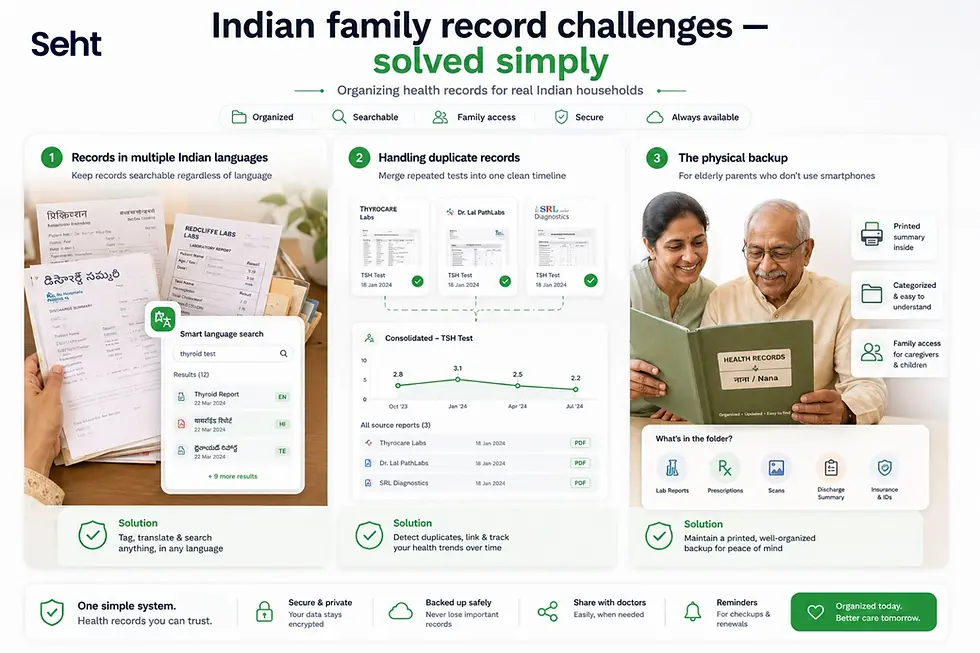
Records in multiple Indian languages
A significant proportion of Indian health records particularly from government hospitals, ESIC facilities, and regional hospitals are written in state languages: Hindi, Telugu, Tamil, Kannada, Malayalam, Bengali, Marathi, Gujarati, and others. Seht stores documents in any language. For critical information in records you cannot read, use Google Lens for instant on-device translation: open the camera, point at the document, tap the translate function. For critical medication names or diagnoses in regional languages, ask the treating doctor to write the English equivalent most will do so if asked.
Handling duplicate records from multiple labs
Indian families often receive the same test (CBC, thyroid, HbA1c) from multiple labs over time Dr. Lal Path Labs, Thyrocare, local NABL labs, hospital laboratories. Each lab uses slightly different reference ranges and report formats. In Seht, tag each report with the lab name and date. For tracked metrics (HbA1c, creatinine, blood pressure), enter the key values manually into the trend tracking section the app then shows you the value over time across all labs, making trends visible regardless of which lab produced each report.
The physical backup for elderly parents who don't use smartphones
For elderly family members who are not smartphone users, maintain the digital Seht profile on your phone (the adult child's phone) while also keeping a physical emergency card in the elderly parent's wallet. Seht emergency health cards are printable. Print, laminate, and place: one copy in the parent's wallet, one in the kitchen drawer, one near the front door. The physical card and the digital profile contain the same information the physical card is the failsafe when digital access is impossible.
The room-by-room audit: finding what already exists in your home
Before digitizing anything new, do a 30-minute room-by-room audit to find what already exists:
Filing cabinet or documents drawer: Most families have one look for plastic folders, envelopes, and loose reports. Collect everything.
Kitchen noticeboard or shelf: Common location for recent prescriptions and lab reports that 'just arrived'. Collect everything.
Phone gallery: Search your photo roll for images of prescriptions and reports look for photos taken in clinic and lab settings. Screenshot and tag by family member.
WhatsApp saved messages and starred messages: Search contact names of doctors, clinics, and labs. Download PDF attachments.
Email inbox: Search for sender names of labs (drlal, srl, thyrocare, apollo, metropolis, redcliffe) and keywords (report, prescription, discharge). Download all health PDFs.
Old phones and tablets: Health records from previous phones are often forgotten. If the device still powers on, transfer documents before the storage is lost.
Once collected, photograph or upload the physical documents using Seht's in-app scanner and file everything into the correct family member's 7-section profile.
For the complete guide to digitizing specific document types including X-rays and handwritten prescriptions, read: How to digitize old paper prescriptions and lab reports in India (https://www.seht.in/post/digitise-paper-prescriptions-lab-reports-india)
When poor record organization leads to a medical problem
A new doctor prescribes without seeing the complete medication list leading to a dangerous drug combination. The immediate solution: enter the medication list in Seht now, before the next medical contact.
A repeated test is ordered because the previous result cannot be found wasting Rs 200–2,000. The solution: the 24-hour upload rule prevents this from happening again.
An insurance claim is rejected for a missing report or discharge summary causing weeks of delay and frustration. The solution: upload discharge summaries before leaving any hospital, and keep all health-related receipts in Seht.
An elderly parent cannot recall their medication list at an emergency room causing delayed or potentially dangerous treatment. The solution: maintain the medication record in Seht and generate and share the emergency health card before any hospital visit.
Emergency: If you discover during a record organization session that a family member is on medications that may interact dangerously call the prescribing doctor the same day.
FAQs
How do I organize medical records at home in India?
To organize medical records at home India: create one profile per family member (never mix records), and within each profile maintain 7 sections: identity and emergency data, current medications, known allergies, active conditions, recent investigations (last 2 years), older investigations, and hospitalization records. In Seht, this structure is built in. Start with blood groups, medications, and allergies these three sections are immediately emergency-ready.
What is the best folder system for medical records in India?
The best medical records folder system for Indian families is one digital profile per family member, with sections for: emergency essentials (blood group, ABHA ID), medications, allergies, active conditions, recent investigations (newest first), older investigations, and hospitalizations. In Seht, this is the default structure. For physical backup of elderly parents: one laminated emergency card (blood group, medications, allergies, conditions) in wallet and near front door.
How do I find old medical records that are scattered around my home?
Do a room-by-room audit: filing drawers (paper reports and prescriptions), kitchen noticeboard (recent documents), phone gallery (photographs of reports), WhatsApp starred messages and downloads (PDFs), email inbox (search for lab names: drlal, thyrocare, srl, apollo, metropolis), and old phones. Collect everything in one place, photograph or upload paper documents using Seht's in-app scanner, and file by family member and record type.
Download Seht — free on iOS and Android
Once your records are organized, Seht keeps them that way automatically. Every new lab PDF from WhatsApp, every new prescription photograph, every discharge summary uploaded to the right family member's profile within 24 hours, categorized correctly, and immediately available to any doctor you share it with.
Download free:


Sources and references
Ayuapp — How to organise medical records for your family in India. https://ayuapp.com/blog/organize-family-medical-records-india
Samarth India — Health file for parents: simplify crises. https://care.samarth.community/blog/medical-care/health-file-for-parents/
National Health Authority — ABDM patient record management. https://abdm.gov.in
Disclaimer: This blog is for informational purposes only and is not medical advice. Seht helps families stay informed, but is not a substitute for professional healthcare guidance.


Comments