Women's health tracking in India: the tests, trends and tools you need


Here's an uncomfortable truth: Indian women are the most diligent healthcare managers in most families tracking their children's vaccinations, their parents' medications, their spouse's cholesterol and the most likely to skip their own checkups. Women's health tracking in India requires a separate, specific approach because the conditions most likely to affect Indian women thyroid disorders, anaemia, PCOD, cervical cancer, breast cancer, osteoporosis have distinct screening schedules, distinct early warning signs, and are missed at dramatically higher rates when women use the same generic 'full body checkup' as their husbands.
For the complete family wellness monitoring framework, read: family health tracking India (https://www.seht.in/post/family-health-tracking-india-guide)
What you'll learn: ✦ The decade-by-decade women's health tracking guide for Indian women ✦ The three tests Indian women most commonly skip and why they shouldn't ✦ Tracking PCOD, thyroid, and anaemia: the numbers that matter ✦ The cervical and breast cancer screening schedule for Indian women ✦ How Seht's reminder system makes women's health tracking automatic |
Why women's health tracking India needs a different approach
Generic health packages are not designed for women. A standard full body checkup gives you a CBC, a fasting glucose, a lipid profile, and a TSH. It misses the ferritin (iron stores), the anti-TPO antibodies (autoimmune thyroid), the Pap smear (cervical cancer), the mammogram (breast cancer), and the entire hormonal assessment that PCOD requires. These omissions are not intentional they're the result of using a single package for everyone.
A woman's health tracking list is different in kind, not just in scope. This guide gives you the specific tests, the right frequency, and the tracking system that actually catches the conditions Indian women are most at risk from.
The decade-by-decade women's health tracking guide
Age range | Essential tests | Additional if symptoms/risk | Frequency | What to watch in results |
20–30 yrs | CBC with ferritin, TSH, Pap smear from age 21 (or 3 years after sexual activity), Hep B if unvaccinated | PCOD panel (FSH, LH, AMH, testosterone) if irregular periods; Vitamin D if fatigue/joint pain | Annual CBC/ferritin/TSH; Pap every 3 years | Haemoglobin below 12 g/dL (anaemia); TSH above 4.5 (hypothyroidism); any abnormal Pap result |
30–40 yrs | All above + HbA1c, full lipid profile, mammogram from age 35 if family history (40 otherwise) | Anti-TPO antibodies if TSH borderline; BRCA discussion if strong family history of breast/ovarian cancer | Annual comprehensive panel; Pap every 3 years; mammogram every 2 years | HbA1c above 5.7%; LDL above 130; ferritin below 20 ng/mL; any abnormal mammogram |
40–50 yrs | All above + bone density (DEXA) at perimenopause, mammogram annually from 40, HPV DNA test with Pap | Oestradiol, FSH, LH (perimenopause assessment); homocysteine; ApoB | Annual; mammogram annually; DEXA every 2–3 years from perimenopause | Bone T-score below -1.0; FSH elevation indicating perimenopause; new lipid changes post-menopause |
50+ yrs | All above + colonoscopy discussion, continued DEXA, continued annual mammogram until 74 | Cognitive screening if any concerns; continued hormonal monitoring if on HRT | Annual; DEXA every 2 years; mammogram until 74 | Accelerated bone loss; lipid changes post-menopause; any new TSH abnormality |
The three tests Indian women most commonly skip and the cost of skipping them
The Pap smear: India's most neglected screening test
India has among the highest cervical cancer rates in the world. The Pap smear is the gold standard for detecting pre-cancerous changes when the condition is completely treatable. Yet only a fraction of Indian women have ever had one. The barrier is often discomfort, not access.
The practical guide: Pap smears are available at Apollo, Fortis, any gynaecology outpatient clinic, and most government hospital gynaecology departments (free for women under 65). Book with a female gynaecologist if that makes it more comfortable. Schedule from age 30 (or 21 if sexually active), every 3 years. An HPV DNA co-test every 5 years is an alternative from age 30 onwards.
Ferritin: the iron test most women never get
Haemoglobin checks whether you're anaemic. Ferritin checks your iron stores before anaemia develops. The difference matters: a woman can have normal haemoglobin but depleted ferritin and the symptoms (fatigue, brain fog, hair loss) are already present. Most standard checkup panels include haemoglobin but not ferritin.
Add ferritin to your annual blood panel. Normal is 20–200 ng/mL for women. Below 20 ng/mL means iron deficiency even without anaemia. Below 12 ng/mL means severe deficiency. Cost: Rs 300–700 at any NABL lab.
Anti-TPO antibodies: the thyroid test most women don't know exists
TSH alone misses Hashimoto's thyroiditis the most common cause of hypothyroidism in Indian women, and the most likely explanation for a TSH that keeps creeping upward. Anti-TPO antibodies test for the immune attack on the thyroid that Hashimoto's produces.
If your TSH has been creeping up over 3+ years (say, from 2.5 to 3.8 to 4.2) even while staying within the 'normal' range, add anti-TPO to your next thyroid panel. Cost: Rs 400–900 at major NABL labs.
In simple terms: Women's health tracking India isn't about doing more tests it's about doing the right tests. Haemoglobin alone doesn't give you the full picture on iron. TSH alone doesn't give you the full picture on thyroid. A standard lipid profile alone doesn't capture the changing cardiovascular risk around perimenopause. The additions are small; the difference in what you catch is significant. |
Tracking PCOD, thyroid, and anaemia: what to log and watch
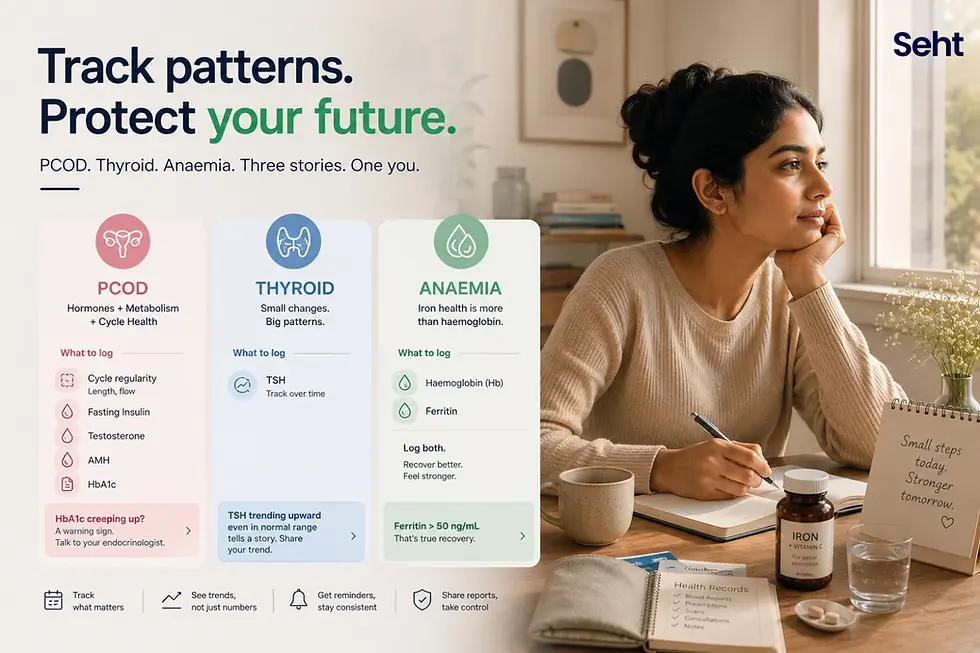
For women managing PCOD: track menstrual cycle regularity alongside fasting insulin, testosterone, AMH, and HbA1c. PCOD and insulin resistance are closely linked an HbA1c that creeps up in a PCOD patient is a specific warning sign that warrants an endocrinology referral.
For thyroid: log TSH over time in Seht. A TSH that trends upward even within normal range tells a story that a single normal reading cannot. Share the multi-year TSH trend with your endocrinologist at the next visit.
For anaemia: log haemoglobin and ferritin together. The combination shows whether you're responding to iron supplementation haemoglobin recovers first, ferritin last. Until ferritin is above 50 ng/mL, the physiological deficit continues even if haemoglobin has normalized.
When women's health tracking reveals a red flag

TSH above 4.5 mIU/L on two consecutive tests, especially alongside fatigue, hair loss, or irregular periods endocrinologist referral
Any abnormal Pap smear result colposcopy within 4–6 weeks as advised by your gynaecologist; do not delay
Ferritin below 12 ng/mL investigate the cause (menstrual loss, dietary deficiency, malabsorption) before supplementing
Any new breast lump, nipple discharge, or skin changes same-week gynaecologist or breast surgeon appointment, not after the next scheduled mammogram
DEXA T-score below -2.5 confirmed osteoporosis requiring specialist management and fracture prevention planning
Emergency: Sudden severe abdominal or pelvic pain, heavy menstrual bleeding causing dizziness or fainting, or any breast change in a woman with known BRCA status seek emergency care.
FAQs
What health tests should Indian women track annually?
Women's health tracking India annually should include: CBC with ferritin (not just haemoglobin), TSH, HbA1c, full lipid profile, Pap smear (every 3 years from age 30), Vitamin D, Vitamin B12. From age 40: mammogram every 1–2 years. From perimenopause: DEXA bone density every 2–3 years. If PCOD symptoms: FSH, LH, AMH, testosterone, fasting insulin. If TSH trends upward: add anti-TPO antibodies.
What are the most important health tracking tests for Indian women with PCOD?
For Indian women tracking PCOD: fasting insulin and HbA1c (insulin resistance is present in 50–70% of Indian women with PCOD), testosterone and DHEA-S (androgen levels), LH/FSH ratio (typically above 2:1 in PCOD), AMH (ovarian reserve), lipid profile (PCOD-associated metabolic syndrome). Monitor weight and menstrual cycle regularity alongside lab values. Log all in Seht for year-over-year trend visibility.
When should Indian women start tracking thyroid health?
Indian women should track thyroid health from age 25 earlier if there are symptoms (fatigue, weight changes, hair loss, irregular periods) or a family history of thyroid disease. Annual TSH is the baseline test. Add free T3, free T4, and anti-TPO antibodies if TSH is borderline or symptoms are present despite normal TSH. Log TSH values over time in Seht the trend across years is often more informative than any single reading.
Download Seht — free on iOS and Android
Your health deserves the same organized tracking system you've built for your family's. Seht's profiles aren't just for children and parents your Pap smear reminder, your TSH trend chart, your ferritin log, your mammogram schedule. Set up your own profile today alongside the rest of your family's.
Download free:


Sources and references
ICMR — Guidelines for women's preventive health screening India. https://icmr.gov.in
Medical Dialogues — Women's Day 2026: essential health tests every Indian woman should undergo. https://health.medicaldialogues.in
Apollo 24/7 — Women's health statistics and screening guidelines India. https://www.apollo247.com
Disclaimer: This blog is for informational purposes only and is not medical advice. Seht helps families stay informed, but is not a substitute for professional healthcare guidance.


Comments