Choosing a family floater health insurance in India: the documents you'll need ready
- Seht Health Team

- Jun 27
- 8 min read
India's medical inflation is running at 11.5% in 2026 nearly three times the general inflation rate of 4-5%. A hospitalisation that cost ₹3 lakh in 2022 costs roughly ₹4.5 lakh today.
A family floater health insurance in India sounds straightforward: one policy, one premium, the whole family covered. The reality has more moving parts than most buyers realise a shared sum insured that can be depleted by a single large claim, waiting periods that catch families off guard, pre-existing condition clauses that complicate claims years later, and a paperwork requirement at claim time that few policyholders are actually prepared for. This guide gives you the complete picture before you buy and what to do if you already have one.
Before you do anything, run this checklist: 1. Know your family's pre-existing conditions before buying disclosing them at inception is legally required and protects you at claim time 2. Understand that the sum insured is shared ₹10 lakh covers the whole family, not ₹10 lakh each 3. Check the claim settlement ratio (CSR) of any insurer aim for 95%+ from IRDAI's annual report 4. Choose the restoration benefit without it, one large claim can leave your family unprotected for the rest of the year 5. Store all policy documents, TPA contacts, and network hospital lists in Seht for instant access at claim time |
What a family floater actually covers and what it doesn't
A family floater is one health insurance policy with a single sum insured shared across all covered members typically you, your spouse, and dependent children. Most plans also allow parents, and some allow parents-in-law, but adding older members raises the premium significantly.
The shared-pool risk is real: a family of four on a ₹10 lakh floater can have one member exhaust ₹8 lakh in a single hospitalisation. The remaining family shares just ₹2 lakh for the rest of the year. This is why the restoration benefit which refills the sum insured after it's used isn't optional for families with members who have existing health conditions.
Coverage typically included
In-patient hospitalisation: Room rent, ICU charges, surgeon's and anaesthetist's fees, nursing, medicines
Pre-hospitalisation: Usually 30-60 days of relevant tests, consultations, and medicines before admission
Post-hospitalisation: Usually 60-90 days after discharge
Day-care procedures: Treatments requiring less than 24 hours (cataract, dialysis, chemotherapy, etc.)
Ambulance charges: Most plans cover up to a fixed amount
Commonly excluded (read the policy wording, not the brochure)
Waiting periods: Initial 15-30 days for any claim except accidents; 1-2 years for specified conditions (cataracts, hernia, piles, joint replacements); 2-4 years for pre-existing conditions
Self-inflicted injuries, substance abuse, cosmetic procedures
OPD consultations and dental treatment (unless specifically added as riders)
Conditions not disclosed at inception this is the most common cause of claim disputes
The sum insured question: ₹10 lakh isn't enough anymore for metros
₹10 lakh was a reasonable family floater sum insured a few years ago. With healthcare inflation running at 11.5% annually, it's the floor not the target for metropolitan cities. A single cardiac surgery at a private hospital in Mumbai or Delhi can exceed ₹6-8 lakh. An ICU stay of 5-7 days can cross ₹2-3 lakh.
City tier | Recommended minimum sum insured | With parents included | Suggested structure |
Metro (Mumbai, Delhi, Bengaluru, Chennai, Hyderabad, Pune) | ₹25 lakh or ₹10 lakh base + super top-up | ₹50 lakh if elderly parents with chronic conditions are included | ₹10 lakh base floater + ₹40 lakh super top-up lower premium than a straight ₹50 lakh policy |
Tier 2 city | ₹15 lakh | ₹25 lakh if parents included | ₹10 lakh base + ₹15 lakh super top-up works well |
Tier 3 city / smaller city | ₹10 lakh | ₹15-20 lakh if parents included | ₹10 lakh floater with unlimited restoration benefit |
In simple terms: A family floater is like a shared bank account for medical bills everyone dips into the same pot. If one person's treatment empties the pot, nobody else can claim until it refills at renewal. This is why choosing a big enough pot, and adding a refill feature (restoration benefit), matters more than finding the cheapest premium. |
The waiting period trap and when it matters most

Every family floater has multiple waiting periods. Most families find out about them for the first time when a claim is rejected.
The three waiting periods to know
Initial waiting period (15-30 days): No claims for any condition during this window, except accidents. If you buy a policy in April and your spouse needs hospitalisation in May, most claims will be rejected unless it was due to an accident.
Specific disease waiting period (1-2 years): A list of conditions cataracts, hernia, piles, ENT disorders, joint replacements, dialysis that are excluded during this window. Varies by policy.
Pre-existing condition waiting period (2-4 years): Any condition you had before buying the policy is not covered until this period ends. This is why buying young and healthy, before conditions develop, dramatically reduces your waiting period exposure.
The practical implication: if an elderly parent has diabetes and hypertension when added to the floater, those conditions won't be covered for 2-4 years. This is why many financial advisors recommend a separate policy for elderly parents rather than adding them to the family floater.
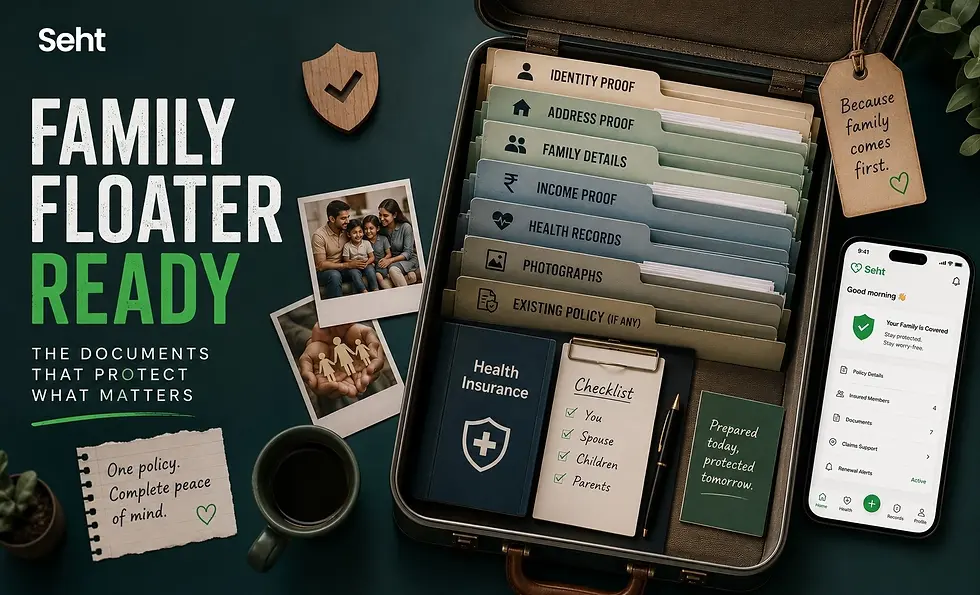
The documents you need to keep ready for claims
This is where most families fail at claim time. The insurer asks for specific documents; the family can't produce them quickly; claims are delayed, reduced, or rejected.
Document | Cashless claim | Reimbursement claim | Where to store it |
Health insurance policy document (soft copy) | Required for pre-authorisation | Required for submission | Seht insurance documents section |
TPA helpline number and cashless hospital list | First call to make | Know your TPA in advance | Seht emergency contacts |
Hospital bills all, not just the final bill | Hospital submits to insurer | Original bills required | Photograph and upload to Seht within 24 hours of discharge |
Discharge summary | Hospital provides to insurer | Submit with claim form | Upload to Seht before leaving hospital |
Doctor's prescription for all medicines claimed | Hospital provides | Submit originals | Photograph and upload same day |
Lab and diagnostic reports from pre-hospitalisation | Less critical for cashless | Submit with claim | Upload to relevant family member's profile in Seht |
Referral letter (if from a GP to a specialist) | Helpful for pre-auth | Include with claim form | Upload at consultation time |
The claim rejection reasons you can actually control

IRDAI data consistently shows documentation failure as one of the top claim rejection reasons in India. Most of these are preventable:
Incomplete or missing discharge summary: Hospitals sometimes provide abbreviated summaries. Request the full clinical discharge summary, not the billing summary.
Mismatch between diagnosis and documents: The diagnosis on the claim form must match the discharge summary, which must match the investigation reports. Any inconsistency triggers scrutiny.
Non-disclosure of pre-existing conditions at inception: This is both a rejection reason and a policy cancellation risk. Disclose all conditions honestly at the time of buying.
Treatment at a non-network hospital without prior approval: Cashless claims only work at network hospitals. For emergencies at non-network hospitals, submit reimbursement claims within the stipulated window (typically 30-60 days).
Address on policy documents not matching current address: A simple administrative issue that can complicate claims. Update your address with the insurer before any hospitalisation.
Storing your complete family medical history in Seht including pre-existing condition documentation, medication lists, and previous hospitalisation records means the documents that support your claim are always organised and accessible, not being hunted for the night before discharge.
For the hospitalisation preparation guide that pairs with insurance readiness, read: Planning a family hospitalisation in India: budget, documents and decisions in advance (https://www.seht.in/post/family-hospitalisation-planning-india)
For comparing diagnostic lab costs that feed into your claim documents, read: Comparing diagnostic lab prices in India: how families can save on routine tests (https://www.seht.in/post/diagnostic-lab-price-comparison-india)
Section 80D: the tax benefit most families underuse
Premiums paid for health insurance qualify for tax deduction under Section 80D of the Income Tax Act. The limits:
₹25,000 per year: For premiums covering yourself, spouse, and dependent children
Additional ₹25,000 (total ₹50,000): If you also pay premiums for parents under 60
Additional ₹50,000 (total ₹75,000 or ₹1 lakh): If parents are senior citizens (60+)
Preventive health checkups: Up to ₹5,000 within the above limits (this is where Seht's receipt storage saves you money at tax filing time)
At a 30% tax bracket, ₹75,000 in health insurance premium deductions saves ₹22,500 in taxes annually. The premium effectively costs less than the sticker price.
When to see a doctor and when to call the insurer
Call your TPA before any planned hospitalisation: ⚠ Planned surgery or procedure: Call the TPA cashless helpline 72 hours in advance for pre-authorisation at a network hospital ⚠ Pre-hospitalisation tests: Get referral from a doctor in writing before booking tests you plan to claim ⚠ Emergency hospitalisation: Inform the TPA within 24 hours of admission; cashless can be applied retroactively at network hospitals ⚠ If claim is rejected: You have the right to appeal to IRDAI's Insurance Ombudsman keep all rejection correspondence |
Emergency: For any genuine medical emergency, go to the nearest suitable hospital immediately. The insurance call can happen from the admission desk or within 24 hours. Your health comes before the paperwork.
FAQs
What is a family floater health insurance in India?
A family floater health insurance in India is a single health policy with one shared sum insured covering all enrolled family members typically the policyholder, spouse, and dependent children. All members draw from the same pool, making it cost-effective for younger, healthier families. The risk is that one large claim can deplete the pool for everyone else which is why the restoration benefit and an adequate sum insured are essential features.
What is the right sum insured for a family floater health insurance in India?
For metro cities (Mumbai, Delhi, Bengaluru), a minimum of ₹25 lakh is advisable or ₹10 lakh base policy with a super top-up of ₹40 lakh, which offers similar protection at a lower premium. For tier-2 cities, ₹15 lakh is a reasonable starting point. India's medical inflation rate of 11.5% in 2026 means ₹10 lakh is now a floor, not a target, for most families in large cities.
What documents are needed for family floater health insurance claims in India?
For cashless claims: your insurance card or policy number and TPA pre-authorisation. For reimbursement claims: complete discharge summary, all original hospital bills, doctor's prescriptions, pre-admission test reports with referral letters, claim form signed by the attending doctor, and your policy document. Missing any of these is among the top reasons claims are rejected or delayed in India.
What is the waiting period in family floater health insurance in India?
Family floater policies have three waiting periods: an initial period of 15-30 days (no claims except accidents), specific disease period of 1-2 years for listed conditions like cataracts, hernia, and joint replacements, and a pre-existing condition period of 2-4 years during which conditions that existed at policy inception are not covered. Understanding these windows and buying a policy before conditions develop is the most effective strategy.
How does Section 80D work for family floater health insurance in India?
Section 80D allows Indian taxpayers to deduct health insurance premiums from taxable income. The deduction is ₹25,000 for a policy covering self, spouse, and dependent children, plus an additional ₹25,000 (₹50,000 if parents are senior citizens) for premiums paid for parents. Preventive health checkup expenses up to ₹5,000 are included within these limits. At a 30% tax bracket, the maximum deduction of ₹75,000 saves ₹22,500 in taxes.
Download Seht — free on iOS and Android
Your insurance claim is only as strong as the documents you can produce quickly. Seht stores every hospitalisation discharge summary, every pre-admission test report, your policy document, and your TPA contact in one organised family profile. When the TPA calls for documents, you're ready in minutes, not days.
Download free:


Sources and references
IRDAI — Annual Report 2025-26: health insurance claim settlement ratios and rejection analysis. https://irdai.gov.in
HDFC ERGO Health Insurance — India's medical trend rate 2026 at 11.5%. https://www.hdfcergo.com
NYVO — Best family floater health insurance plans 2026. https://nyvo.in/health-insurance/best-family-floater-plans
Income Tax India — Section 80D: deduction for health insurance premium. https://incometaxindia.gov.in
Disclaimer: This blog is for informational purposes only and is not medical advice. Seht helps families stay informed, but is not a substitute for professional healthcare guidance.


Comments