Ultimate guide to heart health: how to keep your heart healthy in India

Updated: Apr 30

This heart health guide for India covers everything you need to know to protect your heart from understanding blood pressure and cholesterol numbers to recognising early warning signs and building daily prevention habits. Heart disease is the leading cause of death in India, responsible for over 28% of all deaths, with nearly 50% of cardiac deaths occurring in people under 70. The good news: up to 80% of heart disease is preventable through lifestyle changes.
What you'll learn in this guide: • The blood pressure and cholesterol numbers every Indian adult must know • The 6 daily habits proven to reduce heart disease risk • Early warning signs of high blood pressure and heart trouble • Why Indians face unique heart risks and how to counter them • How to track and organize your heart health records for life |
Why heart health is India's most urgent health priority
India is in the middle of a cardiovascular crisis. The prevalence of CVD has risen sharply over the past two decades, driven by urbanisation, dietary transitions, sedentary lifestyles, and a genetic predisposition that makes Indians uniquely vulnerable. According to the Lancet Global Health, ischaemic heart disease and stroke have more than doubled in India from 1990 to 2016. Hypertension directly responsible for 57% of all stroke deaths and 24% of all coronary heart disease deaths in India affects nearly 30% of Indian adults.
What makes India's situation particularly alarming is the age of onset. In the West, 22% of cardiovascular deaths occur in people under 70. In India, that figure is nearly 50%. Indian hearts are failing younger, faster, and more silently than anywhere else in the world.
The Indian cardiovascular risk profile

Indians are not simply living Western lifestyles in a hotter climate. There are specific biological and lifestyle factors that make the Indian population metabolically distinct:
Atherogenic dyslipidaemia: Indians tend to have borderline high LDL, low HDL, and high triglycerides a pattern directly linked to visceral fat, not overall weight
Insulin resistance: Higher rates of insulin resistance at lower BMI levels compared to Western populations, increasing heart disease risk independently of obesity
Earlier onset: Indians develop coronary artery disease 10–15 years earlier than Europeans on average
Abdominal obesity: Visceral fat accumulation at lower waist circumference thresholds ICMR defines high-risk waist as above 90 cm for men and 80 cm for women
Dietary transition: Shift from traditional dal-roti-sabzi diets to refined carbohydrates, processed snacks, and high-sodium fast foods
Understanding your key heart health numbers
Protecting your heart begins with knowing your numbers. These five metrics form the foundation of cardiovascular health monitoring for every Indian adult above 30.
Metric | Normal | Borderline / At Risk | Dangerous Act Now |
Blood Pressure (systolic/diastolic) | Below 120/80 mmHg | 120–139 / 80–89 mmHg | 140/90 mmHg or above |
Resting Heart Rate | 60–100 bpm | 101–110 bpm | Above 110 or below 50 bpm |
Total Cholesterol | Below 200 mg/dL | 200–239 mg/dL | 240 mg/dL or above |
LDL (bad cholesterol) | Below 100 mg/dL | 100–129 mg/dL | 130 mg/dL or above |
HDL (good cholesterol) | Above 60 mg/dL | 40–59 mg/dL | Below 40 mg/dL |
Triglycerides | Below 150 mg/dL | 150–199 mg/dL | 200 mg/dL or above |
Fasting blood glucose | Below 100 mg/dL | 100–125 mg/dL (prediabetes) | 126 mg/dL or above |
These numbers are not independent they interact. A person with borderline cholesterol, pre-hypertension, and abdominal obesity has a combined cardiovascular risk far higher than any single number suggests. This is why tracking all metrics together, not just one in isolation, is the foundation of effective heart disease prevention in India.
In simple terms: Your heart health is not defined by one number it is the sum of your blood pressure, cholesterol, heart rate, blood sugar, and lifestyle together. You can have normal cholesterol and still have a heart attack if your blood pressure is ignored for years. Track everything, not just the number your doctor last mentioned. |
The 6 daily habits that protect your heart
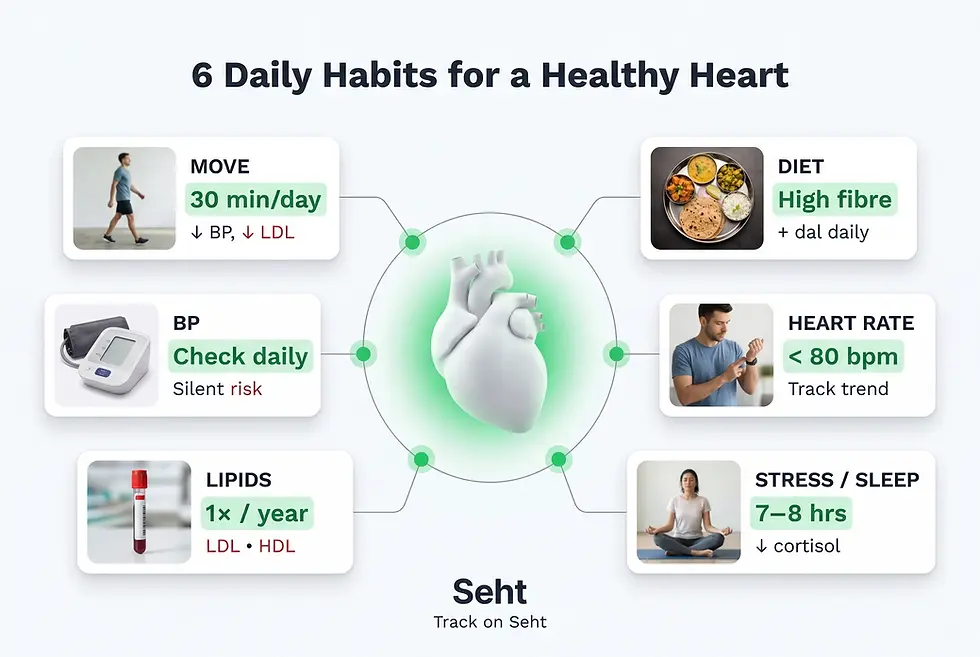
Habit 1: Move for 30 minutes every day
Physical inactivity is one of the three leading modifiable risk factors for cardiovascular disease in India, alongside diet and tobacco. 150 minutes of moderate aerobic activity per week brisk walking, cycling, swimming, or yoga reduces all-cause cardiovascular mortality by up to 35%. For Indians, the most practical and evidence-backed approach is a 30-minute morning or post-meal walk. It costs nothing, requires no equipment, and consistently reduces both blood pressure and LDL cholesterol over time.
Habit 2: Eat the traditional Indian heart-protective diet
Before the processed food transition, the traditional Indian diet was one of the most heart-protective in the world. High in fibre, legumes, vegetables, and fermented foods and low in saturated fat. The key elements to restore:
Dal at every meal: The highest single source of plant protein and soluble fibre available affordably across India. Soluble fibre directly lowers LDL cholesterol.
Reduce sodium: Average Indian dietary sodium intake is 2–3 times the recommended maximum. Reduce by cooking with less salt, avoiding pickles and papads daily, and cutting processed snacks.
Replace refined grains: Swap white rice and maida partially with millets ragi, bajra, jowar which have 3–4x more fibre and a far lower glycemic impact.
Omega-3 fats: Walnuts, flaxseeds, and fatty fish (for non-vegetarians) raise HDL and lower triglycerides. Add a small handful of walnuts daily.
Habit 3: Monitor blood pressure at home
Hypertension is called the silent killer because it has no symptoms in 80% of cases until a stroke or heart attack occurs. The single most impactful habit for heart disease prevention in India is checking blood pressure at home regularly. Home BP monitors are available from ₹800–₹2,500 at any pharmacy. Check at the same time each day ideally morning and evening and log every reading.
For detailed guidance on high blood pressure warning signs, read our cluster article: Early symptoms of high blood pressure to never ignore
Habit 4: Track your resting heart rate
Your resting heart rate (RHR) is one of the most underused indicators of heart health. A consistently elevated RHR above 80 bpm is associated with significantly increased cardiovascular mortality. Check your resting pulse for 60 seconds each morning before getting out of bed. Over weeks and months, a downward trend in RHR reflects improved cardiovascular fitness.
For a complete explanation of what your heart rate numbers mean, read: Understanding heart rate: what your beats per minute say about your health
Habit 5: Get your lipid profile tested annually
Cholesterol problems in India are largely invisible until a cardiac event occurs. The ACC/AHA 2026 guidelines recommend that adults over 30 with any risk factor family history, diabetes, abdominal obesity, or hypertension get a full lipid panel including LDL, HDL, triglycerides, and ApoB annually. In India, a full lipid profile costs ₹300–₹700 at Dr. Lal Path Labs, SRL Diagnostics, or Thyrocare.
For a deep dive into cholesterol numbers and what they mean for Indians, read: Understanding cholesterol: when should you be worried? (https://www.seht.in/post/understanding-cholesterol-india)
Habit 6: Manage stress and protect sleep
Chronic psychological stress is an independent cardiovascular risk factor elevating cortisol, raising blood pressure, disrupting sleep, and promoting visceral fat accumulation. In India's high-pressure work culture, stress management is not optional for heart health. The evidence-backed approaches: 20 minutes of daily meditation or yoga, fixed sleep and wake times targeting 7–8 hours, and deliberate screen-off periods. Sleep deprivation below 6 hours consistently raises blood pressure and LDL cholesterol.
Heart disease risks that specifically affect Indians over 45
After 45, cardiovascular risk in Indians accelerates dramatically. The 45–54 age group sees a 22% prevalence of diagnosed CVD. By 70, that figure rises to 38%. The key risk factors that intensify after 45 in the Indian context:
Hypertension: Prevalence of uncontrolled high blood pressure increases sharply after 45 as arterial stiffness increases naturally with age
Cholesterol changes: HDL declines and triglycerides rise with hormonal changes especially in women post-menopause
Diabetes co-occurrence: 66% of diabetic Indians have diagnosed CVD, creating compounded risk after 45
Reduced physical activity: Physical activity naturally declines after 45 in desk-bound professional populations, removing the protective cardiovascular benefits
For the complete guide on managing heart risks after 45, read: Heart disease risks after 45: what you need to know
Risk Factor | Effect on Heart | India-specific Prevalence | Protective Action |
High blood pressure | Hardens arteries, strains heart | 29.8% of adults | Home BP monitoring + DASH diet |
High LDL cholesterol | Builds plaque in arteries | Rising in urban adults | Annual lipid profile + dietary fat reduction |
Low HDL cholesterol | Removes less plaque | Very common in Indians | Exercise, walnuts, olive oil |
Diabetes | Damages blood vessels and nerves | 9.3% prevalence | Blood sugar monitoring + weight management |
Abdominal obesity | Promotes inflammation, insulin resistance | Widespread at normal BMI | Waist measurement + diet + exercise |
Smoking / tobacco | Direct arterial damage | 26% of adults use tobacco | Complete cessation no safe level |
Warning signs your heart needs urgent attention
Most Indians who die from a first heart attack had warning signs they dismissed for weeks or months. These are the signals that require a doctor visit not next month, but this week:
Chest pain, pressure, squeezing, or tightness especially spreading to the left arm, neck, or jaw
Unexplained shortness of breath during activities that previously felt easy
Persistent morning headaches combined with neck stiffness often a sign of severely elevated blood pressure
Irregular heartbeat (palpitations), especially if accompanied by dizziness or near-fainting
Extreme fatigue that does not improve with rest, in people above 40
Sudden blurred vision or confusion can indicate hypertensive crisis or mini-stroke
Emergency situation: Chest pain combined with sweating, nausea, and left arm pain is a medical emergency. Call 108 (India's emergency number) immediately and do not drive yourself to hospital.
How to use the Seht app for heart health management
Managing heart health means generating a lot of data blood pressure readings, cholesterol reports, ECG results, cardiologist notes, and prescription records. Most Indian families manage this on paper, losing critical information when it matters most. Seht is India's family health management app that stores all of your heart health records and your entire family's in one secure, organized place. When your elderly parent has a hypertensive emergency or your doctor needs your last three blood pressure readings, Seht puts everything at your fingertips instantly.
Store and organize blood pressure logs, lipid profiles, and ECG reports for every family member
Track medication prescriptions for blood pressure and cholesterol drugs
Set reminders for annual cardiac checkups and lipid profile tests
Share complete health history with any cardiologist or specialist in one tap
For guidance on reducing cholesterol through lifestyle habits, read: Lifestyle habits that reduce cholesterol naturally
For managing blood pressure without medication, read: Managing blood pressure naturally: tips for 45+
For understanding daily tracking as a prevention tool, read: How daily tracking helps prevent heart disease
When to see a doctor
Blood pressure consistently above 140/90 mmHg on home readings across 2 weeks
Total cholesterol above 240 mg/dL on a lipid profile test
Resting heart rate consistently above 100 bpm or irregular beats noticed during self-check
Family history of heart attack or stroke before age 55 in a first-degree relative
Chest tightness, shortness of breath, or unexplained fatigue appearing for the first time
Any combination of two or more of the risk factors above without a doctor's assessment in the past year
FAQs
What is the most important thing for heart health in India?
The most important heart health habit for Indians is controlling blood pressure because hypertension is responsible for 57% of all stroke deaths and 24% of coronary heart disease deaths in India. Most Indians with hypertension are unaware of it because it has no symptoms. Regular home blood pressure monitoring combined with a low-sodium diet and daily physical activity is the highest-impact combination for Indian adults.
At what age should Indians start monitoring heart health?
Indians should begin annual cardiovascular screening including blood pressure, lipid profile, fasting blood glucose, and waist circumference at age 30 if they have any risk factors (family history, abdominal obesity, smoking, or diabetes). For those without risk factors, begin at 35. This is 10–15 years earlier than Western guidelines, because Indians develop cardiovascular disease a decade earlier.
Which Indian foods are worst for heart health?
The five most heart-damaging foods common in Indian diets are: vanaspati and partially hydrogenated oils (trans fats), heavily salted pickles and papads consumed daily, full-fat dairy consumed in excess, refined white flour (maida) products including biscuits and white bread, and sugary beverages including sweetened chai consumed multiple times daily. These specifically worsen the Indian atherogenic dyslipidaemia pattern high triglycerides, low HDL.
Can heart disease be reversed naturally in India?
Early-stage atherosclerosis and hypertension can be meaningfully reversed through aggressive lifestyle change not eliminated, but substantially reduced. Clinical trials including the Ornish Programme showed 10–30% regression of coronary artery blockages with a very low-fat plant-based diet, daily exercise, stress management, and social support. For most Indians, the realistic goal is halting progression and reducing risk through diet, exercise, weight management, and smoking cessation.
Is daily heart tracking really useful for preventing heart disease?
Yes with strong evidence. People who regularly monitor blood pressure and heart rate at home detect hypertension and arrhythmias years earlier than those who rely only on clinical visits. A home BP monitor and 60-second daily pulse check, combined with annual lipid profiles and blood glucose tests, constitute a complete early detection system for the two leading causes of heart disease in India: hypertension and hypercholesterolaemia.
Download Seht — free on iOS and Android
Heart health means generating years of data blood pressure logs, lipid profiles, ECG results, cardiologist notes, and prescriptions. Seht stores all of it for every family member in one secure place. Whether you're managing your own heart health or your elderly parent's, Seht ensures no critical record is ever lost.
Download free:


Sources and references
Lancet Global Health — Changing patterns of cardiovascular diseases and risk factors in India, 1990–2016. https://www.thelancet.com/journals/langlo
ICMR — National guidelines for prevention and control of cardiovascular diseases in India. https://icmr.gov.in
WHO — Hypertension fact sheet, 2025. https://www.who.int/news-room/fact-sheets/detail/hypertension
PMC / JACC — Cardiovascular diseases in India compared with the United States. https://pmc.ncbi.nlm.nih.gov/articles/PMC9755955/
ACC/AHA — 2026 Cholesterol Guidelines update. https://www.saaoldelhi.com/blogs/new-cholesterol-guidelines-2026
Disclaimer: This blog is for informational purposes only and is not medical advice. Seht helps families stay informed, but is not a substitute for professional healthcare guidance.
