Chair yoga for elderly Indians: a gentle path to wellness


yoga for elderly Indians is one of the safest, most accessible, and most evidence-backed forms of exercise available for those above 60 especially those with joint pain, limited mobility, or balance problems. A 2016 randomized controlled trial at R.D. Gardi Medical College, Ujjain, confirmed that yoga-based intervention significantly improved well-being, balance, flexibility, and metabolic markers in elderly Indians aged 60–80. Chair yoga adapts traditional yoga poses for a seated position, eliminating the need for floor exercises, balance-critical standing poses, or flexibility that many elderly Indians simply no longer have.
For the full family fitness framework, read: The family that exercise together, stays healthy together
What you'll learn: • What chair yoga is and why it is ideal for Indian elderly • The 8 safest and most beneficial chair yoga poses • A complete 20-minute chair yoga routine • The specific health benefits backed by Indian clinical research • Safety precautions for elderly with joint disease or post-surgery |
Why chair yoga is especially important for elderly Indians
India's elderly population faces a specific and urgent fitness challenge. According to the Longitudinal Ageing Study of India (LASI, 2017–18), approximately 30% of adults above 45 have been diagnosed with CVD. By age 70, that figure rises to 38%. Arthritis affects approximately 14% of Indians, with prevalence increasing steeply after 60. And falls are the leading cause of injury-related hospitalisation in elderly Indians with hip fractures carrying 20–30% mortality in the first year.
Floor-based yoga is inaccessible to most elderly Indians with knee osteoarthritis, post-hip replacement recovery, lumbar spondylosis, or simply the muscle weakness that accompanies sedentary ageing.
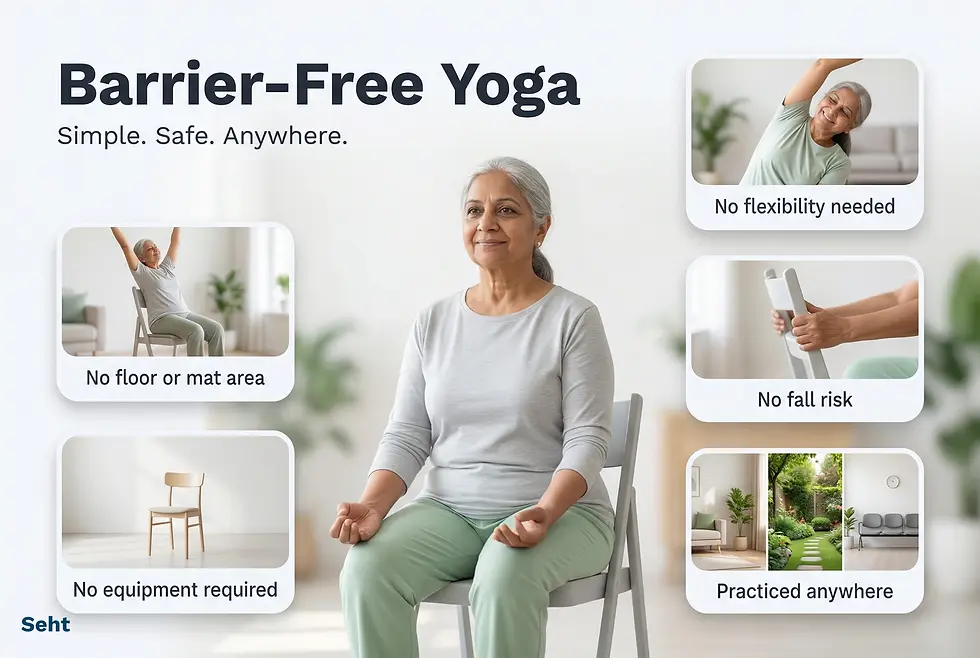
Chair yoga removes every one of these barriers:
No floor work: All poses performed seated in a standard chair or standing with chair support
No minimum flexibility required: Poses are fully adapted to current range of motion
No fall risk: The chair provides constant support, making balance exercises safe
No equipment cost: Any sturdy dining chair works no mat, blocks, or props needed
Practised anywhere: At home, in a hospital waiting room, or in a garden no gym membership
The 8 essential chair yoga poses for elderly Indians
Pose (Sanskrit name) | How to do it | Primary benefit | Duration |
Seated Mountain Pose (Tadasana) | Sit tall, feet flat, spine straight, hands on thighs. Inhale, lengthen spine. Exhale, relax shoulders. | Posture correction, spinal alignment, deep breathing | 5–8 slow breaths |
Seated Cat-Cow (Marjaryasana) | Hands on knees. Inhale, arch back, lift chest (Cow). Exhale, round spine, chin to chest (Cat). Alternate. | Spinal flexibility, lower back pain relief | 5–7 breath cycles |
Seated Forward Bend | Sit at chair edge, feet flat. Inhale, lengthen spine. Exhale, hinge forward from hips, let arms hang. | Hamstring stretch, lower back release | 5–7 breaths |
Seated Spinal Twist (Vakrasana) | Sit tall, place right hand on left knee. Inhale, grow tall. Exhale, gently twist left. Switch sides. | Spinal mobility, digestion improvement | 3–5 breaths each side |
Shoulder Rolls | Inhale, roll shoulders up toward ears. Exhale, roll back and down. Repeat in both directions. | Neck and shoulder tension relief, upper back mobility | 8–10 rounds each direction |
Seated Eagle Arms (Garudasana arms) | Extend arms, cross right over left at elbow. Wrap forearms, bring palms together. Lift elbows. | Shoulder flexibility, upper body stretch | 5–7 breaths each side |
Seated Knee Lifts | Sit tall, hands on sides of chair. Inhale, slowly lift one knee toward chest. Exhale, lower. Alternate. | Core strength, hip flexor activation, balance | 8–10 lifts per side |
Seated Savasana (relaxation) | Sit comfortably in chair, close eyes, breathe naturally. Scan body from toes to head, relaxing each area. | Stress reduction, nervous system calming | 2–3 minutes |
In simple terms: Chair yoga is not a compromise it is a complete yoga practice adapted for the chair. The benefits are identical to floor yoga: better flexibility, stronger muscles, reduced stress, improved balance, and better breathing. The only difference is that everything happens while seated. For elderly Indian parents with knee pain or balance issues, chair yoga is often more beneficial than floor yoga because it can be done safely every single day. |
The complete 20-minute chair yoga routine for Indian elderly
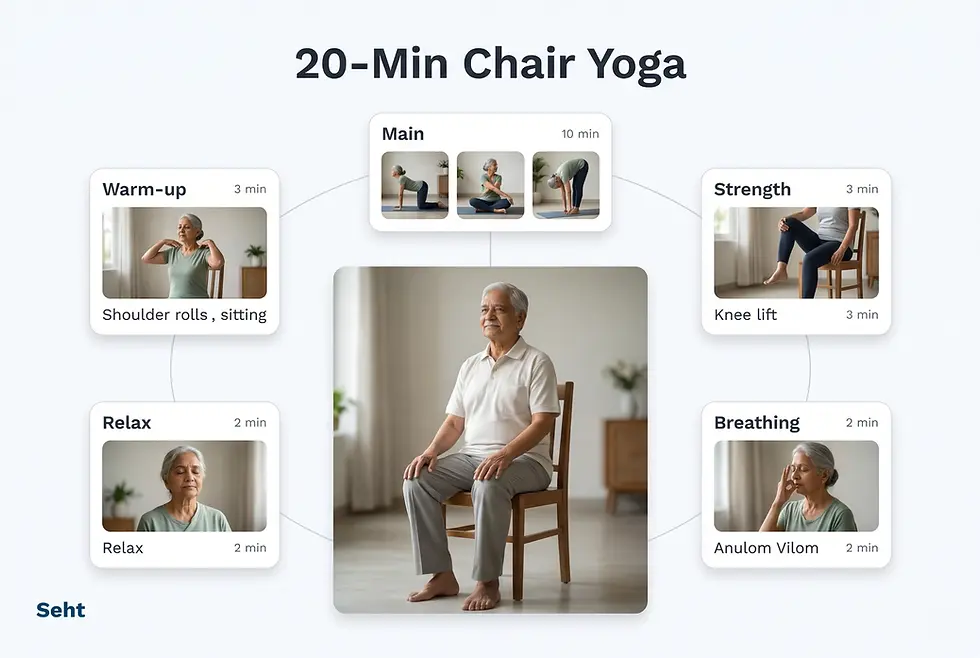
This routine is designed to be done once or twice daily. A sturdy, non-wheeled dining chair is all that is needed. No mat or equipment required.
Warm-up: Seated Mountain Pose + shoulder rolls + neck circles 3 minutes
Main practice: Seated Cat-Cow (5 cycles) + Seated Spinal Twist (3 breaths each side) + Seated Forward Bend (5 breaths) + Seated Eagle Arms (5 breaths each side) 10 minutes
Strengthening: Seated Knee Lifts (8 per side, 2 rounds) 3 minutes
Pranayama: Anulom Vilom (alternate nostril breathing) or Bhramari for 2 minutes cardiovascular and respiratory benefit
Relaxation: Seated Savasana 2 minutes
This 20-minute routine, done consistently 5 days per week, produces measurable improvements in flexibility, balance, and resting heart rate within 8–12 weeks as confirmed in the ICMR-registered yoga intervention trial at R.D. Gardi Medical College.
Health benefits of chair yoga for elderly Indians the evidence
Balance improvement: A 2016 study in elderly Indians showed significant improvement in 30-second chair stand test scores (a validated balance measure) after 12 weeks of chair-based yoga
Respiratory function: PMC-published research confirms yoga's breathing components improve FEV1 and FVC particularly important for the 15% of Indian elderly with COPD
Blood pressure reduction: Regular yoga practice in Indian elderly reduced systolic BP by 5–10 mmHg consistent with antihypertensive medication effects
Pain management: Chair yoga's gentle stretches significantly reduced chronic lower back pain and knee osteoarthritis pain in Indian clinical trials
Cognitive function: SVYASA Institute research shows yoga and pranayama improve attention and memory in elderly Indians and reduce anxiety and depression
Sleep improvement: Yoga nidra (guided relaxation) and evening pranayama practice improved sleep quality significantly in elderly Indian subjects with insomnia
For breathing exercises that complement chair yoga and specifically improve lung health, read: Breathing exercises to boost lung health at any age

Safety precautions for chair yoga in elderly Indians
Get medical clearance before starting if you have: severe osteoporosis, recent hip or knee replacement (within 6 months), severe hypertension above 160/100 mmHg, or active cardiac symptoms
Use a stable, non-wheeled, armless or lightly-armed chair placed against a wall never on a wheeled office chair
Stop any pose that causes pain (not just discomfort) especially in the lower back, hips, or knees
For those with severe knee osteoarthritis: skip the seated knee lifts and replace with seated ankle rotations
For those post-hip replacement: avoid forward bends beyond 90 degrees and avoid deep internal hip rotation poses confirm safe range with your orthopaedic surgeon
When to see a doctor
New or worsening joint pain during or after chair yoga sessions
Dizziness, lightheadedness, or vision changes during seated breathing exercises
Any falls during chair yoga even if no injury seems to have occurred
Chest tightness or unusual breathlessness during the routine
Existing conditions that have not been recently reviewed by a doctor chair yoga is safe but individualised medical clearance protects against rare complications
FAQs
What is chair yoga for elderly Indians and is it effective?
Chair yoga for elderly Indians is traditional yoga adapted to be performed seated in a chair, making it accessible for those with joint problems, limited mobility, or balance issues. A randomized controlled trial registered with the Indian Council of Medical Research (CTRI/2018/07/015051) confirmed that yoga-based intervention significantly improved well-being, balance, and metabolic markers in elderly Indians. Chair yoga achieves equivalent benefits through fully seated or chair-supported modifications.
How long should elderly Indians do chair yoga each day?
A 20-minute chair yoga session, 5 days per week, produces clinically measurable improvements in flexibility, balance, blood pressure, and respiratory function within 8–12 weeks. Starting with just 10 minutes daily is also beneficial any consistent practice is better than none. Research shows that short, frequent sessions (15–20 minutes daily) are more effective than occasional longer sessions for elderly practitioners.
Can chair yoga help with knee pain in elderly Indians?
Yes with important limitations. Chair yoga's seated postures significantly reduce the joint loading that worsens knee osteoarthritis pain during traditional floor yoga. Seated spinal twists, shoulder rolls, and breathing exercises are all fully safe with knee pain. However, seated knee lifts and forward bends with leg extension should be guided by a physiotherapist for those with severe osteoarthritis or post-replacement recovery.
What chair is best for chair yoga for elderly?
The best chair for chair yoga for elderly Indians is a sturdy, stable, straight-backed dining chair without wheels. It should be at a height where feet rest flat on the floor with knees at 90 degrees. Placing a yoga mat (₹500–₹2,000) or non-slip rug under the chair prevents sliding. Never use a wheeled office chair, recliner, or a chair with armrests that restrict arm movement during shoulder exercises.
Is chair yoga safe after hip surgery for elderly Indians?
Chair yoga is generally safe 3–6 months post-hip surgery, but specific modifications are required and must be approved by your orthopaedic surgeon. Avoid any pose that requires hip flexion beyond 90 degrees, internal hip rotation, or crossing legs these motions risk hip dislocation in the first 12 months post-replacement. Safe options include seated upper body stretches, shoulder rolls, spinal twists (without crossing legs), and pranayama breathing exercises.
Download Seht — free on iOS and Android
If you're helping an elderly parent start chair yoga, Seht makes it easy to store their medical reports, orthopaedic clearance letters, and physiotherapy notes in one place. When they visit a new doctor or specialist, their complete medical history is always accessible in seconds.
Download free:


Sources and references
PMC — Effect of yoga on well-being of elderly Indians, R.D. Gardi Medical College Ujjain. https://pmc.ncbi.nlm.nih.gov/articles/PMC6960920/
LASI India — Longitudinal Ageing Study of India, 2017–18. https://www.iipsindia.ac.in/lasi
American Lung Association — Yoga, tai chi and lung health. https://www.lung.org
Disclaimer: This blog is for informational purposes only and is not medical advice. Seht helps families stay informed, but is not a substitute for professional healthcare guidance.


